


Water Intake, Water Balance, and the Elusive Daily Water Requirement
- PMID: 30563134
- PMCID: PMC6315424
- DOI: 10.3390/nu10121928
Water Intake, Water Balance, and the Elusive Daily Water Requirement
Abstract
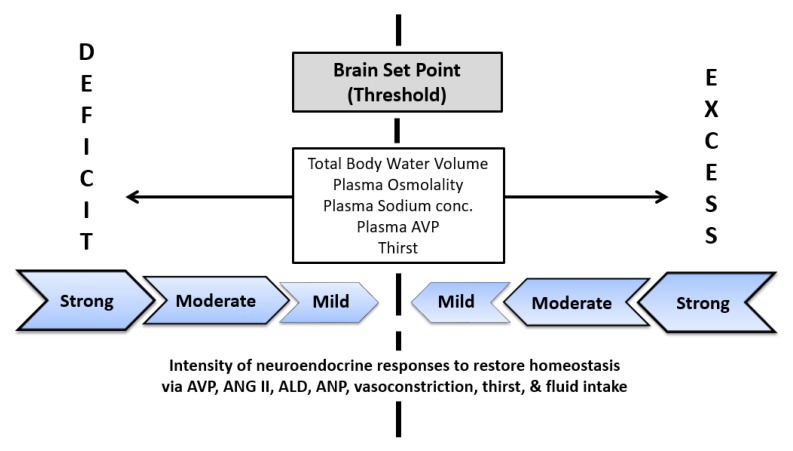
Water is essential for metabolism, substrate transport across membranes, cellular homeostasis, temperature regulation, and circulatory function. Although nutritional and physiological research teams and professional organizations have described the daily total water intakes (TWI, L/24h) and Adequate Intakes (AI) of children, women, and men, there is no widespread consensus regarding the human water requirements of different demographic groups. These requirements remain undefined because of the dynamic complexity inherent in the human water regulatory network, which involves the central nervous system and several organ systems, as well as large inter-individual differences. The present review analyzes published evidence that is relevant to these issues and presents a novel approach to assessing the daily water requirements of individuals in all sex and life-stage groups, as an alternative to AI values based on survey data. This empirical method focuses on the intensity of a specific neuroendocrine response (e.g., plasma arginine vasopressin (AVP) concentration) employed by the brain to regulate total body water volume and concentration. We consider this autonomically-controlled neuroendocrine response to be an inherent hydration biomarker and one means by which the brain maintains good health and optimal function. We also propose that this individualized method defines the elusive state of euhydration (i.e., water balance) and distinguishes it from hypohydration. Using plasma AVP concentration to analyze multiple published data sets that included both men and women, we determined that a mild neuroendocrine defense of body water commences when TWI is ˂1.8 L/24h, that 19⁻71% of adults in various countries consume less than this TWI each day, and consuming less than the 24-h water AI may influence the risk of dysfunctional metabolism and chronic diseases.
Keywords: body water; drinking water; water restriction; water-electrolyte balance.
Conflict of interest statement
Lawrence Armstrong has previously served as a Scientific Advisory Board member, paid consultant, and has received research funding from Danone Nutricia Research, France. He presently serves as a member of the Board of Trustees, Drinking Water Research Foundation, Alexandria, VA and is also a paid consultant to the Foundation. Evan Johnson has previously received funding for research investigations from Danone Nutricia Research, France, and served as a paid consultant to Dr. Armstrong during the preparation of this paper for the Drinking Water Research Foundation, Alexandria, VA, USA.
Figures
References
-
- The third national health and nutrition examination survey (NHANES III 1988–1994) [(accessed on 25 May 2018)]; Available online: https://wwwn.cdc.gov/nchs/data/nhanes3/3a/VIFSE-acc.pdf.
Publication types
MeSH terms
Grants and funding
LinkOut - more resources
Full Text Sources
Medical
Miscellaneous
