


Alternative Splicing of the Aflatoxin-Associated Baeyer⁻Villiger Monooxygenase from Aspergillus flavus: Characterisation of MoxY Isoforms
- PMID: 30563144
- PMCID: PMC6315744
- DOI: 10.3390/toxins10120521
Alternative Splicing of the Aflatoxin-Associated Baeyer⁻Villiger Monooxygenase from Aspergillus flavus: Characterisation of MoxY Isoforms
Abstract
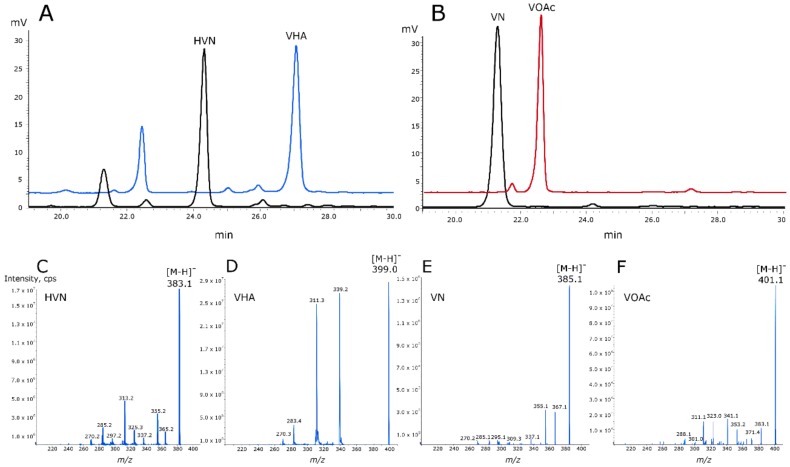
Aflatoxins are carcinogenic mycotoxins that are produced by the filamentous fungus Aspergillus flavus, a contaminant of numerous food crops. Aflatoxins are synthesised via the aflatoxin biosynthesis pathway, with the enzymes involved encoded by the aflatoxin biosynthesis gene cluster. MoxY is a type I Baeyer⁻Villiger monooxygenase (BVMO), responsible for the conversion of hydroxyversicolorone (HVN) and versicolorone (VN) to versiconal hemiacetal acetate (VHA) and versiconol acetate (VOAc), respectively. Using mRNA data, an intron near the C-terminus was identified that is alternatively spliced, creating two possible MoxY isoforms which exist in vivo, while analysis of the genomic DNA suggests an alternative start codon leading to possible elongation of the N-terminus. These four variants of the moxY gene were recombinantly expressed in Escherichia coli, and their activity evaluated with respect to their natural substrates HVN and VN, as well as surrogate ketone substrates. Activity of the enzyme is absolutely dependent on the additional 22 amino acid residues at the N-terminus. Two MoxY isoforms with alternative C-termini, MoxYAltN and MoxYAltNC, converted HVN and VN, in addition to a range of ketone substrates. Stability and flavin-binding data suggest that MoxYAltN is, most likely, the dominant isoform. MoxYAltNC is generated by intron splicing, in contrast to intron retention, which is the most prevalent type of alternative splicing in ascomycetes. The alternative C-termini did not alter the substrate acceptance profile, or regio- or enantioselectivity of the enzyme, but did significantly affect the solubility and stability.
Keywords: Baeyer–Villiger monooxygenase; MoxY; aflatoxin biosynthesis; alternative splicing; hydroxyversicolorone; versicolorone.
Conflict of interest statement
The authors declare no conflict of interest. The funders had no role in the design of the study; in the collection, analyses, or interpretation of data; in the writing of the manuscript, or in the decision to publish the results.
Figures



References
-
- Havelaar A.H., Kirk M.D., Torgerson P.R., Gibb H.J., Hald T., Lake R.J., Praet N., Bellinger D.C., de Silva N.R., Gargouri N., et al. World Health Organization global estimates and regional comparisons of the burden of foodborne disease in 2010. PLoS Med. 2015;12:e1001923. doi: 10.1371/journal.pmed.1001923. - DOI - PMC - PubMed
-
- Hammami W., Fiori S., Al Thani R., Ali Kali N., Balmas V., Migheli Q., Jaoua S. Fungal and aflatoxin contamination of marketed spices. Food Control. 2014;37:177–181. doi: 10.1016/j.foodcont.2013.09.027. - DOI
-
- World Health Organization Evaluation of certain contaminants in food. World Health Organ. Tech. Rep. Ser. 2017;1002:1–166. - PubMed
Publication types
MeSH terms
Substances
LinkOut - more resources
Full Text Sources
