Review
. 2018 Dec 6;7(12):249.
doi: 10.3390/cells7120249.

MicroRNAs as Diagnostic and Prognostic Biomarkers in Ischemic Stroke-A Comprehensive Review and Bioinformatic Analysis

Affiliations
Review

MicroRNAs as Diagnostic and Prognostic Biomarkers in Ischemic Stroke-A Comprehensive Review and Bioinformatic Analysis

Ceren Eyileten et al. Cells. .

Abstract

Stroke is the second-most common cause of death worldwide. The pathophysiology of ischemic stroke (IS) is related to inflammation, atherosclerosis, blood coagulation, and platelet activation. MicroRNAs (miRNAs) play important roles in physiological and pathological processes of neurodegenerative diseases and progression of certain neurological diseases, such as IS. Several different miRNAs, and their target genes, are recognized to be involved in the pathophysiology of IS. The capacity of miRNAs to simultaneously regulate several target genes underlies their unique value as diagnostic and prognostic markers in IS. In this review, we focus on the role of miRNAs as diagnostic and prognostic biomarkers in IS. We discuss the most common and reliable detection methods available and promising tests currently under development. We also present original results from bioinformatic analyses of published results, identifying the ten most significant genes (HMGB1, YWHAZ, PIK3R1, STAT3, MAPK1, CBX5, CAPZB, THBS1, TNFRSF10B, RCOR1) associated with inflammation, blood coagulation, and platelet activation and targeted by miRNAs in IS. Additionally, we created miRNA-gene target interaction networks based on Gene Ontology (GO) information derived from publicly available databases. Among our most interesting findings, miR-19a-3p is the most widely modulated miRNA across all selected ontologies and might be proposed as novel biomarker in IS to be tested in future studies.

Keywords: bioinformatic analysis; biomarker; diagnosis; ischemic stroke; miRNA; miRNA-gene target interaction; network; prognosis.


Conflict of interest statement

The authors declare that there are no conflicts of interest.

Figures
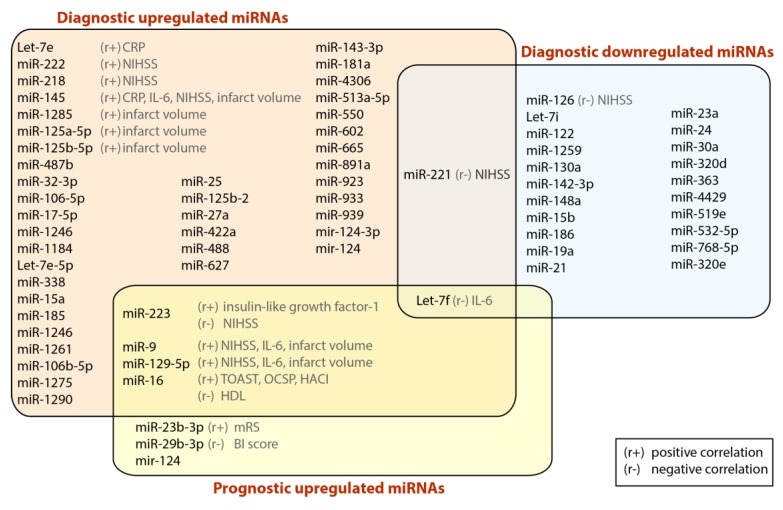
Figure 1
Figure 1
Regulation of diagnostic and prognostic miRNAs serving as biomarkers in ischemic stroke, based on human studies. Abbreviation: miRNA, microRNA; CRP, C-reactive protein; HDL, high density lipoprotein; NIHSS, National Institutes of Health Stroke Scale; IL-6, interleukin 6; TOAST, Trial of Org 10,172 in Acute Stroke Treatment; OCSP, Oxfordshire Community Stroke Project; HACI, hyperacute cerebral infarction; mRS, Modified Rankin Scale; BI, Barthel index. Refs: [41,43,44,45,47,48,53,55,57,58,61,62,67,68,72,73,74,75,76,78].
Figure 2
Figure 2
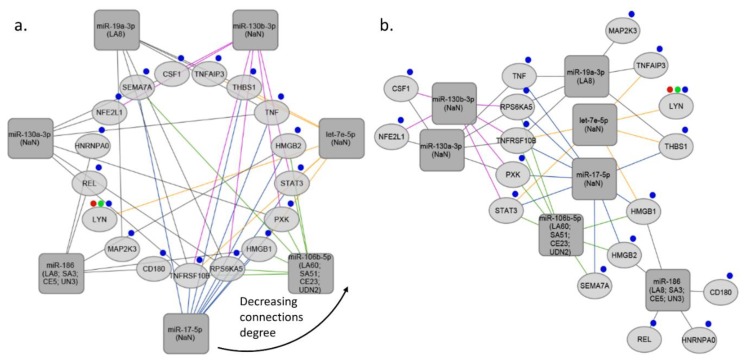
miRNA-target gene networks based on inflammatory response. (a) Inflammatory response-network sorted by the degree of connections, (b) Inflammatory response-interaction network. The rectangles indicate the stroke type miRNAs, the ellipses indicate target genes. Red, green and blue marks represent specific GO process-blood coagulation, platelet activation, and inflammation process, respectively. LA, large artery stroke; SA, small artery stroke; UDN, stroke due to undetermined cause; CE, cardioembolic stroke; NaN, no data.
Figure 3
Figure 3
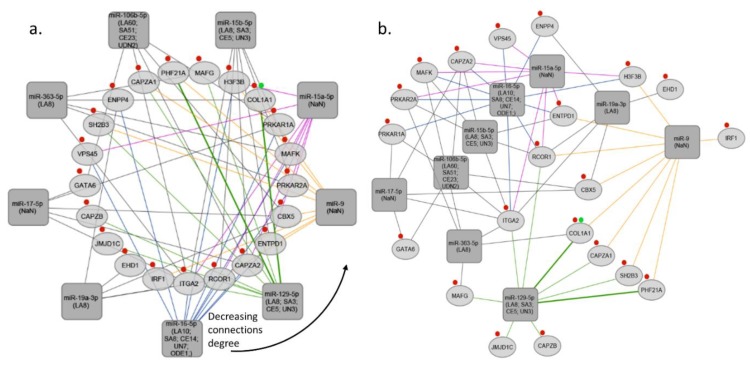
miRNA-target gene networks based on blood coagulation. (a) Blood coagulation- network sorted by the degree of connections, (b) Blood coagulation-interaction network. The rectangles indicate the stroke type miRNAs, the ellipses indicate target genes. Red and green marks represent specific GO process-blood coagulation and platelet activation, respectively. LA, large artery stroke; SA, small artery stroke; UDN, stroke due to undetermined cause; CE, cardioembolic stroke; NaN, no data; ODE, other determined etiology; UN, determined cause.
Figure 4
Figure 4
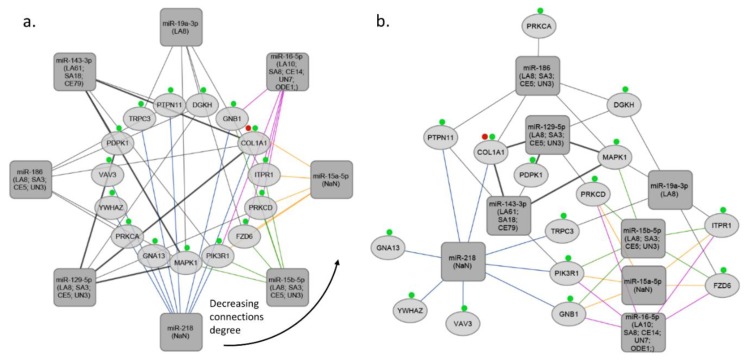
miRNA-target gene networks based on platelet activation. (a) Platelet activation-network sorted by the degree of connections, (b) Platelet activation-interaction network. The rectangles indicate the stroke type miRNAs, the ellipses indicate target genes. Red and green marks represent specific GO process-blood coagulation and platelet activation, respectively. LA, large artery stroke; SA, small artery stroke; UDN, stroke due to undetermined cause; CE, cardioembolic stroke; NaN, no data; ODE, other determined etiology; UN, determined cause.
Figure 5
Figure 5
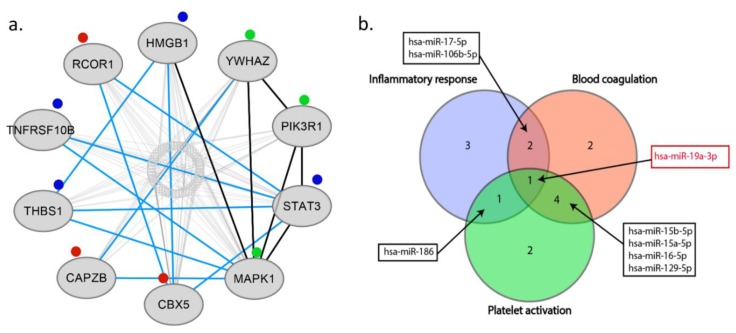
Most important genes targeted by miRNAs and overlapped miRNAs in GO process in IS. (a) Top ten genes targeted by miRNAs associated with IS. The circle in the middle indicates the stroke type miRNAs, the ellipses indicate target genes. Red, green and blue marks represent specific GO process-blood coagulation, platelet activation, and inflammation process, respectively. Black edges represent the high confidence connections between genes, blue edges represent low confidence connections. (b) Overlapped miRNAs in inflammatory response, blood coagulation, and platelet activation. 2 common miRNAs observed in inflammatory response and blood coagulation namely, miR-17-5p miR-106b-5p. 1 common miRNA observed in inflammatory response and platelet activation namely, miR-186. 4 common miRNAs observed in blood coagulation and platelet activation namely, miR-15b-5p, miR-15a-5p, miR-16-5p, miR-129-5p. 1 common miRNA observed in inflammatory response, blood coagulation and platelet activation namely, miR-19a-3p. miR, microRNA.

References

    1. Benjamin E.J., Blaha M.J., Chiuve S.E., Cushman M., Das S.R., Deo R., de Ferranti S.D., Floyd J., Fornage M., Gillespie C., et al. American Heart Association Statistics Committee and Stroke Statistics Subcommittee. Heart Disease and Stroke Statistics-2017 Update: A Report from the American Heart Association. Circulation. 2017;135:146–603. doi: 10.1161/CIR.0000000000000485. - DOI - PMC - PubMed
    1. De Rosa S., Sievert H., Sabatino J., Polimeni A., Sorrentino S., Indolfi C. Percutaneous Closure Versus Medical Treatment in Stroke Patients with Patent Foramen Ovale: A Systematic Review and Meta-analysis. Ann. Intern. Med. 2018;168:343–350. doi: 10.7326/M17-3033. - DOI - PubMed
    1. European Cardiovascular Disease Statistics. 2017th ed. European Heart Network; Brussels, Belgium: 2017.
    1. Luengo-Fernandez R., Gray A.M., Bull L., Welch S., Cuthbertson F., Rothwell P.M. Quality of life after TIA and stroke: Ten-year results of the Oxford Vascular Study. Neurology. 2013;81:1588–1595. doi: 10.1212/WNL.0b013e3182a9f45f. - DOI - PMC - PubMed
    1. Beal C.C. Gender and stroke symptoms: A review of the current literature. J. Neurosci. Nurs. 2010;42:80–87. doi: 10.1097/JNN.0b013e3181ce5c70. - DOI - PubMed

LinkOut - more resources