


Accuracy of genomic selection for growth and wood quality traits in two control-pollinated progeny trials using exome capture as the genotyping platform in Norway spruce
- PMID: 30563448
- PMCID: PMC6299659
- DOI: 10.1186/s12864-018-5256-y
Accuracy of genomic selection for growth and wood quality traits in two control-pollinated progeny trials using exome capture as the genotyping platform in Norway spruce
Abstract
Background: Genomic selection (GS) can increase genetic gain by reducing the length of breeding cycle in forest trees. Here we genotyped 1370 control-pollinated progeny trees from 128 full-sib families in Norway spruce (Picea abies (L.) Karst.), using exome capture as genotyping platform. We used 116,765 high-quality SNPs to develop genomic prediction models for tree height and wood quality traits. We assessed the impact of different genomic prediction methods, genotype-by-environment interaction (G × E), genetic composition, size of the training and validation set, relatedness, and number of SNPs on accuracy and predictive ability (PA) of GS.
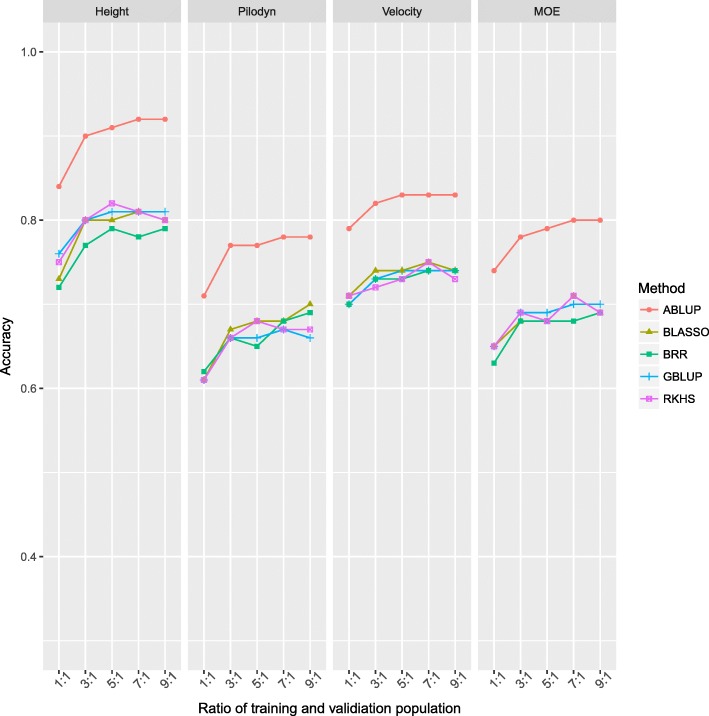
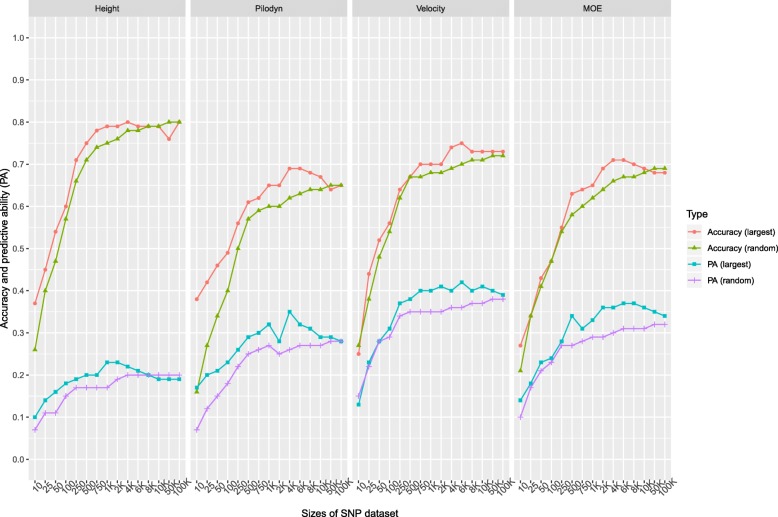
Results: Using G matrix slightly altered heritability estimates relative to pedigree-based method. GS accuracies were about 11-14% lower than those based on pedigree-based selection. The efficiency of GS per year varied from 1.71 to 1.78, compared to that of the pedigree-based model if breeding cycle length was halved using GS. Height GS accuracy decreased to more than 30% while using one site as training for GS prediction and using this model to predict the second site, indicating that G × E for tree height should be accommodated in model fitting. Using a half-sib family structure instead of full-sib structure led to a significant reduction in GS accuracy and PA. The full-sib family structure needed only 750 markers to reach similar accuracy and PA, as compared to 100,000 markers required for the half-sib family, indicating that maintaining the high relatedness in the model improves accuracy and PA. Using 4000-8000 markers in full-sib family structure was sufficient to obtain GS model accuracy and PA for tree height and wood quality traits, almost equivalent to that obtained with all markers.
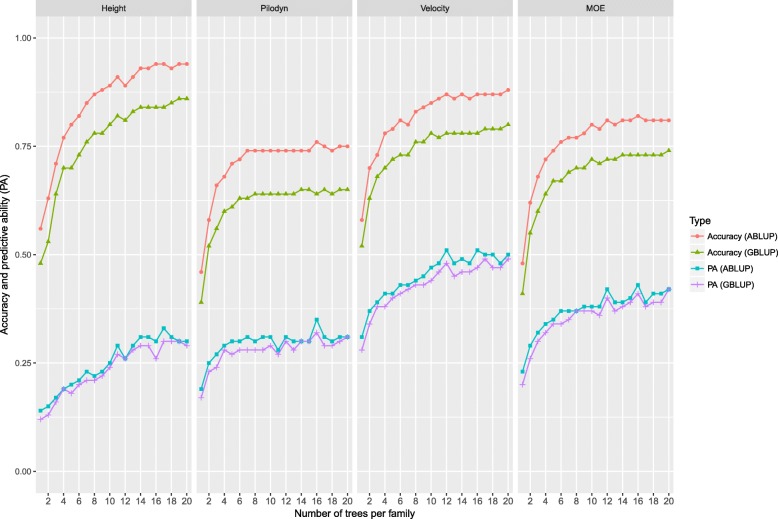
Conclusions: The study indicates that GS would be efficient in reducing generation time of breeding cycle in conifer tree breeding program that requires long-term progeny testing. The sufficient number of trees within-family (16 for growth and 12 for wood quality traits) and number of SNPs (8000) are required for GS with full-sib family relationship. GS methods had little impact on GS efficiency for growth and wood quality traits. GS model should incorporate G × E effect when a strong G × E is detected.
Keywords: Bayesian LASSO; Bayesian ridge regression; Exome capture; GBLUP; Genotype-by-environment interaction; Norway spruce; RKHS.
Conflict of interest statement
Ethics approval and consent to participate
The plant materials analyzed for this study comes from common garden experiments (Plantation and clonal archives) that were established and maintained by the Forestry Research Institute of Sweden (Skogforsk) for breeding selections and research purposes. Three tree breeders in Sweden were coauthors in this paper. They agreed to access the materials.
Consent for publication
Not applicable.
Competing interests
The authors declare that they have no competing interests.
Publisher’s Note
Springer Nature remains neutral with regard to jurisdictional claims in published maps and institutional affiliations.
Figures



References
-
- Hannrup B, Cahalan C, Chantre G, Grabner M, Karlsson B, Le Bayon I, et al. Genetic parameters of growth and wood quality traits in Picea abies. Scand J For Res. 2004;19(1):14–29. doi: 10.1080/02827580310019536. - DOI
-
- Karlsson B, Rosvall O. Progeny testing and breeding strategies. Proceedings of the Nordic group for tree breeding. Edinburgh; 1993.
-
- Resende MDV, Resende MFR, Sansaloni CP, Petroli CD, Missiaggia AA, Aguiar AM, et al. Genomic selection for growth and wood quality in Eucalyptus: capturing the missing heritability and accelerating breeding for complex traits in forest trees. New Phytol. 2012;194(1):116–128. doi: 10.1111/j.1469-8137.2011.04038.x. - DOI - PubMed
MeSH terms
Substances
Grants and funding
LinkOut - more resources
Full Text Sources
Other Literature Sources
