


Prevalence of HIV infection and uptake of HIV/AIDS services among fisherfolk in landing Islands of Lake Victoria, north western Tanzania
- PMID: 30563534
- PMCID: PMC6299499
- DOI: 10.1186/s12913-018-3784-4
Prevalence of HIV infection and uptake of HIV/AIDS services among fisherfolk in landing Islands of Lake Victoria, north western Tanzania
Abstract
Background: New HIV infections in Tanzania have been decreasing, however some populations remain at higher risk. Despite of that, evidence on the magnitude of HIV infection and the associated factors and HIV/AIDS services uptake among fisherfolk in Tanzania are inadequately explored. This study therefore aimed at determining prevalence of HIV infection and utilization of HIV/AIDS services among fishfolk in selected Islands of Lake Victoria for evidence-based interventions.
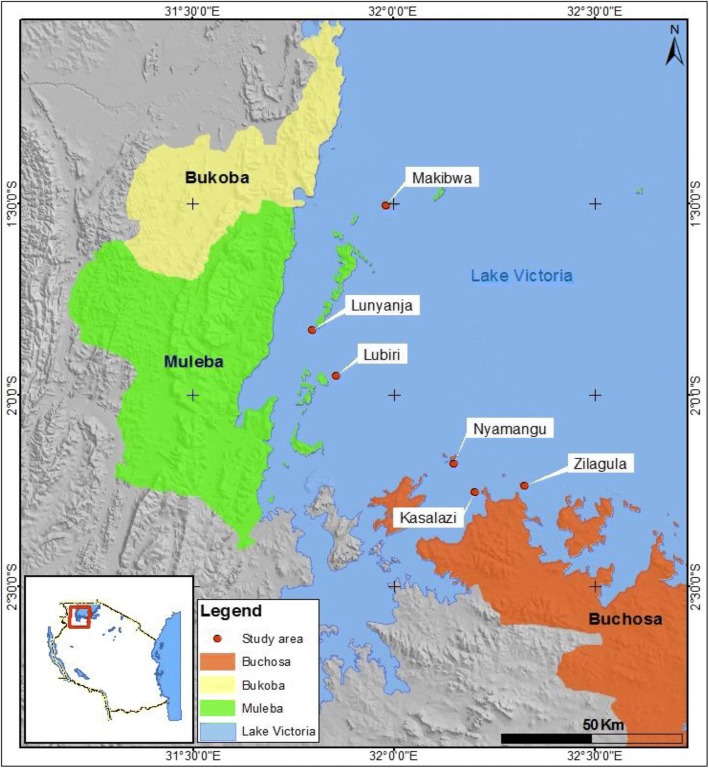
Methods: Cross-sectional study determining status of HIV infection among fisherfolk (n = 456) and retrospective review of voluntary counselling and testing (VCT) registry (n = 1744) were done in Buchosa and Muleba districts. Structured questionnaire and HIV rapid test kits with the standard testing protocol were used as research tools.
Results: A total of 269 (58.9%) male and 187 (41.1%) female fisherfolk were recruited during the community survey. Prevalence of HIV infection was 14% in all surveyed landing sites with a site variation from as low as 7.2% to as high as 23.8%. Participants employed in fishing related employment had higher odds of being HIV infected (5.4 times) than those who practiced fishing and partly farming [OR = 5.40; 95%CI 1.88-15.61; p < 0.001]. Participants employed in fishing related employment had higher odds of being HIV infected (5.4 times) than those practiced fishing and farming [OR = 5.40; 95%CI 1.88-15.61; P < 0.001]. Lack of formal education [aOR = 3.37; 95%CI 1.64-6.92; p < 0.001], being older [aOR = 1.06; 95%CI 1.03-1.09] and using alcohol [aOR = 2.26; 95%CI 1.23-4.15] predicted the likelihood of contracting HIV infection. Approximately three quarters (76%) of respondents had ever tested for HIV infection within past 1 year. Moreover, about half of the study participants had used condom inconsistently and 5 out of 14 (37.5%) of participants who knew their status had never started treatment. Despite the low uptake of most HIV preventive services, majority (88%) of male fisherfolk were circumcised.
Conclusion: The magnitude of HIV infection among fisherfolk was up to 3 times higher than that of the general populations in Muleba and Buchosa districts. Higher age, using alcohol and lack of formal education predicted increased likelihood of HIV infection. The uptake of key HIV/AIDS curative and preventive services was generally low.
Keywords: Fisherfolk; HIV infection; HIV/AIDS services; Landing islands; Tanzania.
Conflict of interest statement
Ethics approval and consent to participate
Ethical approval of this study was given by the Catholic University of Health and allied sciences and the Bugando Teaching and Consultant Hospital joint committee. Local health authorities approved the review of VCT registry and the community survey. A written informed consent was sought to all participants during the community survey. Assent was obtained to all participants under the age of 18 and the assent form was countersigned by parents or caretakers.
Consent for publication
Not applicable. All results are presented in group data without individual’s identification.
Competing interests
The authors declare that they have no competing interests.
Publisher’s Note
Springer Nature remains neutral with regard to jurisdictional claims in published maps and institutional affiliations.
Figures
References
-
- HIV/AIDS JUNPo . Global AIDS update 2016. Geneva: UNAIDS; 2016.
-
- NBS . Tanzania HIV Impact Survey (THIS) 2016/17 Summary sheet result: National Bureau of Statistics. 2017.
Publication types
MeSH terms
LinkOut - more resources
Full Text Sources
Medical
Miscellaneous
