


Review
doi: 10.3389/fphar.2018.01436.
eCollection 2018.
Pharmacogenomics of Medications Commonly Used in the Intensive Care Unit
Affiliations
- PMID: 30564130
- PMCID: PMC6289166
- DOI: 10.3389/fphar.2018.01436
Item in Clipboard
Review
Pharmacogenomics of Medications Commonly Used in the Intensive Care Unit
Front Pharmacol.
.
Abstract
In the intensive care unit (ICU) setting, where highly variable and insufficient drug efficacies, as well as frequent and unpredictable adverse drug reactions (ADRs) occur, pharmacogenomics (PGx) offers an opportunity to improve health outcomes. However, PGx has not been fully evaluated in the ICU, partly due to lack of knowledge of how genetic markers may affect drug therapy. To fill in this gap, we conducted a review to summarize the PGx information for the medications commonly encountered in the ICU.
Keywords: adverse drug reaction; intensive care unit; personalized medicine; pharmacogenetics; pharmacogenomics.
Figures
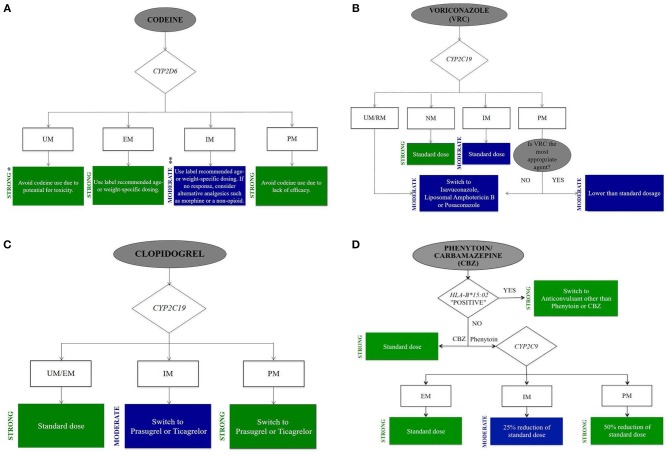
Clinical actionable flow chart of drugs commonly used in ICU. (A) Codeine. (B) Voriconazole. (C) Clopidogrel. (D) Phenytoin/Carbamazepine. Develop clinical actionable flow chart based on CPIC guidelines to facility the adaptation of genomic information in clinical decision-making in ICU. Evidence-based recommendation taken from the online CPIC: Strength of Recommendations, https://cpicpgx.org/strength-of-recommendations/ . * “Strong” means “the evidence is high quality and the desirable effects clearly outweigh the undesirable effects.” ** “Moderate” means “there is a close or uncertain balance as to whether the evidence is high quality and the desirable clearly outweigh the undesirable effects.”
References
-
- Ahmed A. E., Jacob S., Campbell G. A., Harirah H. M., Perez-Polo J. R., Johnson K. M. (2005). Fetal origin of adverse pregnancy outcome: the water disinfectant by-product chloroacetonitrile induces oxidative stress and apoptosis in mouse fetal brain. Brain Res. Dev. Brain Res. 159, 1–11. 10.1016/j.devbrainres.2005.05.008 - DOI - PubMed
-
- Ameer B., Greenblatt D. J. (1981). Lorazepam: a review of its clinical pharmacological properties and therapeutic uses. Drugs 21, 162–200. - PubMed
-
- Angiolillo D. J., Gibson C. M., Cheng S., Ollier C., Nicolas O., Bergougnan L., et al. . (2011). Differential effects of omeprazole and pantoprazole on the pharmacodynamics and pharmacokinetics of clopidogrel in healthy subjects: randomized, placebo-controlled, crossover comparison studies. Clin. Pharmacol. Ther. 89, 65–74. 10.1038/clpt.2010.219 - DOI - PubMed
Publication types
Grants and funding
LinkOut - more resources
Full Text Sources
Miscellaneous
