


The 100 most influential manuscripts in andrology: a bibliometric analysis
- PMID: 30564366
- PMCID: PMC6290538
- DOI: 10.1186/s12610-018-0080-4
The 100 most influential manuscripts in andrology: a bibliometric analysis
Abstract
Background: As the specialty of Andrology expands it is important to establish the most important studies that have shaped, and continue to shape, current research and clinical practice. Bibliometric analysis involving a citation rank list is an established means by which to identify the published material within a given field that has greatest intellectual influence. This bibliometric analysis sought to identify the 100 most influential manuscripts in Andrology, as well as the key research themes that have shaped contemporary understanding and management of andrological conditions.
Methods: The Thompson Reuters Web of Science citation indexing database was interrogated using a number of search terms chosen to reflect the full spectrum of andrological practice. Results were ranked according to citation number and further analysed according to subject, first and senior author, journal, year of publication, institution and country of origin.
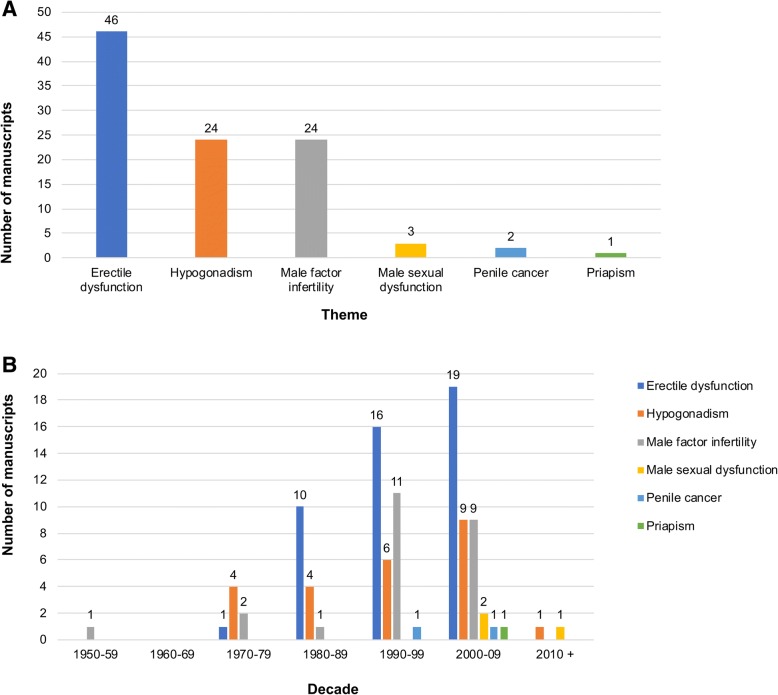
Results: The Web of Science search returned a total of 24,128 manuscripts. Citation number of the top 100 articles ranged from 2819 to 218 (median 320). The most cited manuscript (by Feldman et al., The Journal of Urology 1994; 2819 citations) reported the prevalence and risk factors for erectile dysfunction (ED) in the Massachusetts Male Ageing Study. The Journal of Urology published the highest number of manuscripts (n = 11), followed by the New England Journal of Medicine (n = 10). The most common theme represented within the top 100 manuscripts was erectile dysfunction (n = 46), followed jointly by hypogonadism and male factor infertility (n = 24 respectively).
Conclusion: Erectile dysfunction should be considered the most widely researched, published and cited field within andrological practice. This study provides a list of the most influential manuscripts in andrology and serves as a reference of what comprises a 'highly citable' paper for both researchers and clinicians.
Contexte: Etant donné que la spécialité Andrologie se développe, il est important de dresser un inventaire des études les plus importantes qui ont façonné, et qui continuent à façonner, la recherche actuelle et la pratique clinique. L’analyse bibliométrique, qui inclue une liste de rang de citations, est un moyen bien établi pour identifier le matériel publié, dans un champ donné, qui a la plus grande influence intellectuelle. La présente analyse bibliométrique cherche à identifier les 100 manuscrits les plus influents en Andrologie, ainsi que les principaux thèmes de recherche qui ont façonné la compréhension et la prise en charge contemporaines des situations andrologiques.
Méthodes: La base de données d’indexation des citations du Web of Science de Thompson Reuters a été interrogée en utilisant un nombre de termes de recherche choisis pour refléter l’éventail complet de la pratique andrologique. Les résultats ont été classés selon leur nombre de citations, puis ensuite analysés en fonction du sujet, des premier et dernier auteurs, du journal, de l’année de publication, de l’institution et du pays d’origine.
Résultats: La recherche sur le Web of Science a rapporté un total de 24 128 manuscrits. Le nombre de citations des 100 premiers articles va de 2 819 à 218 (médiane 320). L’article le plus cité (de Feldman et al., The Journal of Urology 1994 ; 2 819 citations) rapportait la prévalence et les facteurs de risque de la dysfonction érectile (DE) dans l’étude du Massachusetts menée chez l’homme vieillissant. The Journal of Urology a publié le plus grand nombre de manuscrits (n=11), suivi du New England Journal of Medicine (n=10). Le thème le plus souvent représenté dans les manuscrits du top 100 était la dysfonction érectile (n=46), suivi conjointement par l’hypogonadisme et l’infertilité d’origine masculine (respectivement n=24).
Conclusion: La dysfonction érectile devrait être considérée comme le champ de la pratique andrologique qui a le plus largement fait l’objet de recherches, de publications et de citations. La présente étude fournit une liste des manuscrits les plus influents en andrologie, et constitue une référence sur ce que signifie un article ‘fortement cité’ à la fois pour les chercheurs et pour les cliniciens.
Keywords: Andrology; Bibliometric analysis; Citation rank; Influential.
Conflict of interest statement
Not applicable.Not applicable.The authors declare that they have no competing interests.Springer Nature remains neutral with regard to jurisdictional claims in published maps and institutional affiliations.
Figures
References
-
- Isidori A. The history of modern andrology. Med Secoli. 2001;13(2):255–268. - PubMed
LinkOut - more resources
Full Text Sources
Research Materials
