. 2018 Dec 14:3:33.
doi: 10.1038/s41525-018-0073-4. eCollection 2018.

Pathogenic copy number variants that affect gene expression contribute to genomic burden in cerebral palsy

Affiliations

Pathogenic copy number variants that affect gene expression contribute to genomic burden in cerebral palsy

Mark A Corbett et al. NPJ Genom Med. .

Erratum in

Abstract

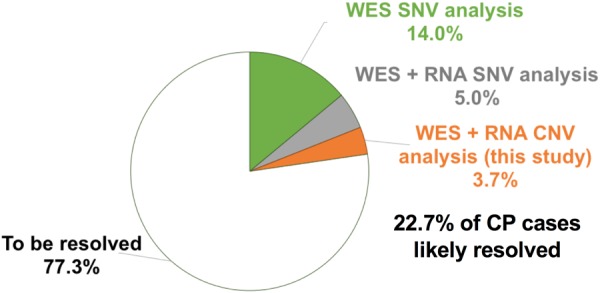
Cerebral palsy (CP) is the most frequent movement disorder of childhood affecting 1 in 500 live births in developed countries. We previously identified likely pathogenic de novo or inherited single nucleotide variants (SNV) in 14% (14/98) of trios by exome sequencing and a further 5% (9/182) from evidence of outlier gene expression using RNA sequencing. Here, we detected copy number variants (CNV) from exomes of 186 unrelated individuals with CP (including our original 98 trios) using the CoNIFER algorithm. CNV were validated with Illumina 850 K SNP arrays and compared with RNA-Seq outlier gene expression analysis from lymphoblastoid cell lines (LCL). Gene expression was highly correlated with gene dosage effect. We resolved an additional 3.7% (7/186) of this cohort with pathogenic or likely pathogenic CNV while a further 7.7% (14/186) had CNV of uncertain significance. We identified recurrent genomic rearrangements previously associated with CP due to 2p25.3 deletion, 22q11.2 deletions and duplications and Xp monosomy. We also discovered a deletion of a single gene, PDCD6IP, and performed additional zebrafish model studies to support its single allele loss in CP aetiology. Combined SNV and CNV analysis revealed pathogenic and likely pathogenic variants in 22.7% of unselected individuals with CP.


Conflict of interest statement

The authors declare no competing interests.

Figures
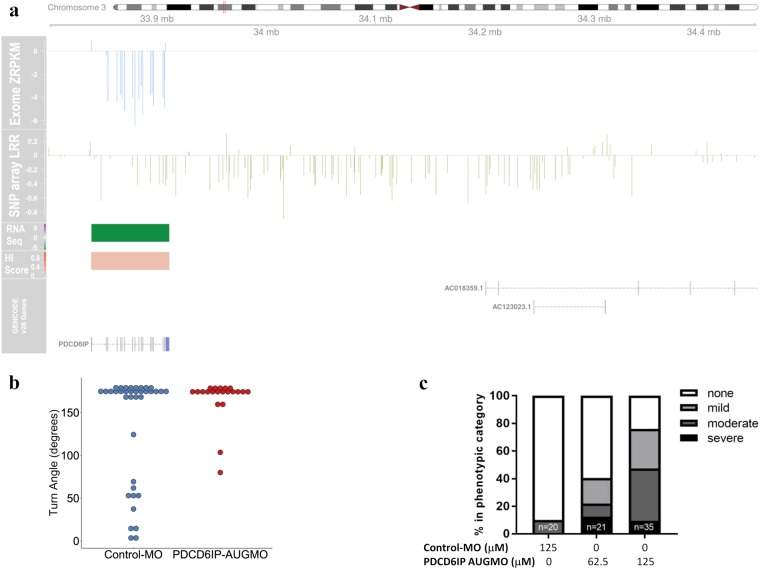
Fig. 1
Fig. 1
PDCD6IP deletion detected by CoNIFER with confirmed effects on gene expression and support for pathogenicity from a zebrafish knock-down model defines a new gene for CP. a Composite plot showing genomic context of the PDCD6IP deletion. The ideogram for chromosome 3 at the top of the plot shows the genomic location of the CNV boxed in red. Base pair positions of the CNV from the hg19 build of the human genome are shown below the ideogram. Data from CoNIFER (Exome SVD-ZRPKM values) are shown in blue with the zero baseline indicated by a grey line. PennCNV Log R ratios are shown in khaki with the zero baseline indicated by a grey line. RNA Seq outlier gene expression for each gene in its genomic context is plotted as a heat map; purple indicates upregulation and green indicates down regulation, grey or light shading indicates the gene is below the cut off of −2 to 2. Haploinsufficency percentile scores (HI scores) from DECIPHER are shown as a heatmap with genes with the darkest orange the most sensitive to copy number variation. GENCODE v28 gene models are shown at the bottom of the plot. b Average turning angle of zebra fish injected with the PDCD6IP-AUGMO at concentrations of 62.5 μM (red, n = 21) compared to a control injected group (blue, n = 37) over three trials stimulating movement with a tap in the first two trials and light in the final trial. PDCD6IP-AUGMO treated fish moved with significantly greater turning angles, p < 0.05 Student’s two-tailed T-test assuming equal variances. c Quantification of phenotypes with increasing concentration of the PDCD6IP-AUGMO. Larvae were classified as having mild, moderate or severe developmental abnormalities depending on whether they had one, two to three, or more than four of the following phenotypes: loss of pigment in eye, decreased eye size, grey matter hindbrain, small head, domed cranium, cardiac abnormality, decreased body size and tail curvature or kinking
Fig. 2
Fig. 2
Overview of pathogenic variants detected in three studies in an unselected Australian cohort of 191 individuals living with CP. Green slice shows percent of cases resolved by our original WES study. Grey slice summarizes SNVs (premature terminations codons and splice variants) that affect gene expression. Orange slice summarizes findings from this study
Fig. 3
Fig. 3
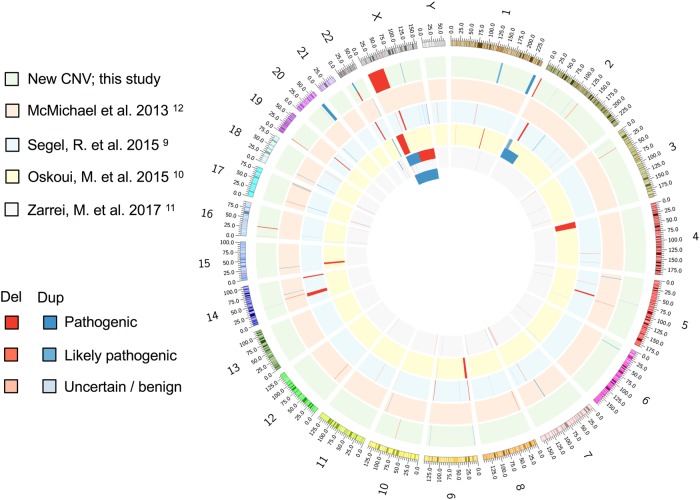
CNV reported in CP to date. Circos plot generated using the ClicO FS tool shows the human karyogram on the outer edge with deletions in red and duplications in blue from this study and the previous four reports as indicated by the study key. The saturation of colour of each CNV indicates its likelihood for pathogenicity

References

    1. Delacy MJ, Reid SM. Australian Cerebral Palsy Register Group. Profile of associated impairments at age 5 years in Australia by cerebral palsy subtype and Gross Motor Function Classification System level for birth years 1996 to 2005. Dev. Med. Child Neurol. 2016;58(Suppl 2):50–56. doi: 10.1111/dmcn.13012. - DOI - PubMed
    1. Lerer I, et al. Deletion of the ANKRD15 gene at 9p24.3 causes parent-of-origin-dependent inheritance of familial cerebral palsy. Hum. Mol. Genet. 2005;14:3911–3920. doi: 10.1093/hmg/ddi415. - DOI - PubMed
    1. Lynex CN, et al. Homozygosity for a missense mutation in the 67 kDa isoform of glutamate decarboxylase in a family with autosomal recessive spastic cerebral palsy: parallels with Stiff-Person Syndrome and other movement disorders. BMC Neurol. 2004;4:20. doi: 10.1186/1471-2377-4-20. - DOI - PMC - PubMed
    1. Kruer MC, et al. Mutations in γ adducin are associated with inherited cerebral palsy. Ann. Neurol. 2013;74:805–814. doi: 10.1002/ana.23971. - DOI - PMC - PubMed
    1. Abou Jamra R, et al. Adaptor protein complex 4 deficiency causes severe autosomal-recessive intellectual disability, progressive spastic paraplegia, shy character, and short stature. Am. J. Hum. Genet. 2011;88:788–795. doi: 10.1016/j.ajhg.2011.04.019. - DOI - PMC - PubMed