


Vitamin D supplements for trunk muscle morphology in older adults: secondary analysis of a randomized controlled trial
- PMID: 30565892
- PMCID: PMC6438333
- DOI: 10.1002/jcsm.12364
Vitamin D supplements for trunk muscle morphology in older adults: secondary analysis of a randomized controlled trial
Abstract
Background: The effect of vitamin D supplementation on postural muscles of the trunk is of particular interest because low 25-hydroxyvitamin D [25(OH) D] levels are associated with decreased postural balance and increased risk of falls. Understanding the role of vitamin D supplementation plays in trunk muscle function of older adults is necessary, as this is a potentially modifiable factor to improve postural muscle function and decrease the risk of falling of older adults. The objective of this randomized controlled trial was to evaluate the effect of 12 months of vitamin D supplementation compared with placebo, on morphology and function of the trunk muscles of adults aged 50 to 79 years with low serum 25(OH) D levels.
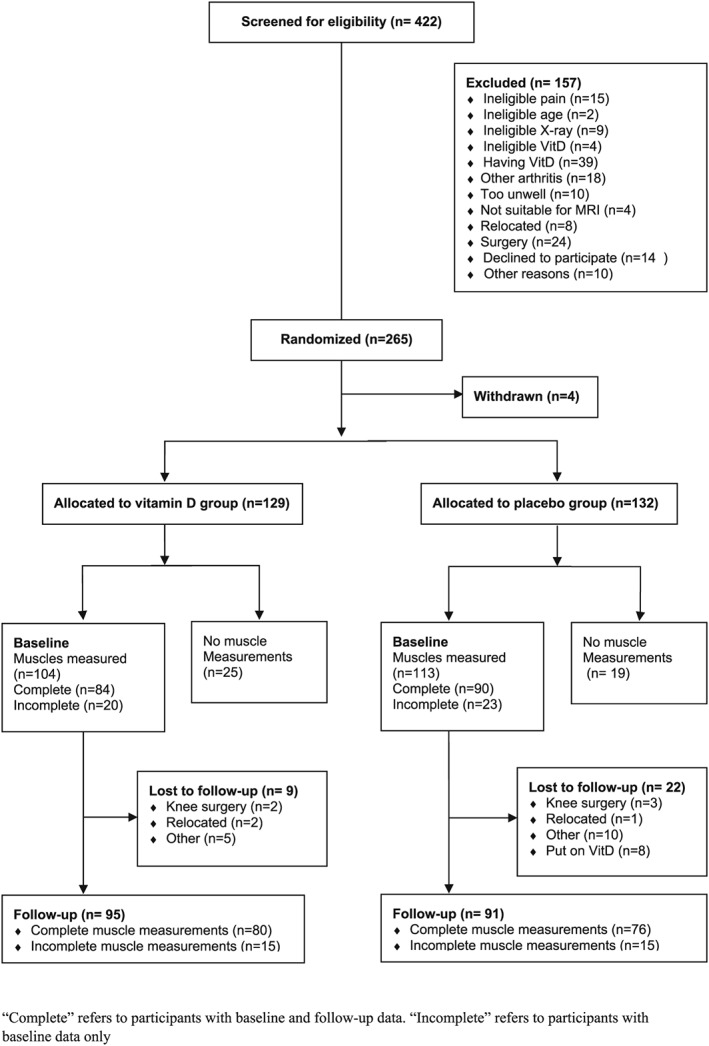
Methods: This was a secondary analysis of a randomized, placebo-controlled, and double-blind clinical trial conducted between June 2010 and December 2013 in Tasmania, Australia. The clinical trial was registered with the Australian New Zealand clinical trial registration agency, ClinicalTrials.gov identifier: NCT01176344; Australian New Zealand Clinical Trials Registry: ACTRN 12610000495022. Participants were aged 50-79 years with ongoing symptoms of knee osteoarthritis and with low serum [25(OH) D] (12.5 to 60 nmol/L, 5.2 to 24 ng/mL). Participants were randomly assigned to either monthly 50 000 IU oral vitamin D3 (n = 104) or an identical placebo (n = 113) for 24 months as per clinical trial protocol. The primary outcomes in this pre-specified secondary analysis were between-group differences in change in size of rectus abdominis, transversus abdominis, internal oblique, external oblique, and lumbar multifidus muscles and function (assessed by change in thickness on contraction) of these muscles (excepting rectus abdominis) from baseline to 12 months. Muscle size was assessed using ultrasound imaging.
Results: Of 217 participants (mean age 63 years, 48% women), 186 (85.7%) completed the study. There were no significant between-group differences in change in size or function of the abdominal or multifidus muscles after 12 months of vitamin D supplementation.
Conclusions: A monthly dose of 50 000 IU of vitamin D3 alone for 12 months does not affect the size or ability to contract trunk muscles of independent community-dwelling older adults with symptomatic knee osteoarthritis and low serum 25(OH) D levels regardless of body mass index status or degree of vitamin D deficiency. An effect of vitamin D supplementation on other aspects of trunk muscle function such as strength, power, or physical function cannot be ruled out.
Keywords: Muscle size and function; Older adults; Postural trunk muscles; Randomized controlled trial; Ultrasound imaging; Vitamin D supplementation.
© 2018 The Authors. Journal of Cachexia, Sarcopenia and Muscle published by John Wiley & Sons Ltd on behalf of the Society on Sarcopenia, Cachexia and Wasting Disorders.
Conflict of interest statement
All authors declare no conflict of interest.
References
-
- Bischoff H, Stähelin H, Tyndall A, Theiler R. Relationship between muscle strength and vitamin D metabolites: are there therapeutic possibilities in the elderly? Z Rheumatol 2000;59:I39–I41. - PubMed
-
- Holick MF. McCollum Award Lecture, 1994: vitamin D—new horizons for the 21st century. Am J Clin Nutr 1994;60:619–630. - PubMed
-
- van Schoor NM, Lips P. Worldwide vitamin D status. Best Pract Res Clin Endocrinol Metab 2011;25:671–680. - PubMed
-
- Nowson CA, McGrath JJ, Ebeling PR, Haikerwal A, Daly RM, Sanders KM, et al. Vitamin D and health in adults in Australia and New Zealand: a position statement. Med J Aust 2012;196:686–687. - PubMed
Publication types
MeSH terms
Substances
Associated data
LinkOut - more resources
Full Text Sources
Medical
