


Health workers' experiences of collaborative quality improvement for maternal and newborn care in rural Tanzanian health facilities: A process evaluation using the integrated 'Promoting Action on Research Implementation in Health Services' framework
- PMID: 30566511
- PMCID: PMC6300247
- DOI: 10.1371/journal.pone.0209092
Health workers' experiences of collaborative quality improvement for maternal and newborn care in rural Tanzanian health facilities: A process evaluation using the integrated 'Promoting Action on Research Implementation in Health Services' framework
Abstract
Background: Quality Improvement (QI) approaches are increasingly used to bridge the quality gap in maternal and newborn care (MNC) in Sub Saharan Africa. Health workers typically serve as both recipients and implementers of QI activities; their understanding, motivation, and level of involvement largely determining the potential effect. In support of efforts to harmonise and integrate the various QI approaches implemented in parallel in Tanzanian health facilities, our objective was to investigate how different components of a collaborative QI intervention were understood and experienced by health workers, and therefore contributed positively to its mechanisms of effect.
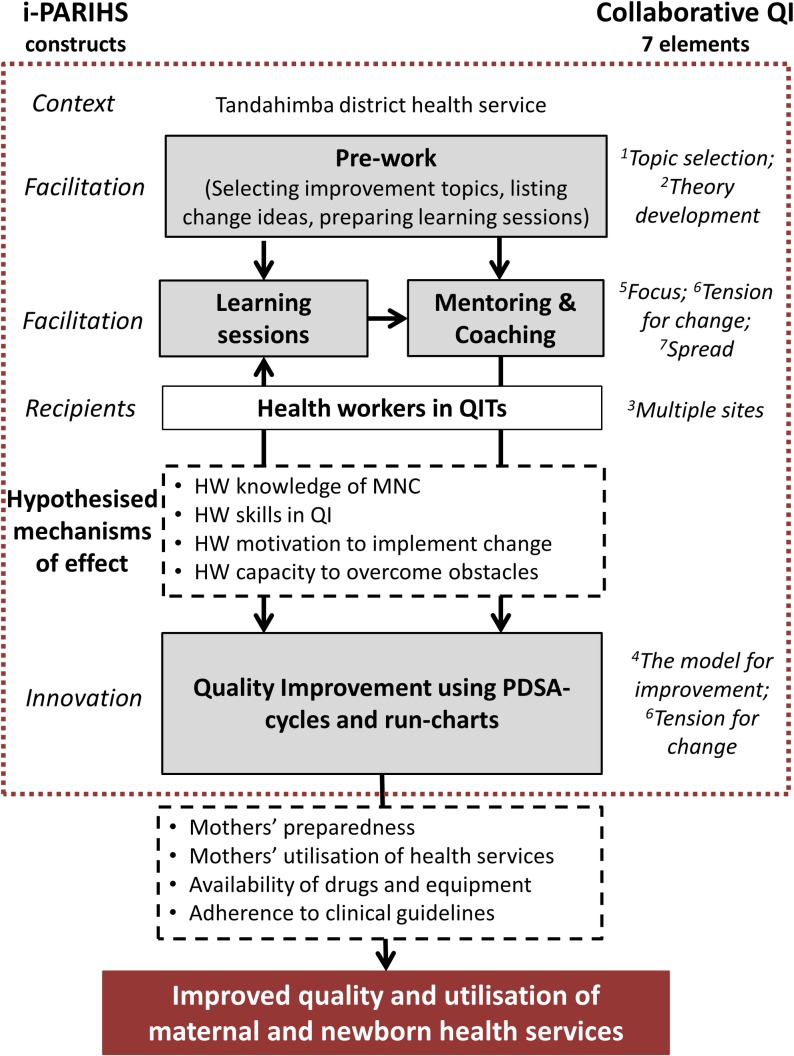
Materials and methods: A qualitative process evaluation of a collaborative QI intervention for MNC in rural Tanzania was carried out. Semi-structured interviews were conducted with 16 health workers in 13 purposively sampled health facilities. A deductive theory-driven qualitative content analysis was employed using the integrated Promoting Action on Research Implementation in Health services (i-PARIHS) framework as a lens with its four constructs innovation, recipients, facilitation, and context as guiding themes.
Results: Health workers valued the high degree of fit between QI topics and their everyday practice and appreciated the intervention's comprehensive approach. The use of run-charts to monitor progress was well understood and experienced as motivating. The importance and positive experience of on-site mentoring and coaching visits to individual health facilities was expressed by the majority of health workers. Many described the parallel implementation of various health programs as a challenge.
Conclusion: Components of QI approaches that are well understood and experienced as supportive by health workers in everyday practice may enhance mechanisms of effect and result in more significant change. A focus on such components may also guide harmonisation, to avoid duplication and the implementation of parallel programs, and country ownership of QI approaches in resource limited settings.
Conflict of interest statement
The authors have declared that no competing interests exist.
Figures
References
-
- Kanamori S, Sow S, Castro MC, Matsuno R, Tsuru A, Jimba M. Implementation of 5S management method for lean healthcare at a health center in Senegal: a qualitative study of staff perception. Global health action. 2015;8:27256 Epub 2015/04/10. 10.3402/gha.v8.27256 ; PubMed Central PMCID: PMCPmc4390558. - DOI - PMC - PubMed
Publication types
MeSH terms
LinkOut - more resources
Full Text Sources
Miscellaneous
