. 2018 Dec 20;19(1):221.
doi: 10.1186/s13059-018-1599-6.

Predicting age from the transcriptome of human dermal fibroblasts

Affiliations

Predicting age from the transcriptome of human dermal fibroblasts

Jason G Fleischer et al. Genome Biol. .

Abstract

Biomarkers of aging can be used to assess the health of individuals and to study aging and age-related diseases. We generate a large dataset of genome-wide RNA-seq profiles of human dermal fibroblasts from 133 people aged 1 to 94 years old to test whether signatures of aging are encoded within the transcriptome. We develop an ensemble machine learning method that predicts age to a median error of 4 years, outperforming previous methods used to predict age. The ensemble was further validated by testing it on ten progeria patients, and our method is the only one that predicts accelerated aging in these patients.

Keywords: Aging; Biological age; Biomarker; Ensemble classifiers; Machine learning; RNA-seq; Skin fibroblasts.


Conflict of interest statement

Ethics approval and consent to participate

This study was previously reviewed by the Salk Institute Institutional Review Board and the need for approval was waived.

Consent for publication

Not applicable

Competing interests

The authors declare that they have no competing interests.

Publisher’s Note

Springer Nature remains neutral with regard to jurisdictional claims in published maps and institutional affiliations.

Figures
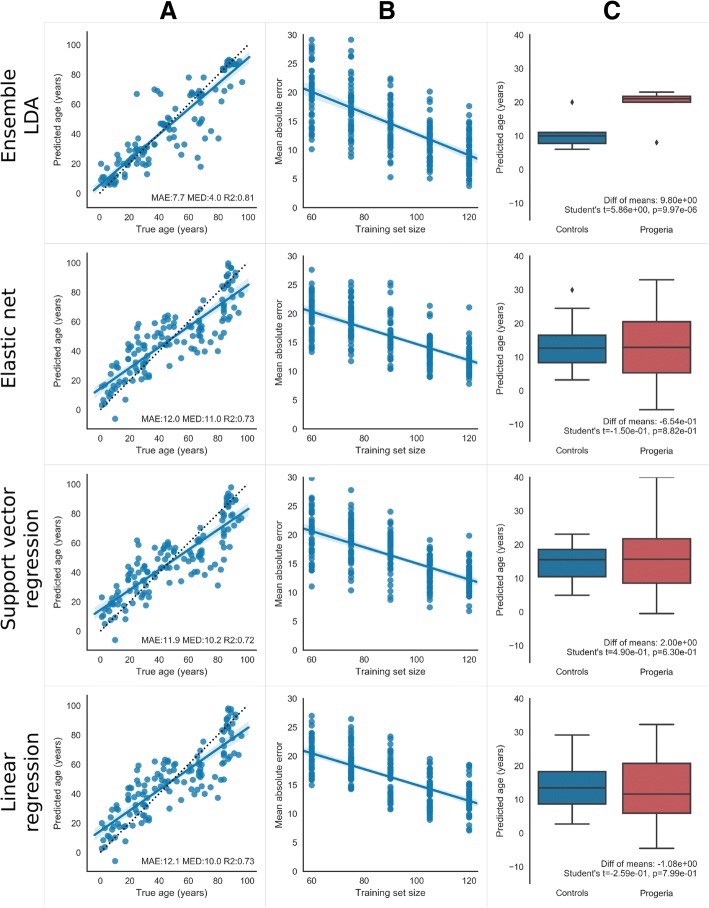
Fig. 1
Fig. 1
Predicting age from gene expression data. Rows from top to bottom show age prediction results for LDA Ensemble with 20-year age bins, elastic net, linear regression, and support vector regression. Model parameters are shown in Table 1. Column (A): Leave-one-out cross-validation predictions for 133 healthy individuals. Dots are plotted for each individual showing predicted age (y-axis) vs. true age (x-axis), with a line of best fit overlaid, and a shadow showing the 95% confidence interval of that line determined through bootstrap resampling of the dots. Text on the bottom of each panel shows performance metrics of mean absolute error (MAE), median absolute error (MED), and R2 goodness-of-fit for the line of best fit. The dotted line is the ideal line, where true age equals predicted age. Column (B): The effect of training set size (x-axis) on the mean absolute error of the ensemble (y-axis). The slope of the best fit line indicates the rate at which age prediction error would decrease with additional samples. Dots indicate mean absolute error from each fold of 2 × 10 cross-validation (y-axis) for varying sizes of random subset of the data (x-axis). A line of best fit and 95% confidence interval is shown. Column (C): Box plots of age predictions of progeria patients (red) and leave-one-out cross-validation predictions of age-matched healthy controls (blue). Box limits denote 25th and 75th percentiles, line is median, whiskers are 1.5× interquartile range, and dots are predictions outside the whisker’s range. The ensemble method is the only method that predicts significantly higher ages for progeria patients. Progeria patients: n = 10, mean ± std. of true age 5.5 ± 2.4; age-matched controls: n = 12, mean ± std. of true age 5.0 ± 2.9

References

    1. Horvath S. DNA methylation age of human tissues and cell types. Genome Biol. 2013;14:3156. doi: 10.1186/gb-2013-14-10-r115. - DOI - PMC - PubMed
    1. Hannum G, Guinney J, Zhao L, Zhang L, Hughes G, Sadda S, et al. Genome-wide methylation profiles reveal quantitative views of human aging rates. Mol Cell. 2013;49:359–367. doi: 10.1016/j.molcel.2012.10.016. - DOI - PMC - PubMed
    1. Peters MJ, Joehanes R, Pilling LC, Schurmann C, Conneely KN, Powell J, et al. The transcriptional landscape of age in human peripheral blood. Nat Commun. 2015;6:8570. doi: 10.1038/ncomms9570. - DOI - PMC - PubMed
    1. Xu C, Qu H, Wang G, Xie B, Shi Y, Yang Y, et al. A novel strategy for forensic age prediction by DNA methylation and support vector regression model. Sci Rep. 2015;5:17788. doi: 10.1038/srep17788. - DOI - PMC - PubMed
    1. Zhang Y, Wilson R, Heiss J, Breitling LP, Saum K-U, Schöttker B, et al. DNA methylation signatures in peripheral blood strongly predict all-cause mortality. Nat Commun. 2017;8:14617. doi: 10.1038/ncomms14617. - DOI - PMC - PubMed

Publication types
