. 2018 Dec 5:9:2954.
doi: 10.3389/fmicb.2018.02954. eCollection 2018.

Annexin A2 in Virus Infection

Affiliations

Annexin A2 in Virus Infection

Julia R Taylor et al. Front Microbiol. .

Abstract

Viral life cycles consist of three main phases: (1) attachment and entry, (2) genome replication and expression, and (3) assembly, maturation, and egress. Each of these steps is intrinsically reliant on host cell factors and processes including cellular receptors, genetic replication machinery, endocytosis and exocytosis, and protein expression. Annexin A2 (AnxA2) is a membrane-associated protein with a wide range of intracellular functions and a recurrent host factor in a variety of viral infections. Spatially, AnxA2 is found in the nucleus and cytoplasm, vesicle-bound, and on the inner and outer leaflet of the plasma membrane. Structurally, AnxA2 exists as a monomer or in complex with S100A10 to form the AnxA2/S100A10 heterotetramer (A2t). Both AnxA2 and A2t have been implicated in a vast array of cellular functions such as endocytosis, exocytosis, membrane domain organization, and translational regulation through RNA binding. Accordingly, many discoveries have been made involving AnxA2 in viral pathogenesis, however, the reported work addressing AnxA2 in virology is highly compartmentalized. Therefore, the purpose of this mini review is to provide information regarding the role of AnxA2 in the lifecycle of multiple epithelial cell-targeting viruses to highlight recurrent themes, identify discrepancies, and reveal potential avenues for future research.

Keywords: A2t; annexin A2; endocytosis; epithelial cells; infection; trafficking; virus; virus lifecycle.


Figures
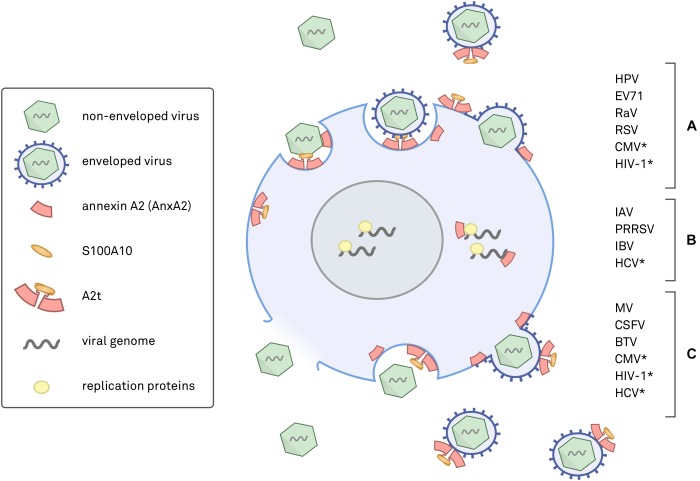
FIGURE 1
FIGURE 1
Schematic diagram of annexin A2 (AnxA2) and heterotetrameric AnxA2/S100A10 (A2t) in viral infections. Placements of AnxA2 depict where either AnxA2 or A2t have been implicated in a viral infection. (A) Viruses with evidence for AnxA2 involvement in attachment and entry, which can occur via endocytosis or by fusion of the viral envelope with the plasma membrane. (B) Viruses shown to utilize AnxA2 during genome replication and expression, a process that can occur in the cytoplasm or nucleus. (C) Viruses that have been shown to involve AnxA2 during assembly, maturation, and egress. Assembly can occur in the nucleus or in the cytoplasm, and release is achieved via cell lysis, apoptosis, exocytosis, or direct budding from the plasma membrane. Evidence for AnxA2 involvement in more than one phase of the viral life cycle.

References

    1. Backes P., Quinkert D., Reiss S., Binder M., Zayas M., Rescher U., et al. (2010). Role of annexin A2 in the production of infectious hepatitis C virus particles. J. Virol. 84 5775–5789. 10.1128/JVI.02343-09 - DOI - PMC - PubMed
    1. Barrow E., Nicola A. V., Liu J. (2013). Multiscale perspectives of virus entry via endocytosis. Virol J. 10 1. 10.1186/1743-422X-10-177 - DOI - PMC - PubMed
    1. Beaton A. R., Rodriguez J., Reddy Y. K., Roy P. (2002). The membrane trafficking protein calpactin forms a complex with bluetongue virus protein NS3 and mediates virus release. Proc. Natl. Acad. Sci. U.S.A. 99 13154–13159. 10.1073/pnas.192432299 - DOI - PMC - PubMed
    1. Bećarević M. (2016). TNF-alpha and annexin A2: inflammation in thrombotic primary antiphospholipid syndrome. Rheumatol Int. 36 1649–1656. 10.1007/s00296-016-3569-1 - DOI - PubMed
    1. Benedicto I., Gondar V., Molina-Jiménez F., García-Buey L., López-Cabrera M., Gastaminza P., et al. (2015). Clathrin mediates infectious hepatitis C virus particle egress. J. Virol. 89 4180–4190. 10.1128/JVI.03620-14 - DOI - PMC - PubMed
