Review
. 2018 Dec 5:9:2991.
doi: 10.3389/fmicb.2018.02991. eCollection 2018.

Viral-Induced Enhanced Disease Illness

Affiliations
Review

Viral-Induced Enhanced Disease Illness

Maria K Smatti et al. Front Microbiol. .

Abstract

Understanding immune responses to viral infections is crucial to progress in the quest for effective infection prevention and control. The host immunity involves various mechanisms to combat viral infections. Under certain circumstances, a viral infection or vaccination may result in a subverted immune system, which may lead to an exacerbated illness. Clinical evidence of enhanced illness by preexisting antibodies from vaccination, infection or maternal passive immunity is available for several viruses and is presumptively proposed for other viruses. Multiple mechanisms have been proposed to explain this phenomenon. It has been confirmed that certain infection- and/or vaccine-induced immunity could exacerbate viral infectivity in Fc receptor- or complement bearing cells- mediated mechanisms. Considering that antibody dependent enhancement (ADE) is a major obstacle in vaccine development, there are continues efforts to understand the underlying mechanisms through identification of the epitopes and antibodies responsible for disease enhancement or protection. This review discusses the recent findings on virally induced ADE, and highlights the potential mechanisms leading to this condition.

Keywords: Fc receptors; antibody-dependent enhancement; complement; immune response; viral infections.


Figures
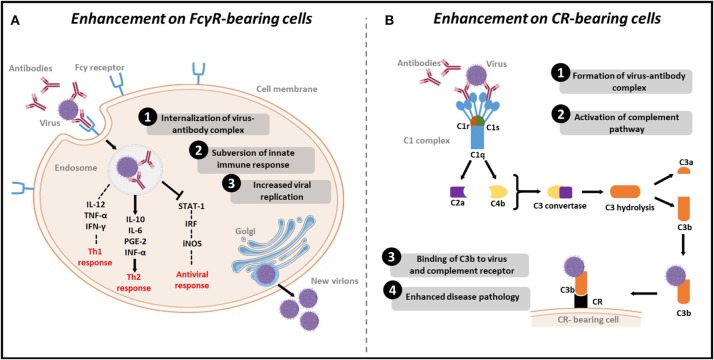
Figure 1
Figure 1
Mechanisms of ADE of viral infections. (A) Enhancement on FcγR bearing cells: (1) Viruses-antibody complexes are internalized to cells after antibody Fc-region binding to FcγR on the immune cells. (2) Subversion of the immune system response by reducing Th1 cytokines IL2, TNF-α and IFN-γ, increasing Th2 cytokines IL-10, IL-6, PGE-2 and INF-α, and inhibiting STAT pathway leading to decreased levels IRF and subsequent decrease in the antiviral iNOS. (3) Increased viral replication as a result of suppression of the antiviral response. (B) Enhancement on CR-bearing cells: (1) Formation of virus-antibody complexes. (2) This complex will activate the complement pathway by binding to C1q. Following activation, C2a and C4b proteins are recruited to produce C3 convertase, which in turn hydrolyses C3, to produce C3b. (3) C3b binds to the virus and to complement receptor (CR) on CR bearing cells. (4) Cell lysis and enhanced disease pathology.
Figure 2
Figure 2
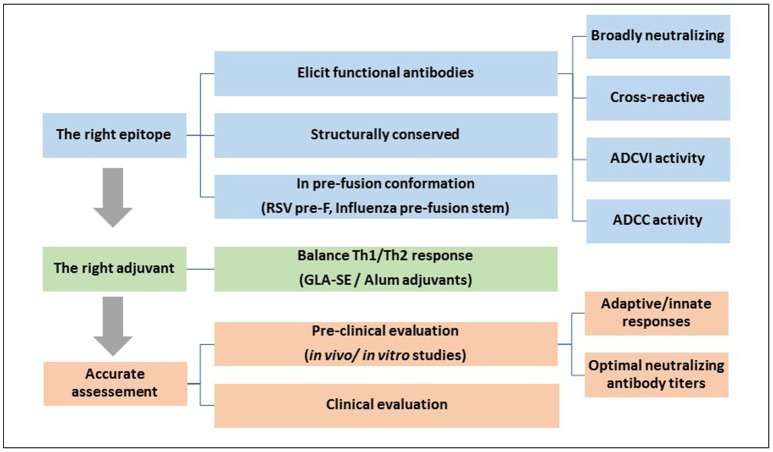
A general strategy for designing an efficacious vaccine that overcomes ADE requires: 1, Identifying the right epitope that elicits functional protective antibodies: An effective vaccine should be designed using conserved and functional epitopes, which usually exist in the pre-fusion conformation of the surface glycoproteins; 2, Selection of the right adjuvant that can direct the immune system toward a balanced Th1/Th2 response; and 3, A carful and accurate assessment of the efficacy and safety of the vaccine at different doses in pre-clinical and clinical trials.

Comment in

References

    1. Acosta P. L., Caballero M. T., Polack F. P. (2015). Brief history and characterization of enhanced respiratory syncytial virus disease. Clin. Vaccine Immunol. 23, 189–195. 10.1128/CVI.00609-15 - DOI - PMC - PubMed
    1. Agrawal A. S., Tao X., Algaissi A., Garron T., Narayanan K., Peng B. H., et al. (2016). Immunization with inactivated Middle East Respiratory Syndrome coronavirus vaccine leads to lung immunopathology on challenge with live virus. Hum. Vaccin. Immunother. 12, 2351–2356. 10.1080/21645515.2016.1177688 - DOI - PMC - PubMed
    1. Ananaba G. A., Anderson L. J. (1991). Antibody enhancement of respiratory syncytial virus stimulation of leukotriene production by a macrophagelike cell line. J. Virol. 65, 5052–5060. - PMC - PubMed
    1. Bardina S. V., Bunduc P., Tripathi S., Duehr J., Frere J. J., Brown J. A., et al. (2017). Enhancement of Zika virus pathogenesis by preexisting antiflavivirus immunity. Science 356, 175–180. 10.1126/science.aal4365 - DOI - PMC - PubMed
    1. Baxt B., Mason P. W. (1995). Foot-and-mouth disease virus undergoes restricted replication in macrophage cell cultures following Fc receptor-mediated adsorption. Virology 207, 503–509. 10.1006/viro.1995.1110 - DOI - PubMed

LinkOut - more resources