. 2018 Dec 20;13(12):e0209209.
doi: 10.1371/journal.pone.0209209. eCollection 2018.

Different host factors are associated with patterns in bacterial and fungal gut microbiota in Slovenian healthy cohort

Affiliations

Different host factors are associated with patterns in bacterial and fungal gut microbiota in Slovenian healthy cohort

Aleksander Mahnic et al. PLoS One. .

Abstract

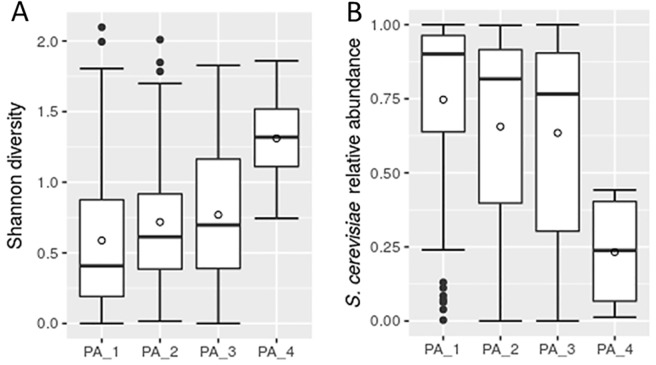
Gut microbiota in a healthy population is shaped by various geographic, demographic and lifestyle factors. Although the majority of research remains focused on the bacterial community, recent efforts to include the remaining microbial members like viruses, archaea and especially fungi revealed various functions they perform in the gut. Using the amplicon sequencing approach we analysed bacterial and fungal gut communities in a Slovenian cohort of 186 healthy volunteers. In the bacterial microbiome we detected 253 different genera. A core microbiome analysis revealed high consistency with previous studies, most prominently showing that genera Faecalibacterium, Bacteroides and Roseburia regularly comprise the core community. We detected a total of 195 fungal genera, but the majority of these showed low prevalence and are likely transient foodborne contaminations. The fungal community showed a low diversity per sample and a large interindividual variability. The most abundant fungi were Saccharomyces cerevisiae and Candida albicans. These, along with representatives from genera Penicillium and Debaryomyces, cover 82% of obtained reads. We report three significant questionnaire-based host covariates associated with microbiota composition. Bacterial community was associated with age and gender. More specifically, bacterial diversity was increased with age and was higher in the female population compared to male. The analysis of fungal community showed that more time dedicated to physical activity resulted in a higher fungal diversity and lower abundance of S. cerevisiae. This is likely dependent on different diets, which were reported by participants according to the respective rates of physical activity.


Conflict of interest statement

The authors declare that no competing interests exist.

Figures
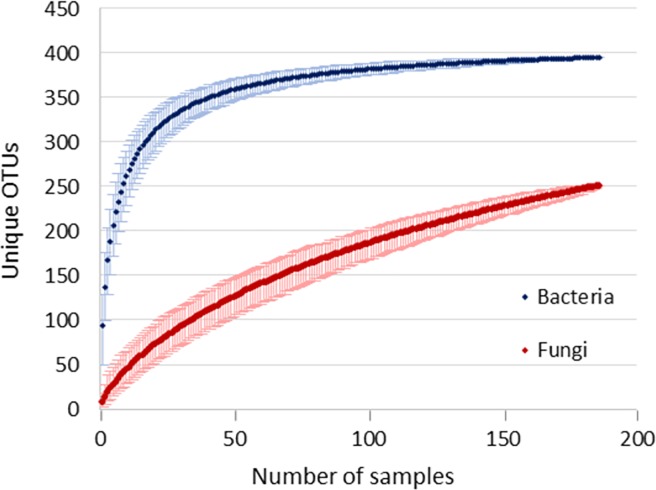
Fig 1
Fig 1. Rarefaction curves for bacterial and fungal OTUs.
Rarefaction curves for bacterial (blue) and fungal (red) OTUs were calculated by rarefying both bacterial and fungal community to 950 reads/sample (only for this specific analysis we rarefied bacterial community to 950 reads/sample in order for the rarefaction curves to be comparable). Plotted data points represent the mean value of OTUs for the respective number of samples (1000 iterations) with a 95% confidence interval.
Fig 2
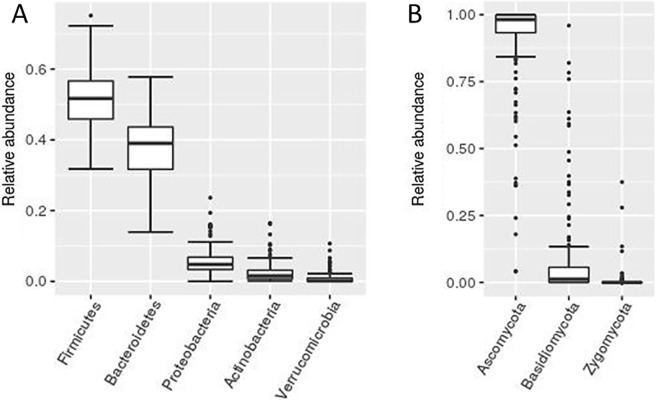
Fig 2. Bacterial and fungal phyla relative abundance.
A box plot presentation of relative abundances of bacterial (A) and fungal (B) phyla. Only phyla with an overall relative abundance greater than 1% are shown.
Fig 3
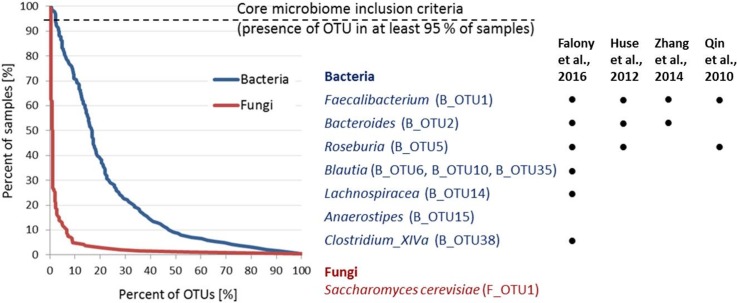
Fig 3. Core microbiome analysis.
The core microbiome is shown as a percent of samples (%) that include the corresponding percent (%) of fungal (red) and bacterial (blue) OTUs. To the right is the list of bacterial (n = 9) and fungal (n = 1) OTUs, which meet the criteria for inclusion into the core community. We compared our observed core taxa with four other studies also reporting core communities (information on studied cohorts and core community inclusion criteria are included in Materials and Methods). The dot indicates that the core taxa identified in our cohort was also reported by respective study at genus or family taxonomic level.
Fig 4
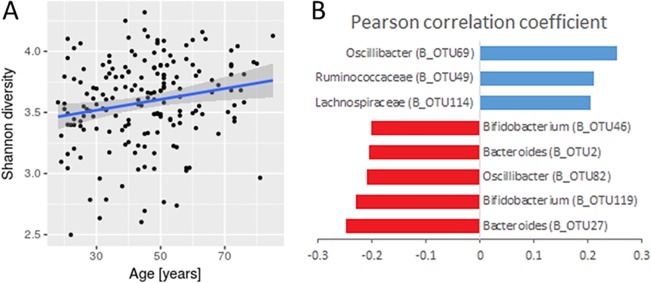
Fig 4. Age-associated changes in bacterial communities.
Graph shows bacterial community Shannon diversity index in relation to age. The linear regression indicates the increase of the Shannon diversity with age and is presented with a 95% confidence interval (A) (Pearson's r = 0.213, P = 0.003). The bar plot shows Pearson correlations of bacterial OTUs that significantly increase (blue) or decrease (red) in relative abundance with age (FDR < 0.05) (B).
Fig 5
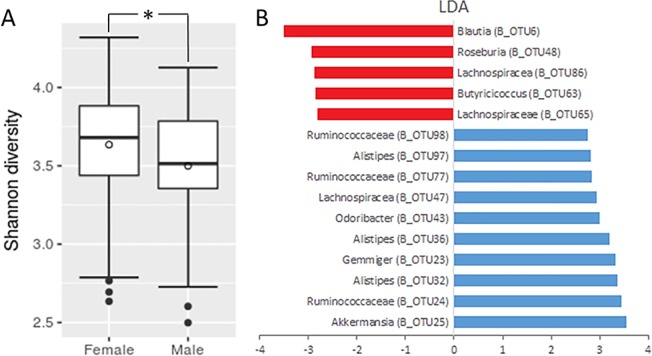
Fig 5. Gender-associated differences in bacterial communities.
A box plot presentation of Shannon diversity indices in females compared to males (Kruskal-Wallis test, P = 0.014) (A). The bar plot presents LEfSe results showing LDA values for OTUs, which were significantly increased in males (red) and females (blue).
Fig 6
Fig 6. Changes in fungal microbiota associated with the reported rate of physical activity.
Box plots presenting the Shannon diversity indices (A) and S. cerevisiae abundance (B) according to the rate of reported physical activity. Physical activity was defined with four categories, i.e. PA_1—occasional exercise; PA_2—exercise approximately once a week; PA_3—exercise multiple times weekly; PA_4—active athlete.

References

    1. Qin J, Li R, Raes J, Arumugam M, Burgdorf KS, Manichanh C, et al. A human gut microbial gene catalogue established by metagenomic sequencing. Nature. 2010. March 4;464(7285):59–65. 10.1038/nature08821 - DOI - PMC - PubMed
    1. Donaldson GP, Lee SM, Mazmanian SK. Gut biogeography of the bacterial microbiota. Nat Rev Microbiol. 2016. January;14(1):20–32. 10.1038/nrmicro3552 - DOI - PMC - PubMed
    1. Lewis JD, Chen EZ, Baldassano RN, Otley AR, Griffiths AM, Lee D, et al. Inflammation, Antibiotics, and Diet as Environmental Stressors of the Gut Microbiome in Pediatric Crohn’s Disease. Cell Host Microbe. 2015. October 14;18(4):489–500. 10.1016/j.chom.2015.09.008 - DOI - PMC - PubMed
    1. Chehoud C, Albenberg LG, Judge C, Hoffmann C, Grunberg S, Bittinger K, et al. A Fungal Signature in the Gut Microbiota of Pediatric Patients with Inflammatory Bowel Disease. Inflamm Bowel Dis. 2015. August;21(8):1948–56. 10.1097/MIB.0000000000000454 - DOI - PMC - PubMed
    1. Kernbauer E, Ding Y, Cadwell K. An enteric virus can replace the beneficial function of commensal bacteria. Nature. 2014. December 4;516(7529):94–8. 10.1038/nature13960 - DOI - PMC - PubMed

Publication types

MeSH terms