


Exploratory study of the impact of perceived reward on habit formation
- PMID: 30572936
- PMCID: PMC6302524
- DOI: 10.1186/s40359-018-0270-z
Exploratory study of the impact of perceived reward on habit formation
Abstract
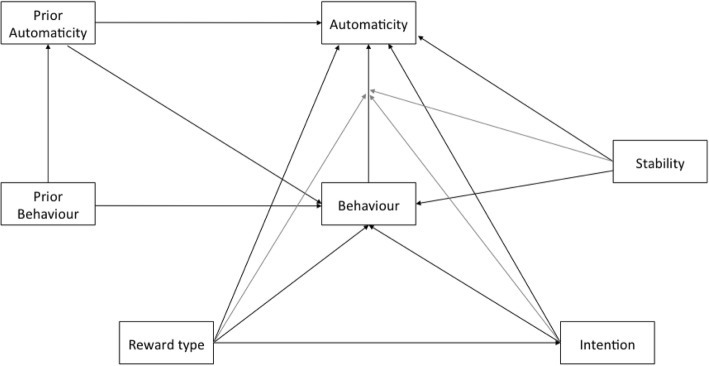
Background: Habits (learned automatic responses to contextual cues) are considered important in sustaining health behaviour change. While habit formation is promoted by repeating behaviour in a stable context, little is known about what other variables may contribute, and whether there are variables which may accelerate the habit formation process. The aim of this study was to explore variables relating to the perceived reward value of behaviour - pleasure, perceived utility, perceived benefits, and intrinsic motivation. The paper tests whether reward has an impact on habit formation which is mediated by behavioural repetition, and whether reward moderates the relationship between repetition and habit formation.
Methods: Habit formation for flossing and vitamin C tablet adherence was investigated in the general public following an intervention, using a longitudinal, single-group design. Of a total sample of 118 participants, 80 received an online vitamin C intervention at baseline, and all 118 received a face-to-face flossing intervention four weeks later. Behaviour, habit, intention, context stability (whether the behaviour was conducted in the same place and point in routine every time), and reward variables were self-reported every four weeks, for sixteen weeks. Structured equation modelling was used to model reward-related variables as predictors of intention, repetition, and habit, and as moderators of the repetition-habit relationship.
Results: Habit strength and behaviour increased for both target behaviours. Intrinsic motivation and pleasure moderated the relationship between behavioural repetition and habit. Neither perceived utility nor perceived benefits predicted behaviour nor interacted with repetition. Limited support was obtained for the mediation hypothesis. Strong intentions unexpectedly weakened the repetition-habit relationship. Context stability mediated and for vitamin C, also moderated the repetition-habit relationship.
Conclusions: Pleasure and intrinsic motivation can aid habit formation through promoting greater increase in habit strength per behaviour repetition. Perceived reward can therefore reinforce habits, beyond the impact of reward upon repetition. Habit-formation interventions may be most successful where target behaviours are pleasurable or intrinsically valued.
Keywords: Automaticity; Behaviour change; Habit formation; Intervention; Reward.
Conflict of interest statement
Ethics approval and consent to participate
The study received ethical approval from the London School of Hygiene and Tropical Medicine Ethics Committee, with application number 5922. Written informed consent was obtained from all participants.
Consent for publication
Not applicable.
Competing interests
The authors declare that they have no competing interests.
Publisher’s Note
Springer Nature remains neutral with regard to jurisdictional claims in published maps and institutional affiliations.
Figures
References
-
- Orbell S, Verplanken B. The automatic component of habit in health behavior: habit as cue-contingent automaticity. Health Psychol. 2010;29(4):374. - PubMed
-
- Wood W, Neal DT. A new look at habits and the habit-goal interface. Psychol Rev. 2007;114(4):843. - PubMed
-
- Rothman A, Sheeran P, Wood W. Reflective and automatic processes in the initiation and maintenance of dietary change. Ann Behav Med. 2009;38(Suppl 1):S4–17. - PubMed
-
- Wood W, Tam L, Guerrero Witt M. Changing circumstances, disrupting habits. J Pers Soc Psychol. 2005;88(6):918–933. - PubMed
-
- Lally P, van Jaarsveld CHM, Potts HWW, Wardle J. How are habits formed: modelling habit formation in the real world. Eur J Soc Psychol. 2010;40(6):998–1009.
