. 2019 Jan;56(1):100-108.
doi: 10.1016/j.amepre.2018.08.018.

Breast Cancer Incidence by Stage Before and After Change in Screening Guidelines

Affiliations

Breast Cancer Incidence by Stage Before and After Change in Screening Guidelines

Fangjian Guo et al. Am J Prev Med. 2019 Jan.

Abstract

Introduction: The U.S. Preventive Services Task Force changed breast cancer screening guidelines in November 2009 for mammograms in women aged 40-49 and 50-74 years. The aim of this study was to assess the impact of the 2009 guideline changes on breast cancer incidence by stage among women aged 40-49 and 50-74 years in the U.S.

Methods: This was a cross-sectional trend analysis of the impact of 2009 guideline change on breast cancer incidence by stage, using data from the National Program for Cancer Registries and Surveillance, Epidemiology, and End Results Incidence-U.S. Cancer Statistics 2001-2014 database among women aged 40-74 years. Incidence was age adjusted to the U.S. standard population. Data were collected in 2001-2014, released in 2017, and analyzed in 2018.

Results: Among women aged 40-49 years, the 4-year average annual incidence of breast cancer increased slightly in 2011-2014 for in situ, localized, and distant cancer, but decreased for regional cancer compared with the incidence in 2006-2009. Among women aged 50-74 years, the 4-year average annual incidence of breast cancer increased in 2011-2014 for localized and distant cancer, but decreased for in situ and regional cancer. Joinpoint analyses revealed that annual percentage changes decreased after 2009 for distant cancer among both women aged 40-49 and 50-74 years. The composition of breast cancer by stage was similar between 2006-2009 and 2011-2014 among both women aged 40-49 and 50-74 years.

Conclusions: Changes in breast cancer screening by the 2009 U.S. Preventive Services Task Force guidelines had little immediate adverse effects on the stage distribution of breast cancer diagnoses in the U.S. Monitoring the incidence by cancer stages over time is needed.


Figures

Figure 1.
Figure 1.
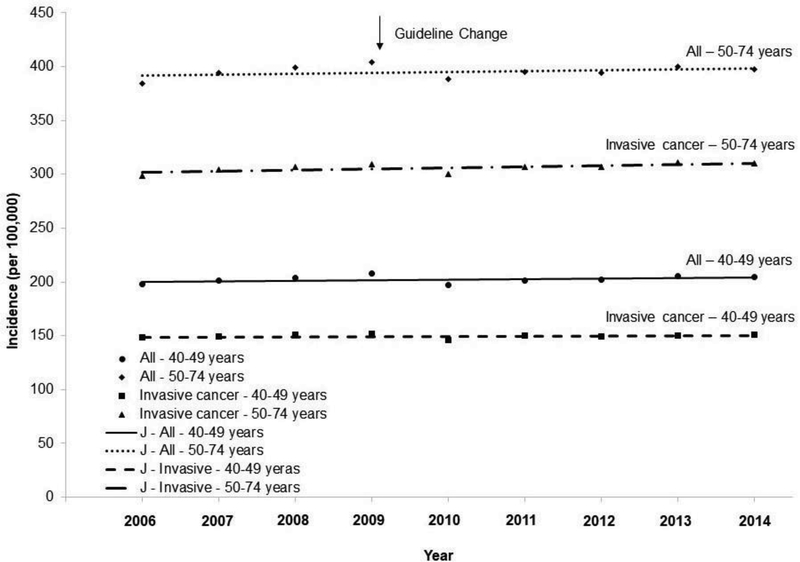
Trends in age-adjusted incidence rate of breast cancer among women aged 40–74 years, 2006–2014. Notes: Red arrow indicates screening guideline change in 2009 for breast cancer. Lines were joinpoint regression lines. Among women aged 40–49 years: All: 2006–2014 APC=0.2, 95% CI= –0.3, 0.7, p=0.30; Invasive: 2006–2014 APC=0.1, 95% CI= –0.2, 0.5, p=0.41. Among women aged 50–74 years: All: 2006–2014 APC=0.2, 95% CI= –0.2, 0.6, p=0.28; Invasive: 2006–2014 APC=0.3, 95% CI= 0, 0.7, p=0.043. J -, joinpoint regression line; APC, annual percentage changes;
Figure 2.
Figure 2.
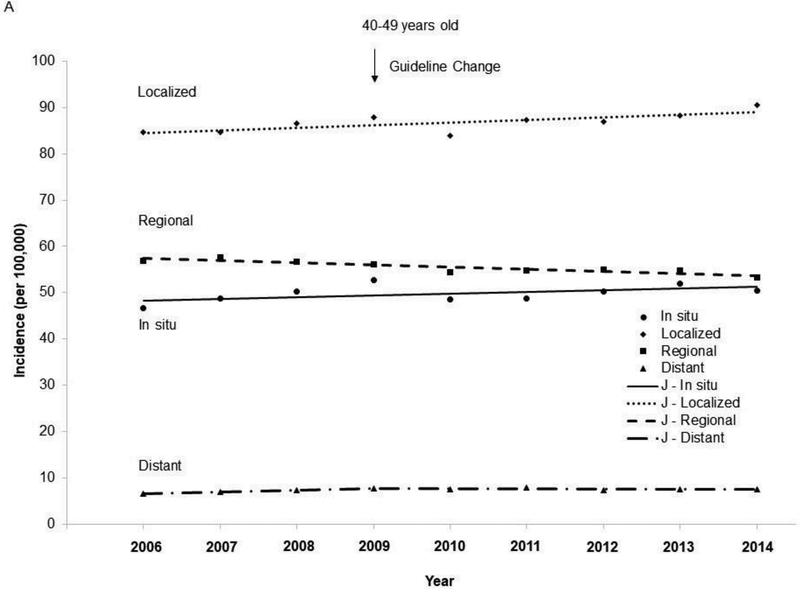
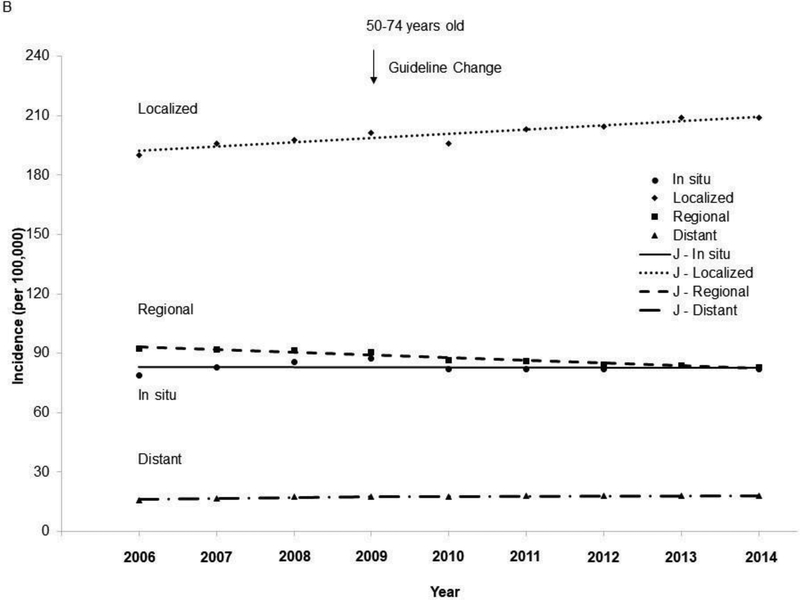
Trends in age-adjusted incidence rate of breast cancer by stage among women aged 40–74 years, 2006–2014. (A) Among women 40–49 years of age. (B) Among women 50–74 years of age. Notes: Red arrow indicates screening guideline change in 2009 for breast cancer. Lines were joinpoint regression lines. Among women aged 40–49 years: In situ: 2006–2014 APC=0.8, 95% CI= –0.3, 1.9, p=0.12; Localized: 2006–2014 APC=0.6, 95% CI=0.1, 1.2, p=0.026; Regional: 2006–2014 APC= –0.8, 95% CI= –1.2, –0.5, p<0.001; Distant: 2006–2009 APC=5.0, 95% CI= –0.2, 10.5, p=0.055; 2009–2014 APC= –0.4, 95% CI= –2.5, 1.7, p=0.63; 2006–2009 vs 2009– 2014, p=0.055. Among women aged 50–74 years: In situ: 2006–2014 APC=0.0, 95% CI= –0.9, 0.8, p=0.93; Localized: 2006–2014 APC=1.1, 95% CI=0.7, 1.5, p<0.001; Regional: 2006–2014 APC= –1.5, 95% CI= –1.9, –1.2, p<0.001; Distant: 2006–2009 APC=2.9, 95% CI=1.4, 4.45, p=0.006; 2009–2014 APC=0.5, 95% CI= –0.1, 1.1, p=0.085; 2006–2009 vs 2009–2014, p=0.015. J -, joinpoint regression line; APC, annual percentage changes.
Figure 2.
Figure 2.
Trends in age-adjusted incidence rate of breast cancer by stage among women aged 40–74 years, 2006–2014. (A) Among women 40–49 years of age. (B) Among women 50–74 years of age. Notes: Red arrow indicates screening guideline change in 2009 for breast cancer. Lines were joinpoint regression lines. Among women aged 40–49 years: In situ: 2006–2014 APC=0.8, 95% CI= –0.3, 1.9, p=0.12; Localized: 2006–2014 APC=0.6, 95% CI=0.1, 1.2, p=0.026; Regional: 2006–2014 APC= –0.8, 95% CI= –1.2, –0.5, p<0.001; Distant: 2006–2009 APC=5.0, 95% CI= –0.2, 10.5, p=0.055; 2009–2014 APC= –0.4, 95% CI= –2.5, 1.7, p=0.63; 2006–2009 vs 2009– 2014, p=0.055. Among women aged 50–74 years: In situ: 2006–2014 APC=0.0, 95% CI= –0.9, 0.8, p=0.93; Localized: 2006–2014 APC=1.1, 95% CI=0.7, 1.5, p<0.001; Regional: 2006–2014 APC= –1.5, 95% CI= –1.9, –1.2, p<0.001; Distant: 2006–2009 APC=2.9, 95% CI=1.4, 4.45, p=0.006; 2009–2014 APC=0.5, 95% CI= –0.1, 1.1, p=0.085; 2006–2009 vs 2009–2014, p=0.015. J -, joinpoint regression line; APC, annual percentage changes.

References

    1. DeSantis CE, Fedewa SA, Goding Sauer A, Kramer JL, Smith RA, Jemal A. Breast cancer statistics, 2015: convergence of incidence rates between black and white women. CA Cancer J Clin. 2016;66(1):31–42. 10.3322/caac.21320. - DOI - PubMed
    1. American Cancer Society. Breast Cancer Facts & Figures 2015–2016. Atlanta, GA: American Cancer Society, Inc; www.cancer.org/acs/groups/content/@research/documents/document/acspc-046.... Published 2015. Accessed on June 30, 2016.
    1. Siegel RL, Miller KD, Jemal A. Cancer Statistics, 2017. CA Cancer J Clin. 2017;67(1):7–30. 10.3322/caac.21387. - DOI - PubMed
    1. Shi R, Taylor H, McLarty J, Liu L, Mills G, Burton G. Effects of payer status on breast cancer survival: a retrospective study. BMC Cancer. 2015;15:211 10.1186/s12885-015-1228-7. - DOI - PMC - PubMed
    1. Sprague BL, Trentham-Dietz A, Gangnon RE, et al. Socioeconomic status and survival after an invasive breast cancer diagnosis. Cancer. 2011;117(7):1542–1551. 10.1002/cncr.25589. - DOI - PMC - PubMed

Publication types