Comparative in vitro study of the accuracy of impression techniques for dental implants: Direct technique with an elastomeric impression material versus intraoral scanner
- PMID: 30573714
- PMCID: PMC6344004
- DOI: 10.4317/medoral.22822
Comparative in vitro study of the accuracy of impression techniques for dental implants: Direct technique with an elastomeric impression material versus intraoral scanner
Abstract
Background: The aim of this study was to compare a conventional technique (elastomeric impression material - EIM) and a digital technique (scanner digital model - SDM) on a six-analog master model (MM) to determine which was the most exact.
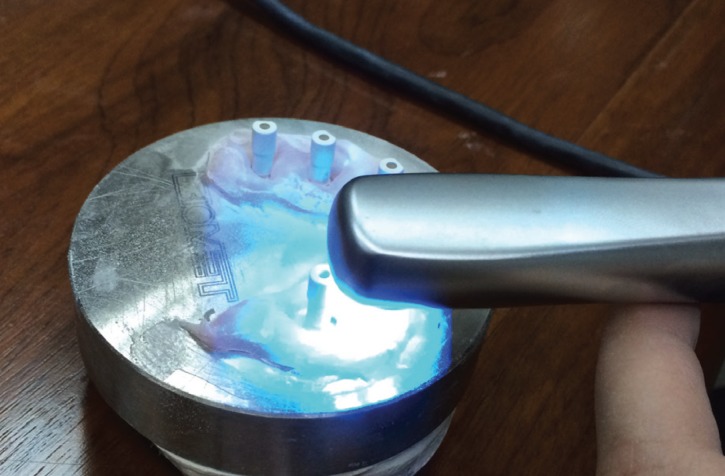
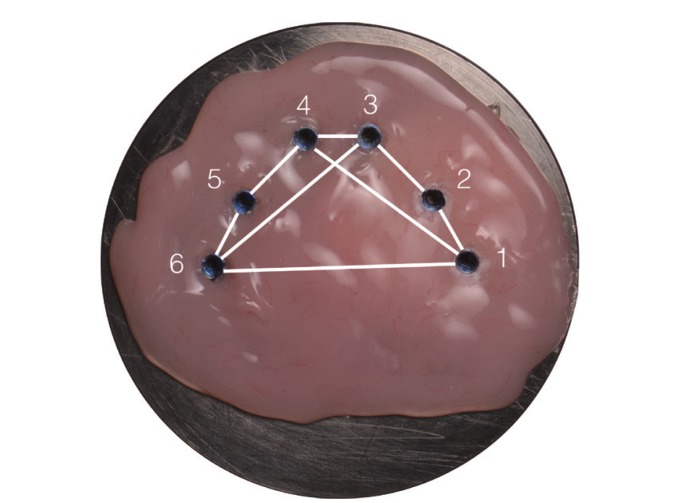
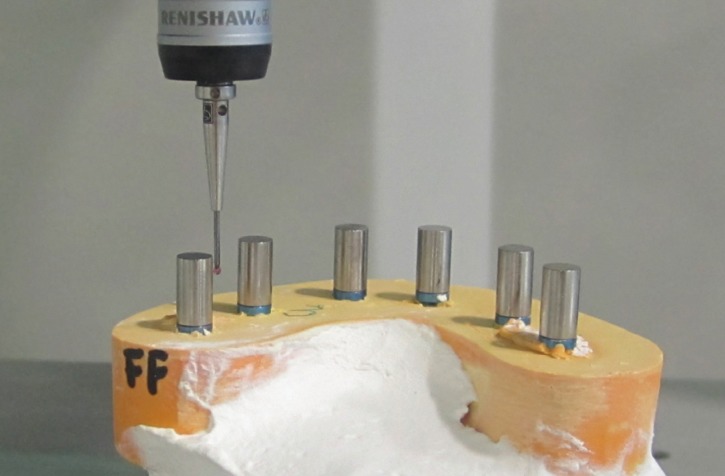
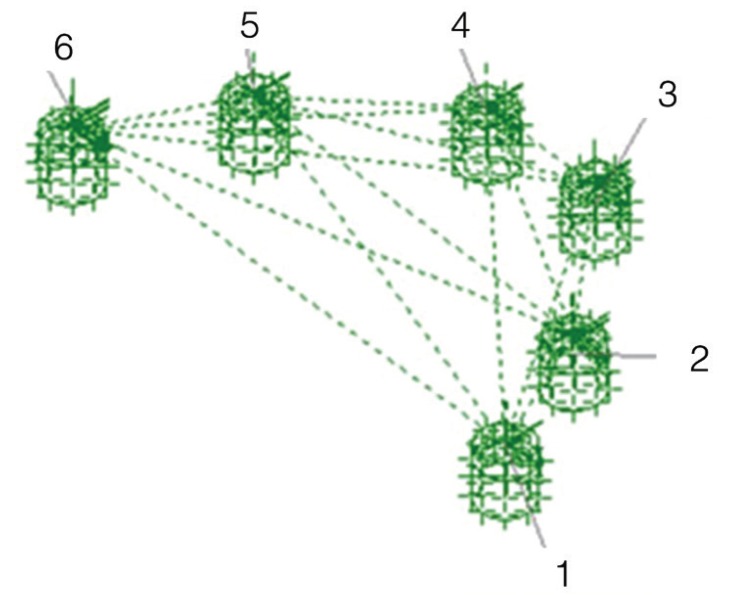
Material and methods: Twenty impressions were taken of a master model (EIM) and twenty scanned impressions (SDM) (True Definition). A coordinate measuring machine (CMM) was used to measure the distances between adjacent analogues (1-2, 2-3, 3-4, 4-5, 5-6), intermittently positioned analogues (1-4, 3-6) and the most distal (1-6). Reference values were established from the master model, which were compared with the two impression techniques. The significance level was established as 5% (p<0.05).
Results: The precision of each technique was compared with MM. For adjacent analogues (1-2), no significant differences were found between EIM-MM (p=0,146). For intermittently positioned analogues (1-4), SDM did not show significant differences with MM (p=0.255). For the distance between distal analogues (1-6), significant differences were found between both techniques and MM (p=0.001).
Conclusions: In a clinical situation with < three implants, EIM is more exact than SDM, but in cases of four implants SDM is more exact. For rehabilitations (> four implants), neither technique can be considered accurate although error falls within the tolerance limits established in the literature (30-150µm).
Conflict of interest statement
Figures
References
-
- Lee H, Ercoli C, Funkenbusch PD, Feng C. Effect of subgingival depth of implant placement on the dimensional accuracy of the implant impression: an in vitro study. J Prosthet Dent. 2008;99:107–13. - PubMed
-
- Lee H, So J, Hochstedler JL, Ercoli C. The accuracy of implant impressions: a systematic review. J Prosthet Dent. 2008;100:285–91. - PubMed
-
- De Vasconcellos D, Noriyuki A, Melo A, Bottino MA, Özcan M. A microstrain comparison of passively fitting screw-retained and cemented titanium frameworks. J Prosthet Dent. 2014;112:834–8. - PubMed
-
- Grosmann Y, Pasciuta M, Finger IM. A novel technique using a coded healing abutment for the fabrication of a CAD/CAM titanium abutment for an implant-supported restoration. J Prosthet Dent. 2006;95:258–61. - PubMed
-
- Güth JF, Keul C, Stimmelmayr M, Beuer F, Edelhoff D. Accuracy of digital models obtained by direct and indirect data capturing. Clin Oral Invest. 2013;7:1201–8. - PubMed
Publication types
MeSH terms
Substances
LinkOut - more resources
Full Text Sources