. 2019 Apr 11;25(5):875-885.
doi: 10.1093/ibd/izy386.

Murine Adherent and Invasive E. coli Induces Chronic Inflammation and Immune Responses in the Small and Large Intestines of Monoassociated IL-10-/- Mice Independent of Long Polar Fimbriae Adhesin A

Affiliations

Murine Adherent and Invasive E. coli Induces Chronic Inflammation and Immune Responses in the Small and Large Intestines of Monoassociated IL-10-/- Mice Independent of Long Polar Fimbriae Adhesin A

Julia M Schmitz et al. Inflamm Bowel Dis. .

Abstract

Background: Adherent and invasive Escherichia coli (AIEC) is preferentially associated with ileal Crohn's disease (CD). The role of AIEC in the development of inflammation and its regional tropism is unresolved. The presence of long polar fimbriae (LPF) in 71% of ileal CD AIEC suggests a role for LPF in the tropism and virulence of AIEC. The aim of our study is to determine if AIEC, with or without LpfA, induces intestinal inflammation in monoassociated IL-10-/- mice.

Methods: We compared murine AIEC strains NC101 (phylogroup B2, LpfA-) and CUMT8 (phylogroup B1, LpfA+), and isogenic mutant CUMT8 lacking lpfA154, with a non-AIEC (E. coli K12), evaluating histologic inflammation, bacterial colonization, mucosal adherence and invasion, and immune activation.

Results: IL-10-/- mice monoassociated with AIEC (either CUMT8, CUMT8:ΔlpfA, or NC101) but not K12 developed diffuse small intestinal and colonic inflammation. There was no difference in the magnitude and distribution of inflammation in mice colonized with CUMT8:ΔlpfA compared with wild-type CUMT8. Bacterial colonization was similar for all E. coli strains. Fluorescence in situ hybridization revealed mucosal adherence and tissue invasion by AIEC but not K12. Production of the cytokines IL-12/23 p40 by the intestinal tissue and IFN-γ and IL-17 by CD4 T cells correlated with inflammation.

Conclusions: IL-10-/- mice monoassociated with murine AIEC irrespective of LpfA expression developed chronic inflammation accompanied by IL-12/23 p40 production in the small and large intestines and IFN-γ/IL-17 production by CD4 T cells that model the interplay between enteric pathosymbionts, host susceptibility, and enhanced immune responses in people with IBD.

Keywords: T cells; adherent invasive E. coli; colitis; cytokines; ileitis.


Figures

FIGURE 1.
FIGURE 1.
Histological representation of small intestine and colon of IL-10-/- and 129S6/SvEv wild-type mice monoassociated with different strains of E. coli. Photomicrographs of H&E-stained swiss-rolled sections of the duodenum, jejunum, ileum, and colon from mice monoassociated with E. coli CUMT8, NC101, or K12 for 12 weeks. Note the marked crypt hyperplasia, goblet cell depletion, and lamina propria cellular infiltration in sections of CUMT8- and NC101-monoassociated IL-10-/- mice shown in (A, B, E, F, I, J, M, and N). Sections from wild-type mice monoassociated with CUMT8 are shown in (D, H, L, and P). Sections from NC101- and K12-monoassociated wild-type mice (not pictured) were very similar histologically to sections from CUMT8-monoassociated wild-type mice.
FIGURE 2.
FIGURE 2.
Histological scores of the small intestine and colon of IL-10-/- and 129S6/SvEv wild-type mice monoassociated with different strains of E. coli. Results show histological scores for sections of the duodenum (A), jejunum (B), ileum (C), and colon (D) from IL-10-/- and wild-type mice monoassociated for 12 weeks with CUMT8, NC101, or K12. Each point represents the score for an individual mouse (n = 8–16). Statistically significant differences in the histological inflammatory scores between IL-10-/- mice monoassociated with either CUMT8 or NC101 vs IL-10-/- mice monoassociated with K12 are indicated above each group. Statistically significant differences in the histological inflammatory scores between IL-10-/- and wild-type mice monoassociated with the same E. coli strains are indicated by asterisks as follows: *P < 0.05, **P < 0.01, and ***P < 0.001. Abbreviation: NS, not significant.
FIGURE 3.
FIGURE 3.
Fluorescence in situ hybridization for E. coli in the ileum of IL-10-/- mice. In the inflamed ileum of IL-10-/- mice, E. coli CUMT8 (A) and NC101 (B) were observed adhering to the epithelium, within the mucosa, and in luminal cellular debris. In contrast, K12 (C) was confined to acellular luminal debris on top of the mucus layer overlying the epithelium. Bacteria are red (Cy3), and nuclei/DNA are blue (DAPI).
FIGURE 4.
FIGURE 4.
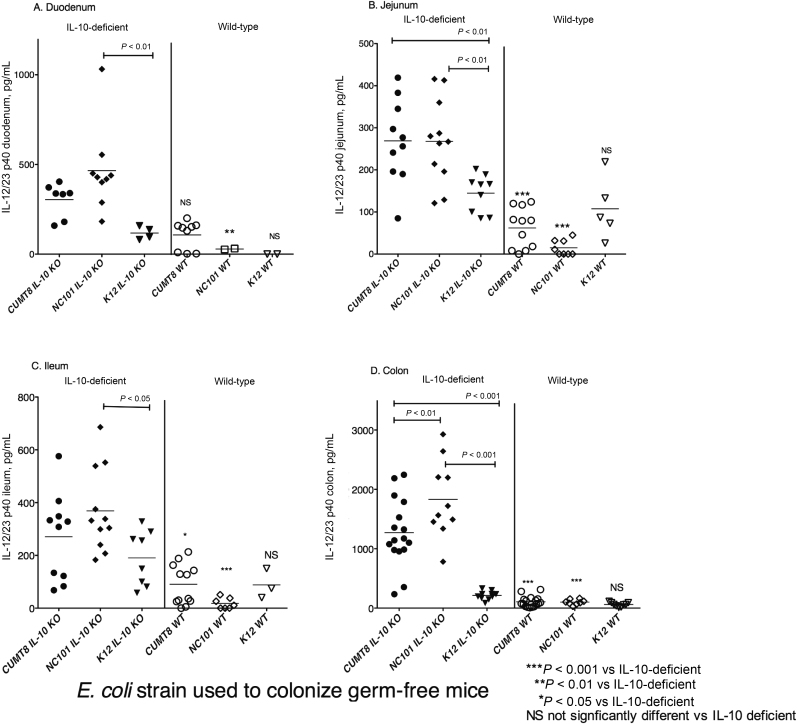
IL-12/23p40 in supernatants of small intestine and colon fragment cultures. Weighed fragments of the duodenum (A), jejunum (B), ileum (C), and colon (D) were cultured overnight, and the amount of IL-12/23p40 in supernatants was determined by ELISA. Each point represents the amount of IL-12/23 p40 in the supernatant of an individual culture. Statistically significant differences in the amounts of IL-12/23 p40 between IL-10-/- mice monoassociated with either CUMT8 or NC101 vs IL-10-/- mice monoassociated with K12 are indicated above each group. Statistically significant differences in the amounts of IL-12/23 p40 comparing IL-10-/- mice and wild-type mice monoassociated with the same E. coli strains are indicated by asterisks as follows: *P < 0.05, **P < 0.01, and ***P < 0.001. Abbreviation: NS, not significant.
FIGURE 5.
FIGURE 5.
IFN-γ and IL-17 in supernatants of CD4+ MLN cells stimulated with bacterial lysate–pulsed APC. CD4+ MLN cells were co-cultured with bacterial lysate–pulsed APCs for 72 hours. The bacteria used to pulse APCs were the same as the bacteria used to colonize the germ-free mice. The amounts of IFN-γ (A) and IL-17 (B) secreted into culture supernatants were measured by ELISA. Each point represents the amount of IFN-γ or IL-17 in the mean of the triplicate supernatants of CD4+ MLN cells from an individual mouse. Statistically significant differences in the amounts of IFN-γ and IL-17 between IL-10-/- mice monoassociated with either CUMT8 or NC101 vs IL-10-/- mice monoassociated with K12 are indicated above each group of values. Statistically significant differences in the amounts of IFN-γ and IL-17 between IL-10-/- mice and wild-type mice monoassociated with the same E. coli strain are indicated by asterisks ***P < 0.001. Abbreviation: NS, not significant.
FIGURE 6.
FIGURE 6.
Comparison between E. coli NC101 and K12 for in vitro activation of CD4+ MLN cells. CD4+ MLN cells from either E. coli NC101 (A and B)– or K12 (C and D)–monoassociated IL-10-/- mice were co-cultured with bacterial lysate–pulsed APCs for 72 hours. The E. coli lysate used to pulse APCs is identified below the x-axis. The amounts of IFN-γ (A and C) and IL-17 (B and D) secreted into culture supernatants were measured by ELISA. Each point represents the amount of IFN-γ or IL-17 in the mean of the triplicate supernatants of CD4+ MLN cells from an individual mouse. Points connected by lines indicate results for an individual mouse.

References

    1. Sartor RB, Wu GD.. Roles for intestinal bacteria, viruses, and fungi in pathogenesis of inflammatory bowel diseases and therapeutic approaches. Gastroenterology. 2017;152:327–339.e4. - PMC - PubMed
    1. Blander JM, Longman RS, Iliev ID, et al. Regulation of inflammation by microbiota interactions with the host. Nat Immunol. 2017;18:851–860. - PMC - PubMed
    1. Hall AB, Tolonen AC, Xavier RJ.. Human genetic variation and the gut microbiome in disease. Nat Rev Genet. 2017;18:690–699. - PubMed
    1. Khor B, Gardet A, Xavier RJ.. Genetics and pathogenesis of inflammatory bowel disease. Nature. 2011;474:307–317. - PMC - PubMed
    1. Abraham C, Medzhitov R.. Interactions between the host innate immune system and microbes in inflammatory bowel disease. Gastroenterology. 2011;140:1729–1737. - PMC - PubMed

Publication types

MeSH terms