


Multiplex SYBR Green and duplex TaqMan real-time PCR assays for the detection of Photorhabdus Insect-Related (Pir) toxin genes pirA and pirB
- PMID: 30576786
- PMCID: PMC7127373
- DOI: 10.1016/j.mcp.2018.12.004
Multiplex SYBR Green and duplex TaqMan real-time PCR assays for the detection of Photorhabdus Insect-Related (Pir) toxin genes pirA and pirB
Abstract
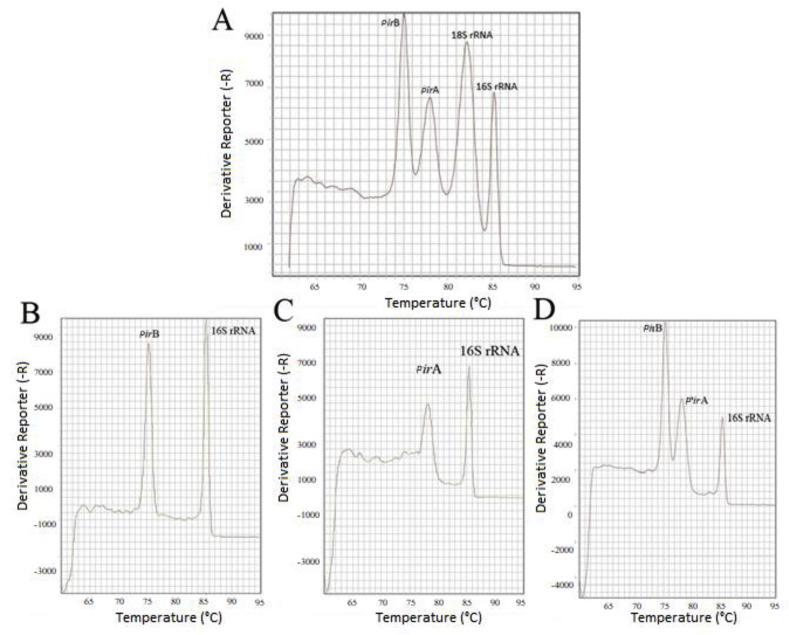
Acute hepatopancreatic necrosis disease (AHPND), also known as Early mortality syndrome (EMS), is a recently emerged lethal disease that has caused major economic losses in shrimp aquaculture. The etiologic agents are Vibrio spp. that carry Photorhabdus Insect-Related (Pir) toxin genes pirA and pirB. A multiplex SYBR Green real-time PCR was developed that detects pirA, pirB, and two internal control genes, the shrimp 18S rRNA and the bacterial 16S rRNA genes in a single reaction. The pirB primers amplify the 3'-end of the pirB gene allowing the detection of Vibrio spp. mutants that contain a complete deletion of pirA and the partial deletion of pirB. The assay also detects mutants that contain the entire pirA gene and the deletion of the pirB gene. Since both toxin genes are needed for disease development, this assays can distinguish between pathogenic strains of Vibrio spp. that cause AHPND in shrimp and mutants that do not cause disease. The amplicons for pirA, pirB, 18S rRNA and 16S rRNA showed easily distinguishable melting temperatures of 78.21 ± 0.18, 75.20 ± 0.20, 82.28 ± 0.34 and 85.41 ± 0.21 °C respectively. Additionally, a duplex real-time PCR assay was carried out by designing TaqMan probes for the pirA and pirB primers. The diagnostic sensitivity and specificity was compared between the SYBR Green and TaqMan assays. Both assays showed similar sensitivity with a limit of detection being 10 copies for pirA and pirB, and neither assays showed any cross reaction with other known bacterial and viral pathogens in shrimp. The high sensitivity of both assays make them suitable for the detection of low copies of the pirA and pirB genes in AHPND causing Vibrio spp. as well as for detecting non-pathogenic mutants.
Keywords: Acute hepatopancreatic necrosis disease; Early mortality syndrome; Multiplex real-time PCR; Pathogen detection; SYBR Green; TaqMan.
Copyright © 2018. Published by Elsevier Ltd.
Conflict of interest statement
Authors' contributions
Roberto Cruz-Flores, Hung Nam Mai, Arun K. Dhar designed the experiments. Roberto Cruz-Flores wrote the manuscript, designed the primers and optimized the conditions of the multiplex SYBR Green real-time PCR and the duplex TaqMan real-time PCR. Roberto Cruz-Flores and Hung Nam Mai prepared the DNA samples. Hung Nam Mai prepared, maintained and extracted DNA from the axenic cultures of the different
Figures




References
-
- Lee C., Chen I., Yang Y., Ko T., Huang Y., Huang J., Huang M., Lin S., Chen C., Lin S., Donald V., Wang H., Wang A.H., Wang H., Hor L., Lo C. Correction for Lee et al., the opportunistic marine pathogen Vibrio parahaemolyticus becomes virulent by acquiring a plasmid that expresses a deadly toxin. Proc. Natl. Acad. Sci. Unit. States Am. 2015;112 doi: 10.1073/pnas.1517100112. E5445–E5445. - DOI - PMC - PubMed
-
- Han J.E., Tang K.F.J., Aranguren L.F., Piamsomboon P. Characterization and pathogenicity of acute hepatopancreatic necrosis disease natural mutants, pirABvp(‐) V. parahaemolyticus, and pirABvp(+) V. campbellii strains. Aquaculture. 2017;470:84–90. doi: 10.1016/j.aquaculture.2016.12.022. - DOI
-
- FAO Report of the FAO/MARD technical workshop on early mortality syndrome (EMS) or acute hepatopancreatic necrosis syndrome (AHPNS) of cultured shrimp (under TCP/VIE/3304), FAO fish. Aquac. Rep. 2013;1053:1–52.
Publication types
MeSH terms
Substances
LinkOut - more resources
Full Text Sources
Miscellaneous
