


sRNA-FISH: versatile fluorescent in situ detection of small RNAs in plants
- PMID: 30577085
- PMCID: PMC6465150
- DOI: 10.1111/tpj.14210
sRNA-FISH: versatile fluorescent in situ detection of small RNAs in plants
Abstract
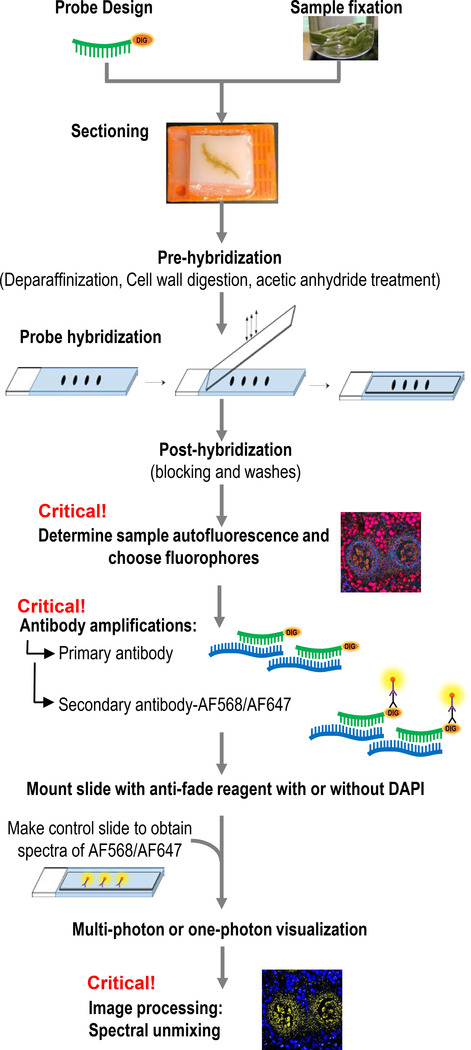
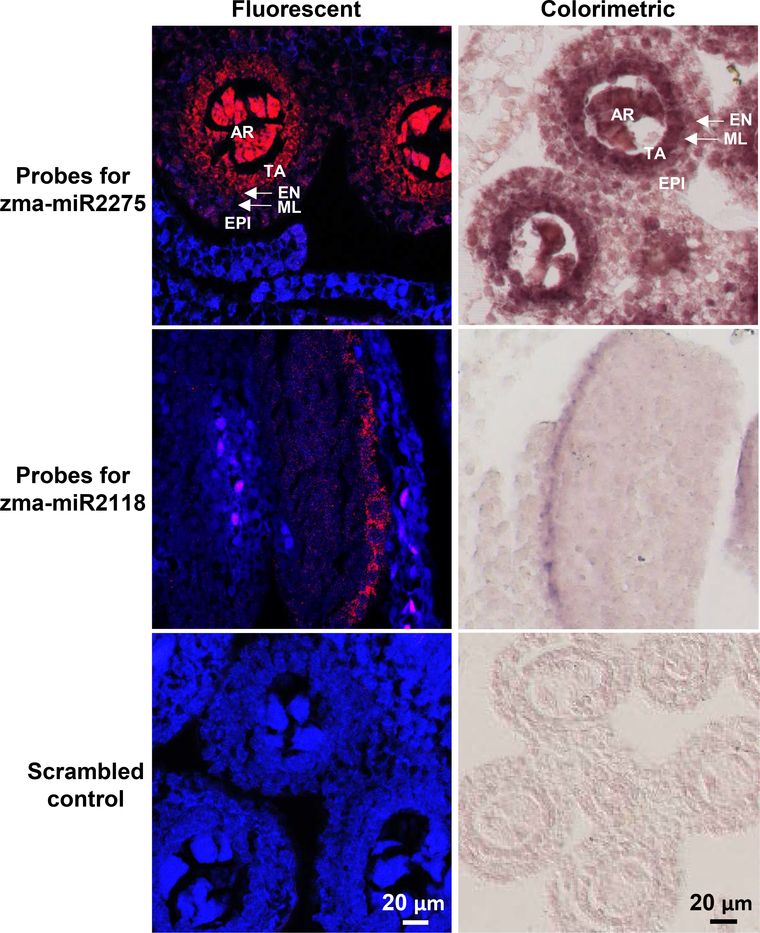
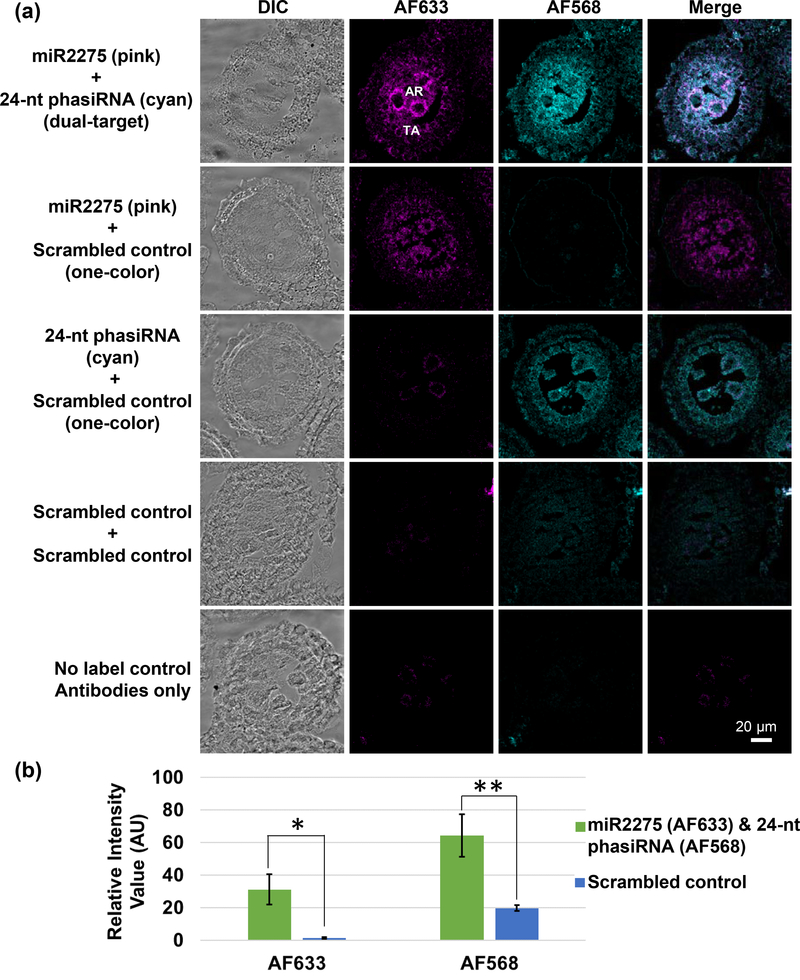
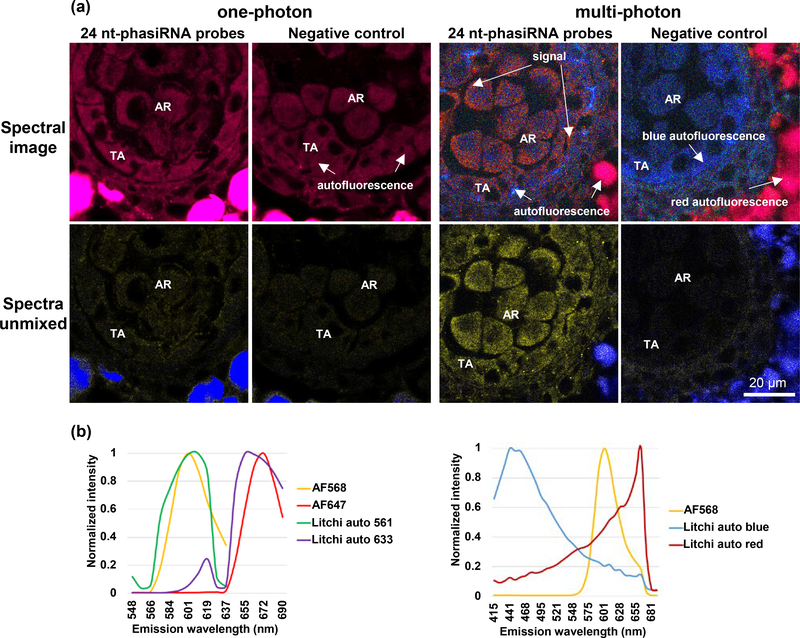
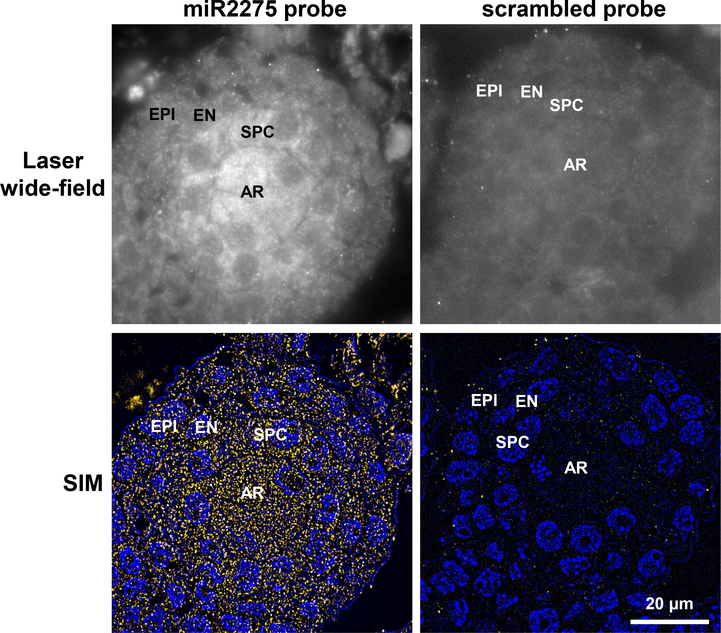
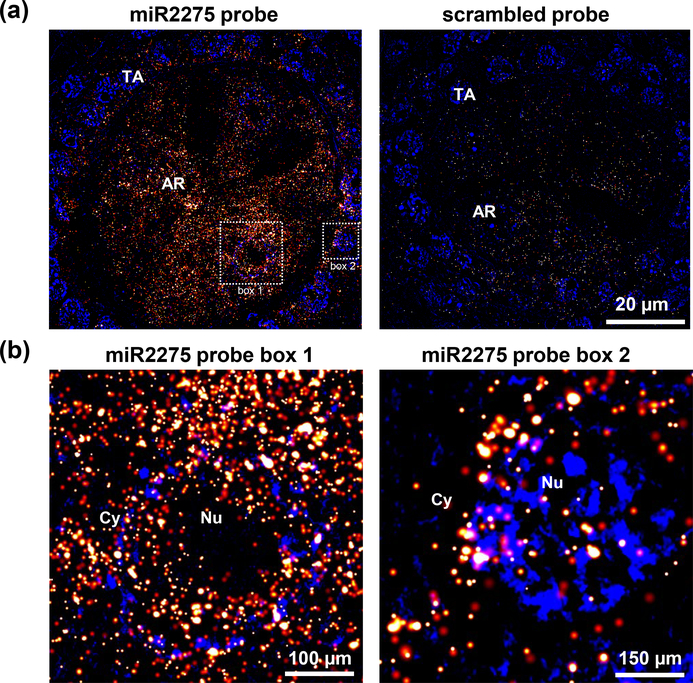
Localization of mRNA and small RNAs (sRNAs) is important for understanding their function. Fluorescent in situ hybridization (FISH) has been used extensively in animal systems to study the localization and expression of sRNAs. However, current methods for fluorescent in situ detection of sRNA in plant tissues are less developed. Here we report a protocol (sRNA-FISH) for efficient fluorescent detection of sRNAs in plants. This protocol is suitable for application in diverse plant species and tissue types. The use of locked nucleic acid probes and antibodies conjugated with different fluorophores allows the detection of two sRNAs in the same sample. Using this method, we have successfully detected the co-localization of miR2275 and a 24-nucleotide phased small interfering RNA in maize anther tapetal and archesporial cells. We describe how to overcome the common problem of the wide range of autofluorescence in embedded plant tissue using linear spectral unmixing on a laser scanning confocal microscope. For highly autofluorescent samples, we show that multi-photon fluorescence excitation microscopy can be used to separate the target sRNA-FISH signal from background autofluorescence. In contrast to colorimetric in situ hybridization, sRNA-FISH signals can be imaged using super-resolution microscopy to examine the subcellular localization of sRNAs. We detected maize miR2275 by super-resolution structured illumination microscopy and direct stochastic optical reconstruction microscopy. In this study, we describe how we overcame the challenges of adapting FISH for imaging in plant tissue and provide a step-by-step sRNA-FISH protocol for studying sRNAs at the cellular and even subcellular level.
Keywords: Litchi chinensis; Oryza sativa; Zea mays; sRNA; LNA probes; fluorescent in situ hybridization; immunofluorescence; microRNA; multi-photon microscopy; technical advance.
© 2018 The Authors The Plant Journal © 2018 John Wiley & Sons Ltd.
Conflict of interest statement
CONFLICTS OF INTEREST
The authors declare no conflicts of interest.
Figures
References
-
- Barroso-Chinea P, Aymerich MS, Castle MM, Perez-Manso M, Tunon T, Erro E and Lanciego JL (2007) Detection of two different mRNAs in a single section by dual in situ hybridization: a comparison between colorimetric and fluorescent detection. J Neurosci Meth, 162, 119–128. - PubMed
-
- Beliveau BJ, Boettiger AN, Avendano MS, Jungmann R, McCole RB, Joyce EF, Kim-Kiselak C, Bantignies F, Fonseka CY, Erceg J, Hannan MA, Hoang HG, Colognori D, Lee JT, Shih WM, Yin P, Zhuang X and Wu CT (2015) Single-molecule super-resolution imaging of chromosomes and in situ haplotype visualization using Oligopaint FISH probes. Nat Commun, 6, 7147. - PMC - PubMed
-
- Berezikov E (2011) Evolution of microRNA diversity and regulation in animals. Nat Rev Gen, 12, 846–860. - PubMed
-
- Clay H and Ramakrishnan L (2005) Multiplex fluorescent in situ hybridization in zebrafish embryos using tyramide signal amplification. Zebrafish, 2, 105–111. - PubMed
