. 2018 Dec 21;8(1):14.
doi: 10.3390/jcm8010014.

Effects of Corticosteroid Treatment and Antigen Avoidance in a Large Hypersensitivity Pneumonitis Cohort: A Single-Centre Cohort Study

Affiliations

Effects of Corticosteroid Treatment and Antigen Avoidance in a Large Hypersensitivity Pneumonitis Cohort: A Single-Centre Cohort Study

Laurens J De Sadeleer et al. J Clin Med. .

Abstract

Background: Although the third most frequent interstitial lung disease, hypersensitivity pneumonitis (HP) remains an enigmatic disease without clear diagnostic and therapeutic guidelines. We assessed the effect of the commonly used therapeutic interventions (i.e. exposure avoidance and corticosteroid treatment) in an HP cohort.

Methods: We collected clinical data of all HP patients followed at our centre between January 1, 2005, and December 31, 2016. HP patients were stratified according to the presence of fibrosis on chest CT. Survival was analysed using the multivariate Cox proportional hazards model. Forced vital capacity (percent predicted, FVC%) and diffusing capacity of the lung for carbon monoxide (percent predicted, DLCO%) evolution were analysed using linear mixed-effect models.

Results: Two hundred and two HP patients were identified: 93 non-fibrotic HP (nfHP) and 109 fibrotic HP (fHP), experiencing a monthly FVC% decline before treatment of 0.93% and 0.56%, respectively. While nfHP had an excellent survival, fHP patients experienced a median survival of 9.2 years. Corticosteroid treatment and exposure avoidance did not result in survival differences. Although nfHP patients showed FVC% and DLCO% increase after corticosteroid initiation, no therapeutic effect was seen in fHP patients. FVC% and DLCO% increased in nfHP patients after exposure avoidance, while a positive numerical trend was seen for FVC% after exposure avoidance in fHP patients (p = 0.15).

Conclusions: nfHP patients experienced an excellent survival with good therapeutic effect on pulmonary function tests with both corticosteroid initiation as well as antigen avoidance. In contrast, fHP patients experienced a dismal prognosis (median survival of 9.2 years) without any therapeutic effect of corticosteroid treatment. Whether antigen avoidance is useful in fHP patients is still unclear.

Keywords: hypersensitivity pneumonitis; mixed models; treatment.


Conflict of interest statement

De Sadeleer reports non-financial support from Roche and Boehringer-Ingelheim, outside the submitted work. Wuyts reports grants from Roche, grants from Boehringer-Ingelheim, grants from fund scientific research Flanders, grants from National institute of Health, all paid to the institution (University Hospitals Leuven), outside the submitted work. Hermans, De Dycker, Yserbyt, Verschakelen, Verbeken, and Verleden have nothing to disclose.

Figures
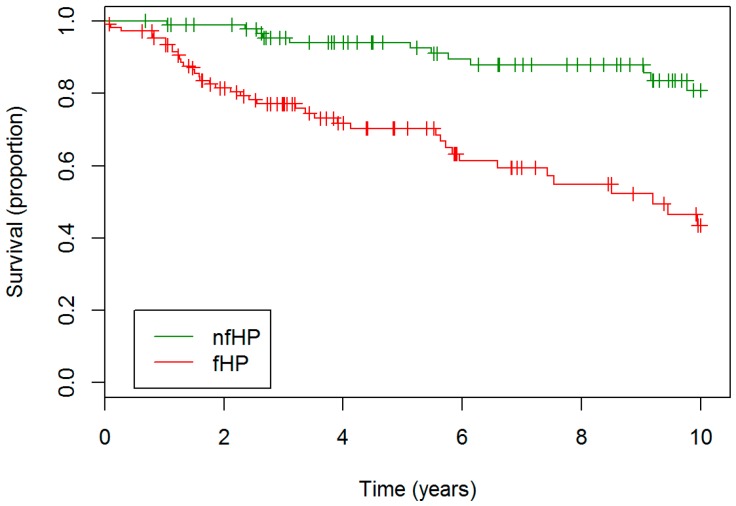
Figure 1
Figure 1
Survival nfHP and fHP patients. fHP patients experienced a worse outcome compared to nfHP patients. Definition of abbreviation: nfHP, non-fibrotic hypersensitivity pneumonitis, fHP, fibrotic chronic hypersensitivity pneumonitis
Figure 2
Figure 2
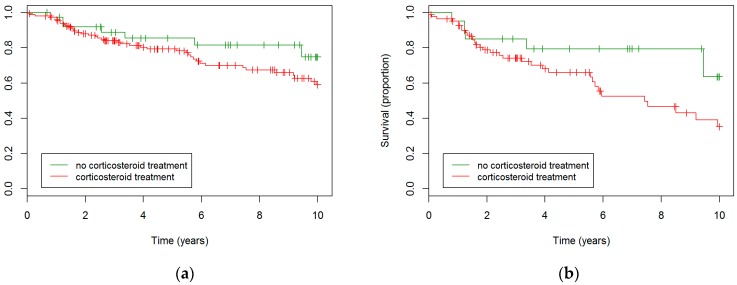
Survival in corticosteroid-treated patients compared to never-treated patients. (a) Kaplan Meier based on the entire cohort. No statistically significant differences were observed. (b) Kaplan Meier based on the fHP subgroup. A trend towards worse survival in the treated group was observed (p = 0.096).
Figure 3
Figure 3
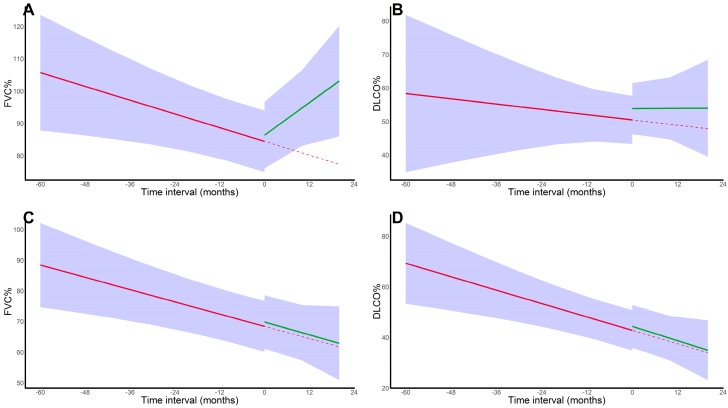
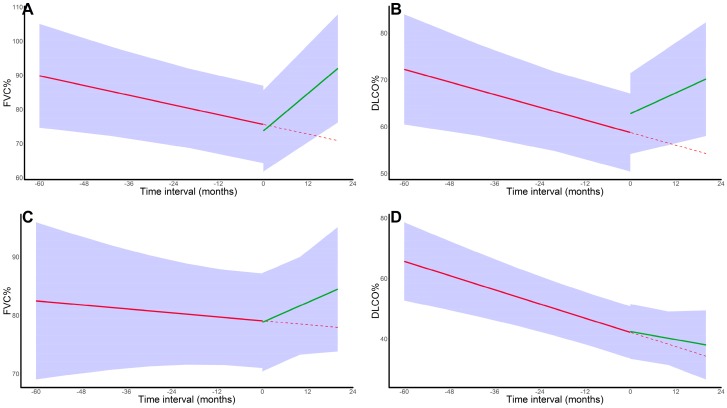
Pulmonary function test evolution in corticosteroid-treated patients. (A). FVC% trajectory in nfHP patients; (B). DLCO% trajectory in nfHP patients; (C). FVC% trajectory in fHP patients; (D). DLCO% trajectory in fHP patients. For FVC%, a positive effect of corticosteroid initiation was seen in nfHP, whereas this effect was absent in the fHP group. For DLCO%, no impact on decline was observed however, nfHP patients experienced an immediate numerical increase in DLCO% after treatment initiation. The solid red line represents the mixed effect model estimates before corticosteroid initiation, the solid green line represents the mixed effect model estimates after corticosteroid initiation and the dotted red line represents the pre-treatment trend. Subject was corrected for as a random effect, both with random intercept and (independent) random slope. Fixed effects were time, age, gender, ever smoker status, and immunosuppression use. Definition of abbreviation: nfHP, non-fibrotic hypersensitivity pneumonitis; fHP, fibrotic chronic hypersensitivity pneumonitis.
Figure 4
Figure 4
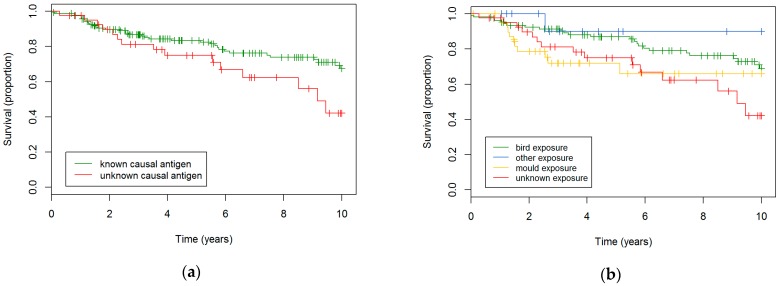
Survival in HP patients according to exposure. (a) Survival in HP patients with known and unknown antigen A trend towards worse survival in the patient group with unknown antigen was observed (HR 1.8, p = 0.056), which became statistically significant after multivariate correction (HR 1.8, p = 0.045). (b) Survival in HP patients based on exposure type. Bird exposure resulted in a better survival: vs. mould exposure (HR 2.0, p = 0.057); unknown exposure (HR 2.1, p = 0.029).
Figure 5
Figure 5
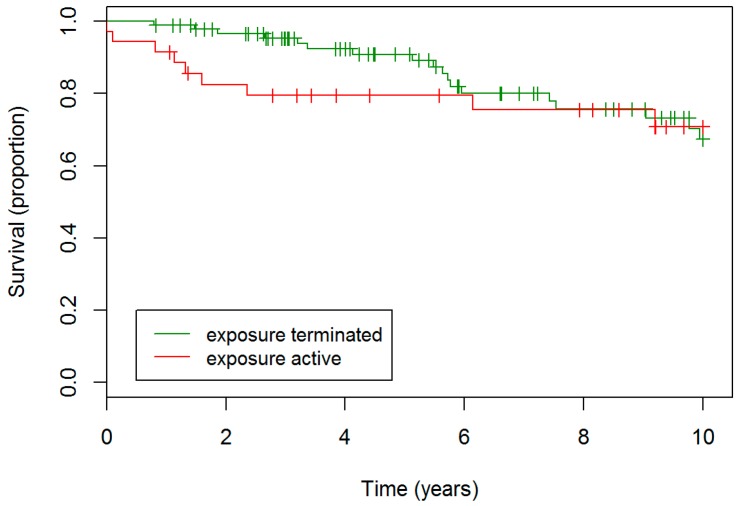
Survival in HP patients based on active exposure throughout follow-up. No significant differences were observed
Figure 6
Figure 6
Pulmonary function test evolution in patients who terminated the exposure. (A). FVC% trajectory in nfHP patients; (B). DLCO% trajectory in nfHP patients; (C). FVC% trajectory in fHP patients; (D). DLCO% trajectory in fHP patients. nfHP patients experienced both an FVC% and DLCO% increase after exposure avoidance. fHP patients experienced a non-significant trend towards FVC% increase after exposure avoidance (p = 0.15). The solid red line represents the mixed effect model estimates before exposure termination, the solid green line represents the mixed effect model estimates after exposure termination and the dotted red line represents the pre-treatment trend. Subject was corrected for as a random effect, both with random intercept and (independent) random slope. Fixed effects were time, age, gender, ever smoker status, and immunosuppression use. Definition of abbreviation: nfHP, non-fibrotic hypersensitivity pneumonitis; fHP, fibrotic chronic hypersensitivity pneumonitis.

References

    1. Solaymani-Dodaran M., West J., Smith C., Hubbard R. Extrinsic allergic alveolitis: Incidence and mortality in the general population. QJM. 2007;100:233–237. doi: 10.1093/qjmed/hcm008. - DOI - PubMed
    1. Costabel U., Bonella F., Guzman J. Chronic Hypersensitivity Pneumonitis. Clin. Chest Med. 2012;33:151–163. doi: 10.1016/j.ccm.2011.12.004. - DOI - PubMed
    1. Lacasse Y., Girard M., Cormier Y. Recent advances in hypersensitivity pneumonitis. Chest. 2012;142:208–217. doi: 10.1378/chest.11-2479. - DOI - PubMed
    1. Mönkäre S. Influence of corticosteroid treatment on the course of farmer’s lung. Eur. J. Respir. Dis. 1983;64:283–293. - PubMed
    1. Kokkarinen J.I., Tukiainen H.O., Terho E.O. Effect of corticosteroid treatment on the recovery of pulmonary function in farmer’s lung. Am. Rev. Respir. Dis. 1992;145:3–5. doi: 10.1164/ajrccm/145.1.3. - DOI - PubMed