


Guiding intensive care physicians' communication and behavior towards bereaved relatives: study protocol for a cluster randomized controlled trial (COSMIC-EOL)
- PMID: 30577862
- PMCID: PMC6303988
- DOI: 10.1186/s13063-018-3084-7
Guiding intensive care physicians' communication and behavior towards bereaved relatives: study protocol for a cluster randomized controlled trial (COSMIC-EOL)
Abstract
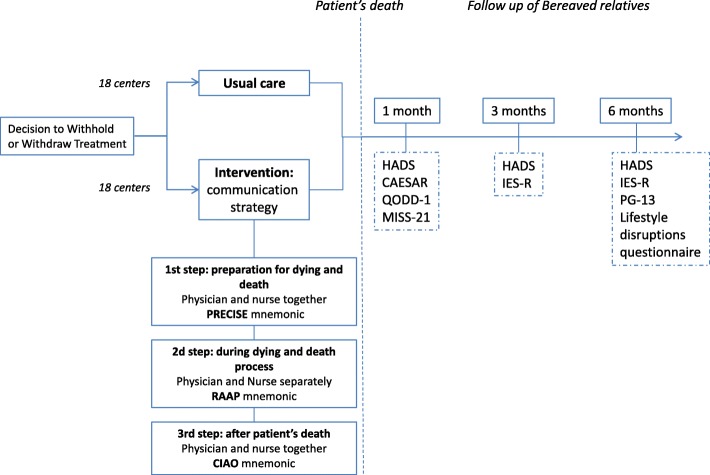
Background: Providing appropriate support and care for end-of-life patients and their relatives is a major concern and a daily responsibility for intensivists. Bereaved relatives of non-surviving patients in intensive care units (ICUs) often suffer from prolonged grief, posttraumatic stress disorder, anxiety, and depression. A physician-driven intervention, consisting of three meetings with the family, might reduce the post-ICU burden of bereaved family members 6 month after death. The patient's nurse is actively involved at each step. We hypothesize that this strategy will improve communication in the end-of-life setting and thus, should reduce the post-ICU burden for family members, specifically the development of prolonged grief 6 months after the death.
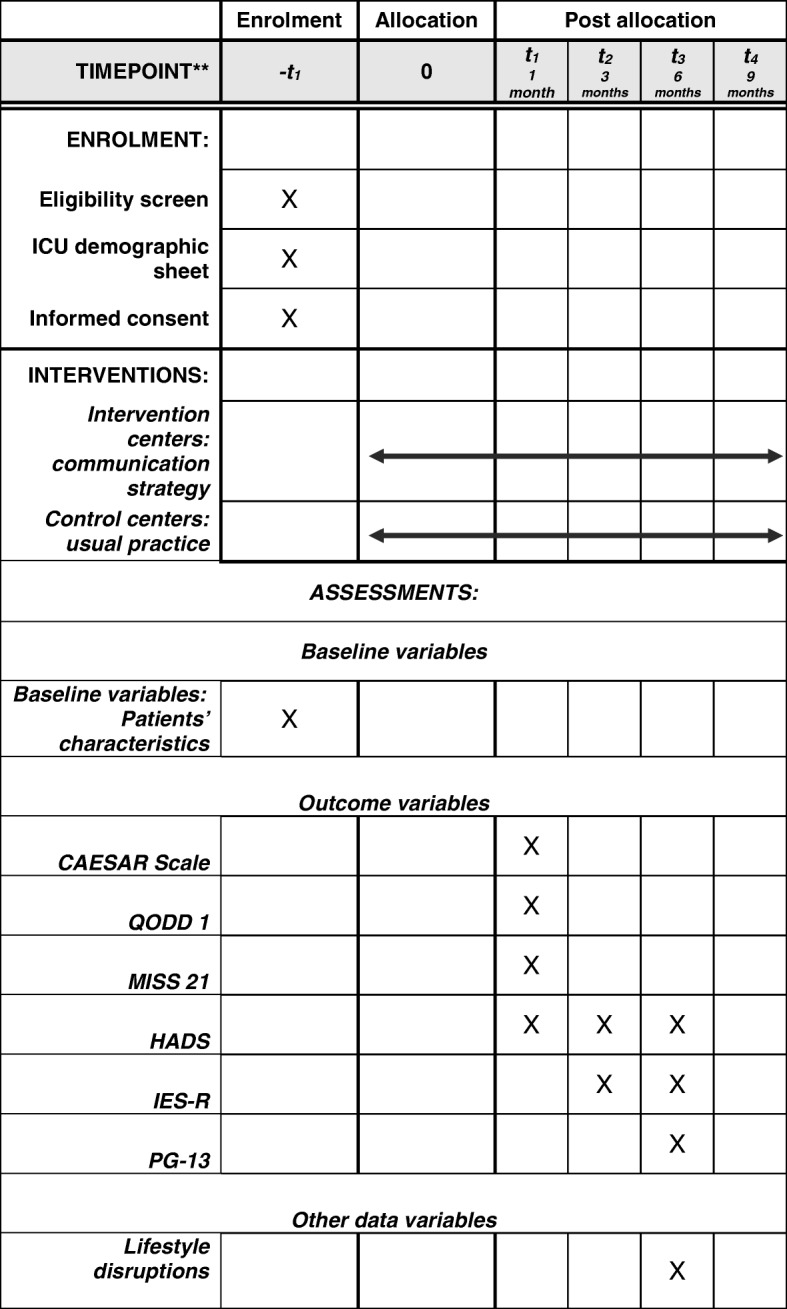
Methods/design: The COSMIC-EOL trial is a prospective, multicenter, cluster randomized controlled trial in which centers are allocated to two parallel arms: (1) intervention centers where relatives benefit from three-step physician-driven support during the dying and death process and (2) control centers where, during the dying and death process, relatives receive the standard of care practice. Each of the 36 participating centers will include 25 relatives of patients with a length of stay ≥2 days. Participating relatives will be followed up by phone at 1, 3, and 6 months after the patient's death to complete questionnaires permitting evaluation of their post-ICU burden. The main outcome is prolonged grief measured 6 months after the death using the PG-13. Other outcomes include evaluation of quality of dying, quality of communication, anxiety, depression, and post-traumatic stress. The estimated duration of the study is 36 months.
Discussion: The results of the trial will provide information about the effectiveness of physician-driven support for relatives of patients dying in an ICU. The study is expected to demonstrate a decrease in the ICU burden for bereaved relatives who benefitted from this intervention.
Trial registration: ClinicalTrials.gov, NCT02955992 . Registered on November 3rd 2016.
Keywords: Communication; End-of-life; Intensive care; Palliative care.
Conflict of interest statement
Ethics approval and consent to participate
The study was approved by our local institutional review board (Comité de protection des personnes, Ile de France IV, Saint Louis; number 2016/13), Commission Nationale de l’Informatique et des Libertés (which is responsible for ensuring that data privacy law is applied to the collection, storage, and use of personal data; number MMS/ABD/AR1611499), and Comité Consultatif sur les Traitements de l’Information en matière de Recherche dans le domaine de la Santé (number 16–315). All participating relatives signed an informed consent form.
Consent for publication
Not applicable.
Competing interests
The authors declare that they have no competing interests.
Publisher’s Note
Springer Nature remains neutral with regard to jurisdictional claims in published maps and institutional affiliations.
Figures
References
Publication types
MeSH terms
Associated data
Grants and funding
LinkOut - more resources
Full Text Sources
Medical
