. 2019 Feb:20:51-62.
doi: 10.1016/j.molmet.2018.12.001. Epub 2018 Dec 5.

Optimized GIP analogs promote body weight lowering in mice through GIPR agonism not antagonism

Affiliations

Optimized GIP analogs promote body weight lowering in mice through GIPR agonism not antagonism

Piotr A Mroz et al. Mol Metab. 2019 Feb.

Abstract

Objective: Structurally-improved GIP analogs were developed to determine precisely whether GIP receptor (GIPR) agonism or antagonism lowers body weight in obese mice.

Methods: A series of peptide-based GIP analogs, including structurally diverse agonists and a long-acting antagonist, were generated and characterized in vitro using functional assays in cell systems overexpressing human and mouse derived receptors. These analogs were characterized in vivo in DIO mice following acute dosing for effects on glycemic control, and following chronic dosing for effects on body weight and food intake. Pair-feeding studies and indirect calorimetry were used to survey the mechanism for body weight lowering. Congenital Gipr-/- and Glp1r-/- DIO mice were used to investigate the selectivity of the agonists and to ascribe the pharmacology to effects mediated by the GIPR.

Results: Non-acylated, Aib2 substituted analogs derived from human GIP sequence showed full in vitro potency at human GIPR and subtly reduced in vitro potency at mouse GIPR without cross-reactivity at GLP-1R. These GIPR agonists lowered acute blood glucose in wild-type and Glp1r-/- mice, and this effect was absent in Gipr-/- mice, which confirmed selectivity towards GIPR. Chronic treatment of DIO mice resulted in modest yet consistent, dose-dependent decreased body weight across many studies with diverse analogs. The mechanism for body weight lowering is due to reductions in food intake, not energy expenditure, as suggested by pair-feeding studies and indirect calorimetry assessment. The weight lowering effect was preserved in DIO Glp-1r-/- mice and absent in DIO Gipr-/- mice. The body weight lowering efficacy of GIPR agonists was enhanced with analogs that exhibit higher mouse GIPR potency, with increased frequency of administration, and with fatty-acylated peptides of extended duration of action. Additionally, a fatty-acylated, N-terminally truncated GIP analog was shown to have high in vitro antagonism potency for human and mouse GIPR without cross-reactive activity at mouse GLP-1R or mouse glucagon receptor (GcgR). This acylated antagonist sufficiently inhibited the acute effects of GIP to improve glucose tolerance in DIO mice. Chronic treatment of DIO mice with high doses of this acylated GIPR antagonist did not result in body weight change. Further, co-treatment of this acylated GIPR antagonist with liraglutide, an acylated GLP-1R agonist, to DIO mice did not result in increased body weight lowering relative to liraglutide-treated mice. Enhanced body weight lowering in DIO mice was evident however following co-treatment of long-acting selective individual agonists for GLP-1R and GIPR, consistent with previous data.

Conclusions: We conclude that peptide-based GIPR agonists, not peptide-based GIPR antagonists, that are suitably optimized for receptor selectivity, cross-species activity, and duration of action consistently lower body weight in DIO mice, although with moderate efficacy relative to GLP-1R agonists. These preclinical rodent pharmacology results, in accordance with recent clinical results, provide definitive proof that systemic GIPR agonism, not antagonism, is beneficial for body weight loss.

Keywords: Agonism; Diet-induced obese (DIO) mice; Glucose-dependent insulinotropic polypeptide (GIP); Obesity; Pharmacology.


Figures

Figure 1
Figure 1
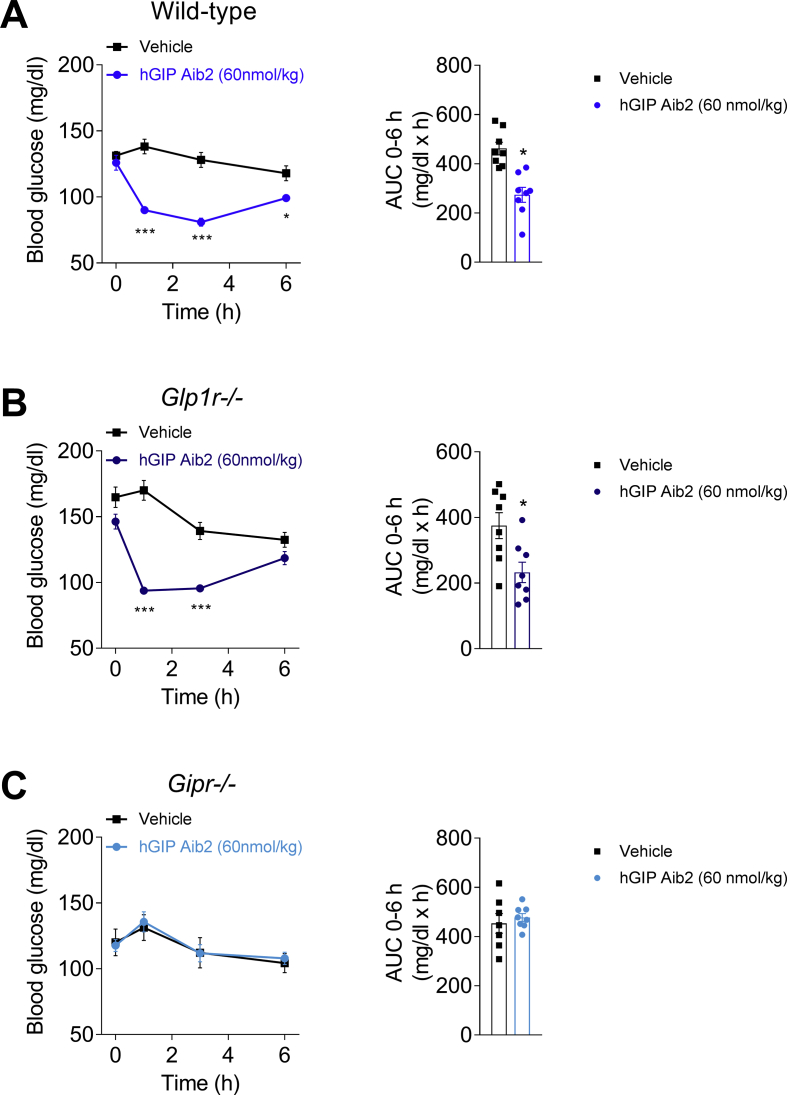
Acute blood glucose effects of GIPR agonism in mice. Effects on blood glucose over 2 h and AUC following a single injection of vehicle or hGIP Aib2 at 60 nmol/kg in lean (A) wild-type mice (blue circles), (B) Glp1r−/− mice (dark blue circles), and (C) Gipr−/− mice (light blue circles). Animals (N = 8) were fasted for 2 h prior to a subcutaneous injection of hGIP Aib2. AUC was calculated based on the change in blood glucose from time point t = 0 within each group. Data are presented as mean ± SEM. *P < 0.05 compared with vehicle treated controls within each genotype and calculated using regular one-way or two-way ANOVA with Dunnett's multiple comparisons test.
Figure 2
Figure 2
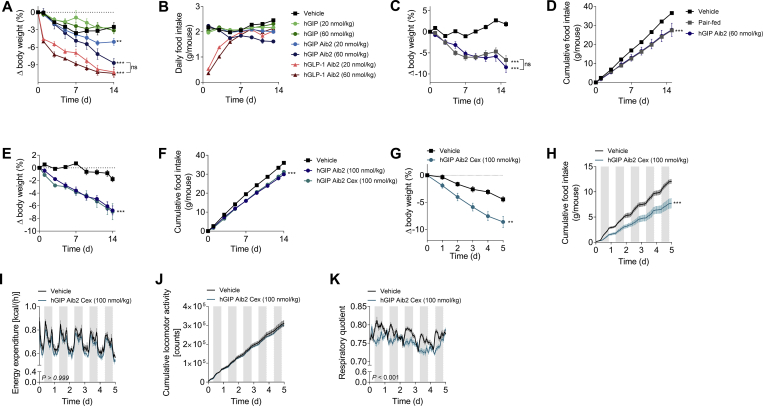
GIPR agonism lowers body weight by food intake mechanisms in DIO mice. Effects in DIO mice (baseline body weight of 54.8 g) on (A) body weight change and (B) cumulative food intake following daily subcutaneous injections of vehicle (black squares), native hGIP (green circles), hGIP Aib2 (blue circles), and GLP-1 Aib2 Cex (red circles) at doses of 20 nmol/kg (light shading) or 60 nmol/kg (dark shading). Effects in DIO mice (baseline body weight of 44.5 g) on (C) body weight change and (D) cumulative food intake following daily subcutaneous injections of vehicle (black squares), hGIP Aib2 at a dose of 60 nmol/kg (blue circles), and pair-fed vehicle treated mice (gray squares). Effects in DIO mice (baseline body weight of 63.5 g) on (E) body weight change and (F) cumulative food intake following daily subcutaneous injections of vehicle (black squares), hGIP Aib2 (blue circles), and hGIP Aib2 Cex* (teal circles) at a dose of 100 nmol/kg. Effects in DIO mice (baseline body weight of 59.4 g) on (G) body weight change, (H) cumulative food intake, (I) energy expenditure, (J) locomotor activity, and (K) respiratory quotient, as measured by indirect calorimetry, following daily injections of vehicle (black squares) and hGIP Aib2 Cex (teal circles) at a dose of 100 nmol/kg. Group sizes are N = 8 and data are presented as mean ± SEM. *P < 0.05, **P < 0.01, and ***P < 0.001 compared with vehicle treated controls within each study unless otherwise indicated. Statistical analysis was calculated using regular two-way ANOVA with Dunnett's multiple comparisons test when necessary (A–F).
Figure 3
Figure 3
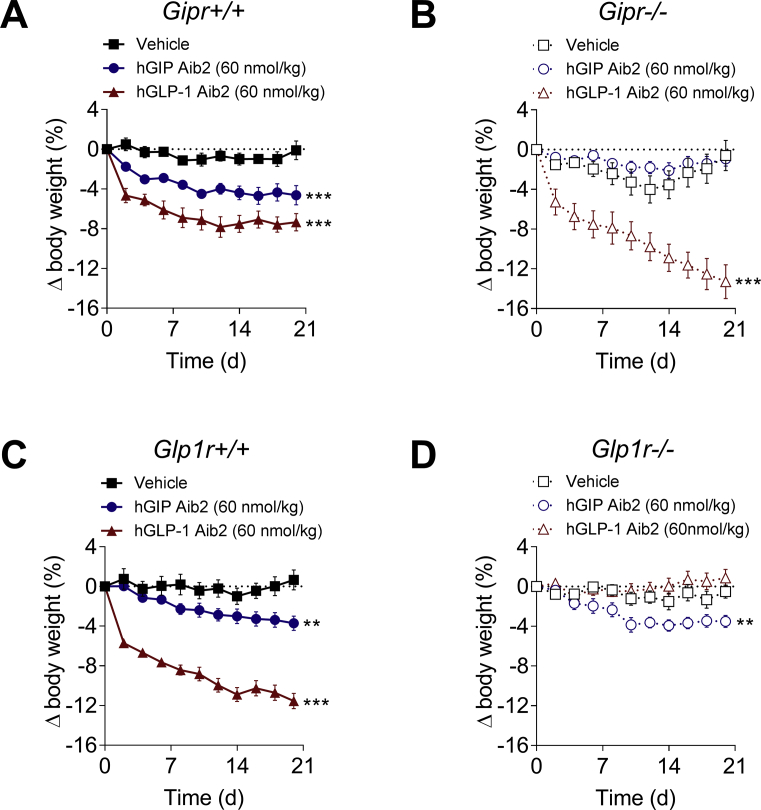
hGIP Aib2 lowers body weight in DIO mice via GIPR. Effects on body weight change following daily subcutaneous injections of vehicle (black squares), hGIP Aib2 (blue circles) and GLP-1 Aib2 Cex (red triangles) at a dose of 60 nmol/kg in DIO (A) Gipr+/+ (solid shapes with solid lines; baseline body weight of 53.2 g) and (B) Gipr−/− (open shapes with dashed lines; baseline body weight of 45.9 g) littermates. Effects on body weight change following daily subcutaneous injections of vehicle (black squares), hGIP Aib2 (blue circles) and GLP-1 Aib2 Cex (red triangles) at a dose of 60 nmol/kg in DIO (C) Glp1r+/+ (solid shapes with solid lines; baseline body weight of 46.3 g) and (D) Glp1r−/− (open shapes with dashed lines; baseline body weight of 39.5 g) littermates. Group sizes are N = 8 and data are presented as mean ± SEM. *P < 0.05, **P < 0.01, and ***P < 0.001 compared with vehicle treated controls within each genotype. Statistical analysis was calculated using regular two-way ANOVA with Dunnett's multiple comparisons test.
Figure 4
Figure 4
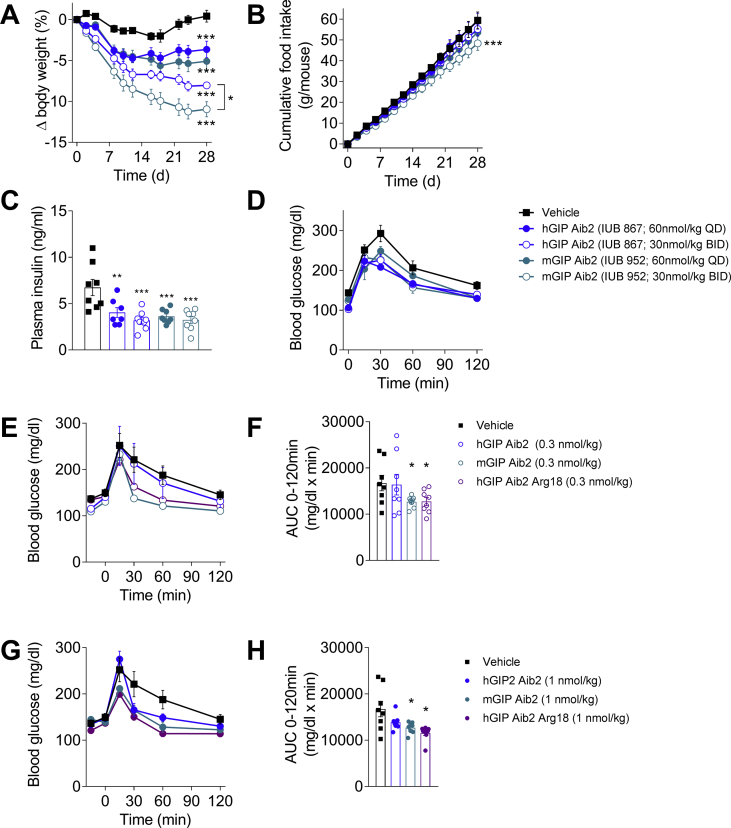
Mouse derived GIP is more potent at lowering body weight than human derived GIP. Effects in DIO mice (baseline body weight of 49.8 g) on (A) body weight change, (B) cumulative food intake, (C) plasma insulin, and (D) glucose tolerance following daily (solid shapes) or twice-daily (open shapes) subcutaneous injections of vehicle (black squares), hGIP Aib2 (blue circles) and mGIP Aib2 (teal circles) at equivalent daily dose of 60 nmol/kg. The BID treatment groups received two injections at a dose level of 30 nmol/kg each separated by 8 h between injections. Effects in DIO mice on (E–H) acute glucose tolerance following a single subcutaneous injection of vehicle (black squares), hGIP Aib2 (blue circles), mGIP Aib2 (teal circles) and hGIP Aib2 Arg18 (purple circles) at doses of (E, F) 0.3 nmol/kg (open shapes) or (G, H) 1 nmol/kg (solid shapes) given 15 min prior to the glucose challenge. Group sizes are N = 8, and data are presented as mean ± SEM. *P < 0.05, **P < 0.01, and ***P < 0.001 compared with vehicle treated controls within each study unless otherwise indicated. Statistical analysis was calculated using regular one-way or two-way ANOVA with Dunnett's multiple comparisons test.
Figure 5
Figure 5
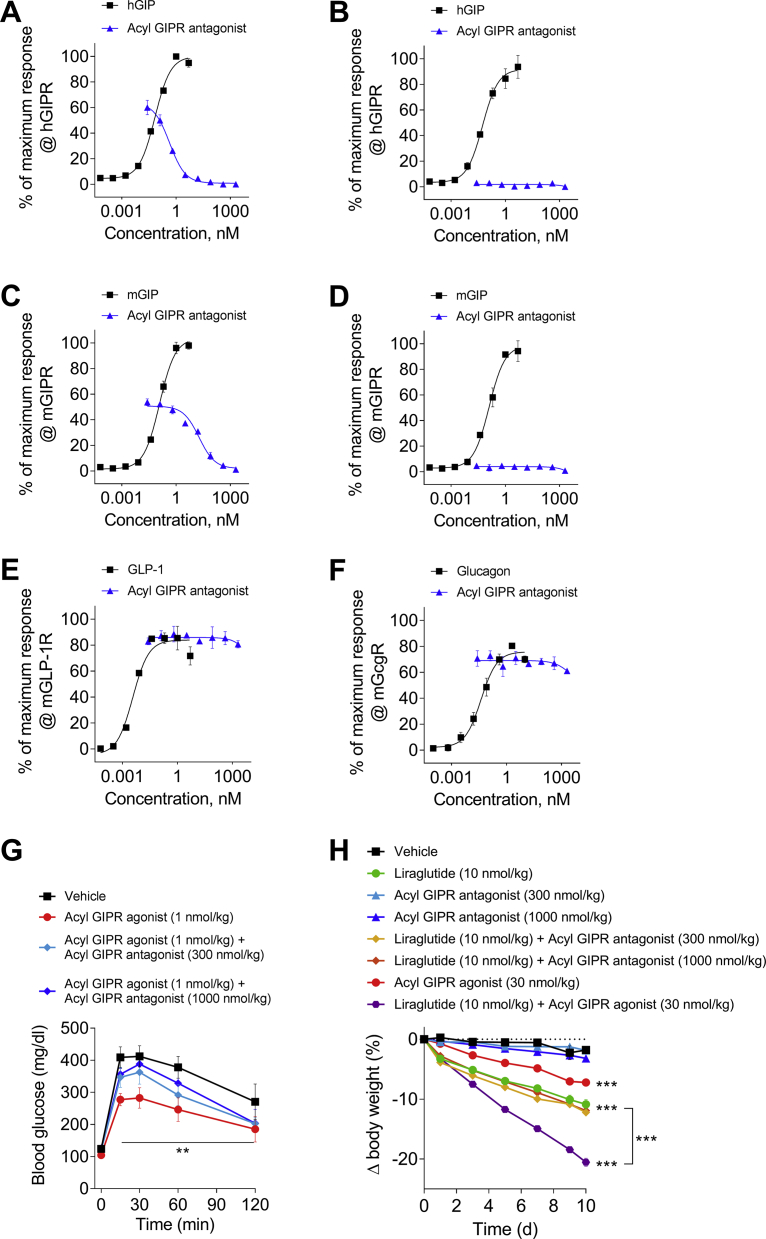
Antagonism of mGIPR does not cause weight loss in DIO mice. In vitro receptor potency of hGIP(5–42) NαAc K10[γEγE-C16] Arg18 tested for (A) hGIPR antagonism, (B) hGIPR agonism, (C) mGIPR antagonism, (D) mGIPR agonism, (E) mGLP-1R antagonism, and (F) mGcgR antagonism. (G) Effects in DIO mice on acute glucose tolerance following a single subcutaneous injection of vehicle (black squares), hGIP Aib2 K43[γEγEγE-C16] at 1 nmol/kg (red circles), or the co-administration of hGIP Aib2 K43[γEγEγE-C16] at 1 nmol/kg with hGIP(5–42) NαAc K10[γEγE-C16] Arg18 at doses of 300 nmol/kg (light blue diamonds) and 1000 nmol/kg (blue diamonds). The acyl GIPR antagonist, hGIP(5–42) NαAc K10[γEγE-C16] Arg18, was administered 2 h before the glucose challenge. The acyl GIPR agonist, hGIP Aib2 K43[γEγEγE-C16], was administered 1 h before the glucose challenge. (H) Effects in DIO mice (baseline body weight of 57.2 g) on body weight change following daily subcutaneous injections of vehicle (black squares), liraglutide at 10 nmol/kg (green circles), hGIP(5–42) NαAc K10[γEγE-C16] Arg18 at doses of 300 nmol/kg (light blue triangles) and 1000 nmol/kg (blue triangles), co-administration of liraglutide (10 nmol/kg) with hGIP(5–42) NαAc K10[γEγE-C16] Arg18 at 300 nmol/kg (yellow diamonds) and 1000 nmol/kg (orange diamonds), hGIP Aib2 K43[γEγEγE-C16] at 30 nmol/kg (red circles), or co-administration of liraglutide (10 nmol/kg) with hGIP Aib2 K43[γEγEγE-C16] at 30 nmol/kg (purple hexagons). Group sizes are N = 8 and data are presented as mean ± SEM. *P < 0.05, **P < 0.01, and ***P < 0.001 compared with vehicle treated controls within each study unless otherwise indicated. Statistical analysis was calculated using regular two-way ANOVA with Dunnett's multiple comparisons test.

References

    1. Marso S.P., Bain S.C., Consoli A., Eliaschewitz F.G., Jodar E., Leiter L.A. Semaglutide and cardiovascular outcomes in patients with type 2 diabetes. New England Journal of Medicine. 2016;375(19):1834–1844. - PubMed
    1. Marso S.P., Daniels G.H., Brown-Frandsen K., Kristensen P., Mann J.F., Nauck M.A. Liraglutide and cardiovascular outcomes in type 2 diabetes. New England Journal of Medicine. 2016;375(4):311–322. - PMC - PubMed
    1. Nauck M.A., Heimesaat M.M., Orskov C., Holst J.J., Ebert R., Creutzfeldt W. Preserved incretin activity of glucagon-like peptide 1 [7-36 amide] but not of synthetic human gastric inhibitory polypeptide in patients with type-2 diabetes mellitus. Journal of Clinical Investigation. 1993;91(1):301–307. - PMC - PubMed
    1. Hojberg P.V., Vilsboll T., Rabol R., Knop F.K., Bache M., Krarup T. Four weeks of near-normalisation of blood glucose improves the insulin response to glucagon-like peptide-1 and glucose-dependent insulinotropic polypeptide in patients with type 2 diabetes. Diabetologia. 2009;52(2):199–207. - PubMed
    1. Finan B., Ma T., Ottaway N., Muller T.D., Habegger K.M., Heppner K.M. Unimolecular dual incretins maximize metabolic benefits in rodents, monkeys, and humans. Science Translational Medicine. 2013;5(209):209ra151. - PubMed

Publication types

MeSH terms