


Serum 25(OH)D is associated with an altered bone turnover marker response after a hip fracture
- PMID: 30578572
- PMCID: PMC6484430
- DOI: 10.1002/jor.24200
Serum 25(OH)D is associated with an altered bone turnover marker response after a hip fracture
Abstract
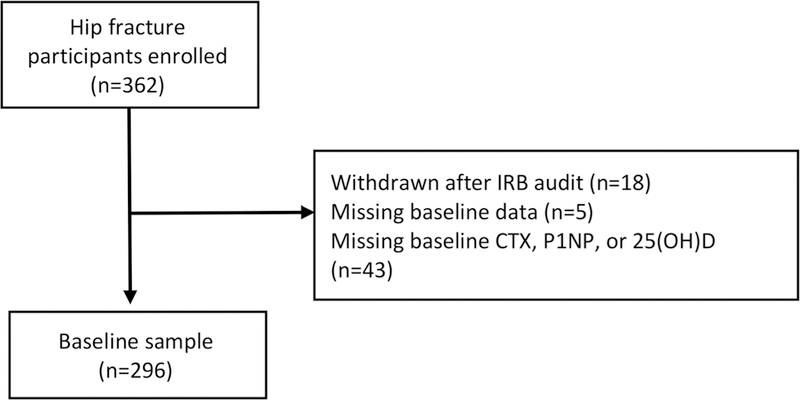
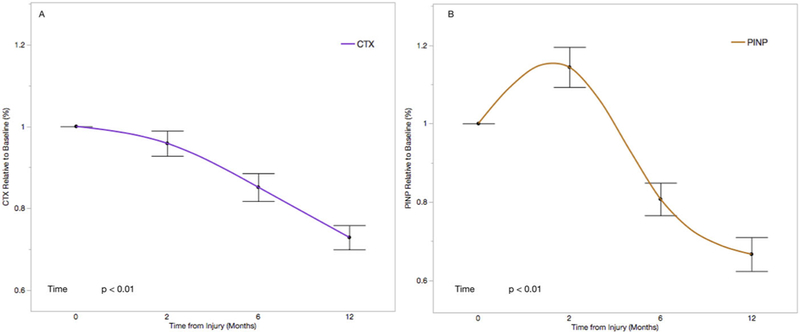
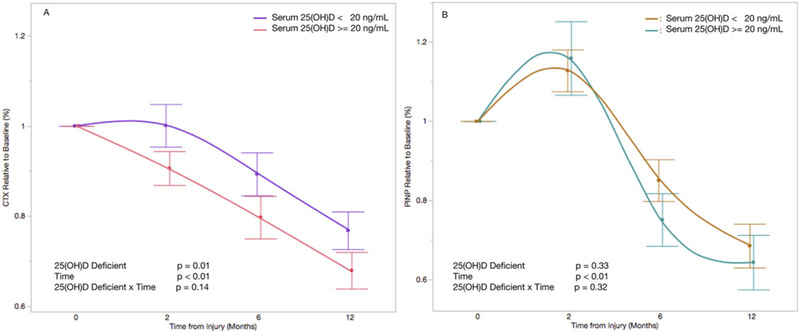
C-terminal telopeptide of type I collagen (CTX) and procollagen type 1 N-terminal propeptide (P1NP) are bone turnover markers (BTMs) that are promising surrogate measures of fracture healing; however, it is unknown if their response is affected by other bone healing metabolites. Since 70% of fracture patients are reported to have insufficient serum vitamin D, we sought to determine if serum 25(OH)D levels are associated with differential changes in CTX and P1NP concentrations after hip fracture. This prospective cohort included hip fracture patients 65 years of age or older admitted to one of eight Baltimore-area hospitals. Serum samples were collected at baseline, 2-, 6-, and 12-month post-fracture. A mixed-effects repeated-measures analysis was used to determine the longitudinal association between vitamin D deficiency (25(OH)D < 20 ng/ml) and CTX and P1NP. Baseline lab values were obtained for 296 participants (mean age, 80.8 years; 51% male; 55% 25(OH)D < 20 ng/ml). During the acute fracture healing period P1NP concentrations increased by 14% (95%CI: 7-21%, p < 0.01) while CTX levels did not change (p = 0.07). Both CTX and P1NP decreased below baseline at 6 and 12 months. CTX levels were higher in participants with baseline 25(OH)D < 20 ng/ml (p = 0.01). There was no association between 25(OH)D < 20 ng/ml and P1NP levels over the study duration (p = 0.33). Data from this large, longitudinal cohort support claims that CTX and P1NP concentrations change during fracture healing; however, the differential response of CTX among vitamin D deficient patients highlights important questions for its utility as a reliable surrogate marker of fracture healing. © 2018 Orthopaedic Research Society. Published by Wiley Periodicals, Inc. J Orthop Res.
Keywords: CTX; P1NP; bone turnover markers; hip fracture; vitamin D.
© 2018 Orthopaedic Research Society. Published by Wiley Periodicals, Inc.
Figures
References
-
- Cunningham BP, Brazina S, Morshed S, et al. 2017. Fracture healing: a review of clinical, imaging and laboratory diagnostic options. Injury 48:S69–S75. - PubMed
-
- Vasikaran S, Eastell R, Bruyere O, et al. 2011. Markers of bone turnover for the prediction of fracture risk and monitoring of osteoporosis treatment: a need for international reference standards. Osteoporos Int 22:391–420. - PubMed
-
- Szulc P, Naylor K, Hoyle NR, et al. 2017. Use of CTX-I and PINP as bone turnover markers: National Bone Health Alliance recommendations to standardize sample handling and patient preparation to reduce pre-analytical variability. Osteoporos Int 28:2541–2556. - PubMed
-
- Pountos I, Georgouli T, Pneumaticos S, et al. 2013. Fracture non-union: can biomarkers predict outcome? Injury 44:1725–1732. - PubMed
-
- Veitch SW, Findlay SC, Hamer AJ, et al. 2006. Changes in bone mass and bone turnover following tibial shaft fracture. Osteoporos Int 17:364–372. - PubMed
Publication types
MeSH terms
Substances
Grants and funding
LinkOut - more resources
Full Text Sources
Medical
Miscellaneous
