


When trafficking and signaling mix: How subcellular location shapes G protein-coupled receptor activation of heterotrimeric G proteins
- PMID: 30578610
- PMCID: PMC6387827
- DOI: 10.1111/tra.12634
When trafficking and signaling mix: How subcellular location shapes G protein-coupled receptor activation of heterotrimeric G proteins
Abstract
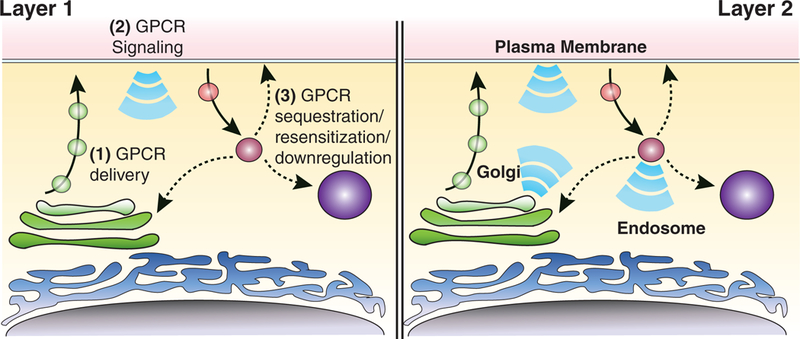
G protein-coupled receptors (GPCRs) physically connect extracellular information with intracellular signal propagation. Membrane trafficking plays a supportive role by "bookending" signaling events: movement through the secretory pathway delivers GPCRs to the cell surface where receptors can sample the extracellular environment, while endocytosis and endolysosomal membrane trafficking provide a versatile system to titrate cellular signaling potential and maintain homeostatic control. Recent evidence suggests that, in addition to these important effects, GPCR trafficking actively shapes the cellular signaling response by altering the location and timing of specific receptor-mediated signaling reactions. Here, we review key experimental evidence underlying this expanding view, focused on GPCR signaling mediated through activation of heterotrimeric G proteins located in the cytoplasm. We then discuss lingering and emerging questions regarding the interface between GPCR signaling and trafficking.
Keywords: G protein; GPCR; endosome; signaling; trafficking.
© 2018 John Wiley & Sons A/S. Published by John Wiley & Sons Ltd.
Figures
References
-
- Hepler JR, Gilman AG. G proteins. Trends Biochem Sci 1992;17(10): 383–387. - PubMed
Publication types
MeSH terms
Substances
Grants and funding
LinkOut - more resources
Full Text Sources
