. 2019 Aug;56(8):521-525.
doi: 10.1136/jmedgenet-2018-105700. Epub 2018 Dec 22.

Does multilocus inherited neoplasia alleles syndrome have severe clinical expression?

Affiliations

Does multilocus inherited neoplasia alleles syndrome have severe clinical expression?

Agostina Stradella et al. J Med Genet. 2019 Aug.

Abstract

Importance: Genetic testing of hereditary cancer using comprehensive gene panels can identify patients with more than one pathogenic mutation in high and/or moderate-risk-associated cancer genes. This phenomenon is known as multilocus inherited neoplasia alleles syndrome (MINAS), which has been potentially linked to more severe clinical manifestations.

Objective: To determine the prevalence and clinical features of MINAS in a large cohort of adult patients with hereditary cancer homogeneously tested with the same gene panel.

Patients and methods: A cohort of 1023 unrelated patients with suspicion of hereditary cancer was screened using a validated panel including up to 135 genes associated with hereditary cancer and phakomatoses.

Results: Thirteen (1.37%) patients harbouring two pathogenic mutations in dominant cancer-predisposing genes were identified, representing 5.7% (13/226) of patients with pathogenic mutations. Most (10/13) of these cases presented clinical manifestations associated with only one of the mutations identified. One case showed mutations in MEN1 and MLH1 and developed tumours associated with both cancer syndromes. Interestingly, three of the double mutants had a young age of onset or severe breast cancer phenotype and carried mutations in moderate to low-risk DNA damage repair-associated genes; two of them presented biallelic inactivation of CHEK2. We included these two patients for the sake of their clinical interest although we are aware that they do not exactly fulfil the definition of MINAS since both mutations are in the same gene.

Conclusions and relevance: Genetic analysis of a broad cancer gene panel identified the largest series of patients with MINAS described in a single study. Overall, our data do not support the existence of more severe manifestations in double mutants at the time of diagnosis although they do confirm previous evidence of severe phenotype in biallelic CHEK2 and other DNA repair cancer-predisposing genes.

Keywords: cancer syndromes; gene panel; genetic testing; multilocus inherited neoplasia alleles syndrome.


Conflict of interest statement

Competing interests: None declared.

Figures
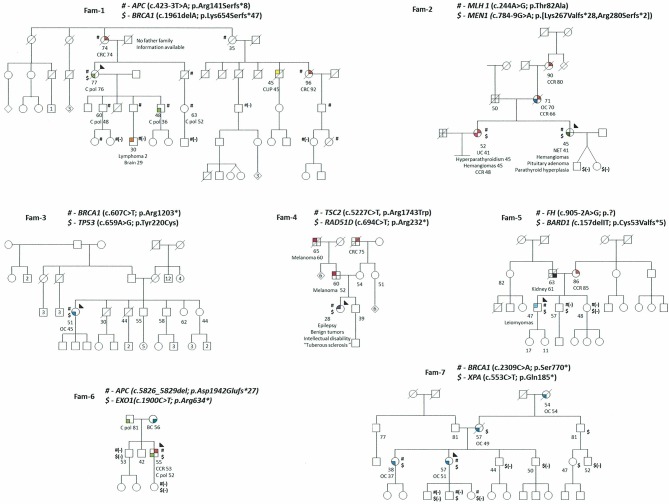
Figure 1
Figure 1
Pedigrees of MINAS patients. Filled quarters of symbols indicate affected patients (each color denotes a specific type of tumor). Current age, age at death and age at diagnosis, when available, are also detailed. Proband is marked by an arrow, carrier status was studied in available relatives, and those carrying the variant are shown with the variant symbol (#,$) and if genotyped and not carriers a (-) is under the mutation symbol. A number inside a symbol denotes the number of siblings condensed in the symbol.  Brain C (light orange), BC: breast cancer (emerald), C pol: colon polyposis (light green), CRC: colorectal cancer (red), CUP: carcinoma of unknown primary (yellow), Kidney Cancer (black), Leiomyomas (light blue), Lymphoma (orange), Melanoma (brown), NET: neuroendocrine tumor (dark green), OC: ovarian cancer (blue), Tuberous sclerosis (purple), UC: uterine carcinoma (pink).
Figure 2
Figure 2
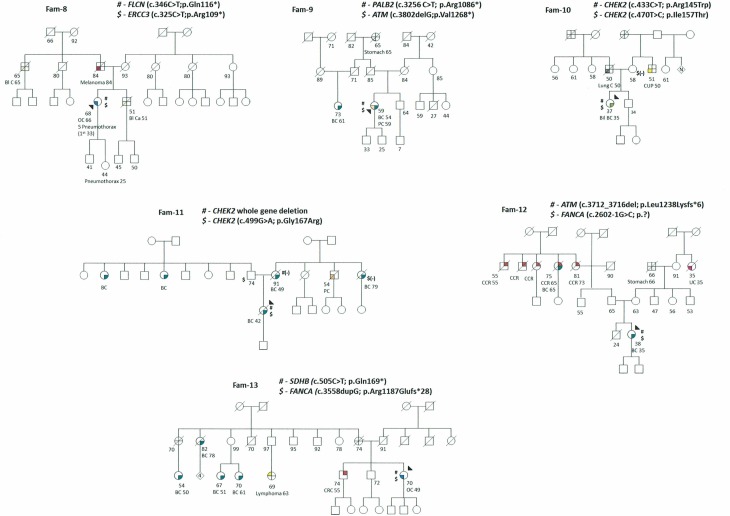
Pedigrees of MINAS patients. Filled quarters of symbols indicate affected patients (each color denotes a specific type of tumor). Current age, age at death and age at diagnosis, when available, are also detailed. Proband is marked by an arrow, carrier status was studied in available relatives, and those carrying the variant are shown with the variant symbol (#,$) and if genotyped and not carriers a (-) is under the mutation symbol. A number inside a symbol denotes the number of siblings condensed in the symbol. Bl C: bladder cancer (light yellow), BC: breast cancer (emerald), Bil BC: bilateral breast cancer (emerald), CRC: colorectal cancer (red), CUP: carcinoma of unknown primary (yellow), Kidney Cancer (black), LC: lung cancer (grey), Lymphoma (orange), Melanoma (brown), OC: ovarian cancer (blue), PC: pancreas cancer (light orange), Stomach cancer (light grey), Tuberous sclerosis (purple), UC: uterine carcinoma (pink).

References

    1. Foulkes WD. Inherited susceptibility to common cancers. N Engl J Med 2008;359:2143–53. 10.1056/NEJMra0802968 - DOI - PubMed
    1. Cooper DN, Krawczak M, Polychronakos C, Tyler-Smith C, Kehrer-Sawatzki H. Where genotype is not predictive of phenotype: towards an understanding of the molecular basis of reduced penetrance in human inherited disease. Hum Genet 2013;132:1077–130. 10.1007/s00439-013-1331-2 - DOI - PMC - PubMed
    1. Narod SA, Foulkes WD. BRCA1 and BRCA2: 1994 and beyond. Nat Rev Cancer 2004;4:665–76. 10.1038/nrc1431 - DOI - PubMed
    1. Robson ME, Bradbury AR, Arun B, Domchek SM, Ford JM, Hampel HL, Lipkin SM, Syngal S, Wollins DS, Lindor NM. American Society of clinical oncology policy statement update: genetic and genomic testing for cancer susceptibility. J Clin Oncol 2015;33:3660–7. 10.1200/JCO.2015.63.0996 - DOI - PubMed
    1. Thompson ER, Rowley SM, Li N, McInerny S, Devereux L, Wong-Brown MW, Trainer AH, Mitchell G, Scott RJ, James PA, Campbell IG. Panel testing for familial breast cancer: calibrating the tension between research and clinical care. J Clin Oncol 2016;34:1455–9. 10.1200/JCO.2015.63.7454 - DOI - PubMed

Publication types

Substances