


CHA2DS2-VASc Score and Stroke Prediction in Atrial Fibrillation in Whites, Blacks, and Hispanics
- PMID: 30580712
- PMCID: PMC6541553
- DOI: 10.1161/STROKEAHA.118.021453
CHA2DS2-VASc Score and Stroke Prediction in Atrial Fibrillation in Whites, Blacks, and Hispanics
Abstract
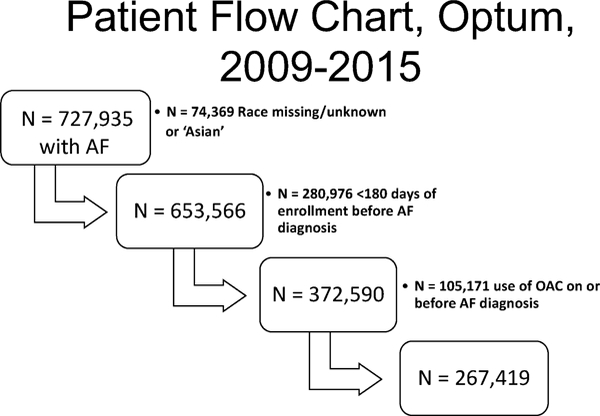
Background and Purpose- Despite modest predictive ability for ischemic stroke (IS), the CHA2DS2-VASc score is widely used for stroke prediction in atrial fibrillation. Among patients with atrial fibrillation, we aimed to (1) compare the IS or transient ischemic attack (TIA) incidence by CHA2DS2-VASc in blacks and Hispanics versus whites; (2) compare predictive ability of CHA2DS2-VASc score for IS or TIA in blacks and Hispanics versus whites; and (3) determine improvement in predictive ability of CHA2DS2-VASc score from addition of race/ethnicity. Methods- Using data from Optum Clinformatics, a large administrative claims database, we analyzed patients with atrial fibrillation enrolled in commercial and Medicare Advantage health plans from 2009 to 2015. We computed IS or TIA incidence rates, improvement in C statistic, continuous and categorical net reclassification improvement, and relative integrated discrimination improvement from addition of race/ethnicity to CHA2DS2-VASc. Results- A total of 267 419 patients (mean age, 73.1 [SD, 12.3] years; 46.6% women; 84.2% white, 8.5% black, 7.3% Hispanic) were studied. After a mean follow-up of 22 months, there were 6202 IS or TIA events. IS or TIA incidence rates were higher in blacks than Hispanics or whites (1.65, 1.40, and 1.22 cases per 100 person-years, respectively) and increased with higher CHA2DS2-VASc, with no race/ethnicity-based differences (P for interaction=0.17). The CHA2DS2-VASc and CHA2DS2-VASc+race/ethnicity C statistic (95% CI) were 0.679 (0.670-0.686) and 0.679 (0.671-0.688). The CHA2DS2-VASc C statistic in the 3 groups were comparable. With addition of race/ethnicity, the categorical net reclassification improvement, continuous net reclassification improvement, and relative integrated discrimination improvement were -0.045 (95% CI, -0.067 to -0.025), 0.045 (95% CI, 0.025-0.068), and 0.016 (95% CI, 0.014-0.018). Conclusions- The predictive ability of CHA2DS2-VASc for IS or TIA in atrial fibrillation is comparable among whites, blacks, and Hispanics; hence, it can be used in the latter 2 groups. Addition of race/ethnicity to the CHA2DS2-VASc does not improve its predictive ability.
Keywords: atrial fibrillation; incidence; race; risk; stroke.
Figures

References
-
- Wolf PA, Abbott RD, Kannel WB. Atrial fibrillation as an independent risk factor for stroke: The framingham study. Stroke. 1991;22:983–988. PMID: - PubMed
-
- January CT, Wann LS, Alpert JS, Calkins H, Cigarroa JE, Cleveland JC Jr., et al. 2014 aha/acc/hrs guideline for the management of patients with atrial fibrillation: A report of the american college of cardiology/american heart association task force on practice guidelines and the heart rhythm society. Circulation. 2014;130:e199–267 - PMC - PubMed
-
- Kirchhof P, Benussi S, Kotecha D, Ahlsson A, Atar D, Casadei B, et al. 2016 esc guidelines for the management of atrial fibrillation developed in collaboration with eacts. Eur Heart J. 2016;37:2893–2962 - PubMed
-
- Rosamond WD, Folsom AR, Chambless LE, Wang CH, McGovern PG, Howard G, et al. Stroke incidence and survival among middle-aged adults - 9-year follow-up of the atherosclerosis risk in communities (aric) cohort. Stroke. 1999;30:736–743. PMID: - PubMed
Grants and funding
LinkOut - more resources
Full Text Sources
