


Evidence to the role of interflavan linkages and galloylation of proanthocyanidins at sustaining long-term dentin biomodification
- PMID: 30580969
- PMCID: PMC6346742
- DOI: 10.1016/j.dental.2018.11.029
Evidence to the role of interflavan linkages and galloylation of proanthocyanidins at sustaining long-term dentin biomodification
Abstract
Objectives: The interactivity of proanthocyanidins (PACs) with collagen modulates dentin matrix biomechanics and biostability. Herein, PAC extracts selected based on structural diversity were investigated to determine key PAC features driving sustained effects on dentin matrices over a period of 18months.
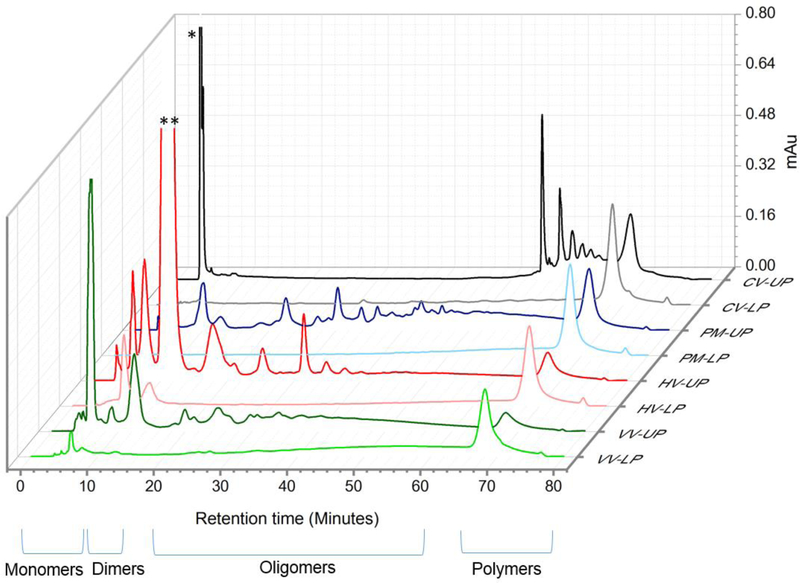
Methods: The chemical profiles of PAC-rich plant sources, Pinus massoniana (PM), Cinnamomum verum (CV) and Hamamelis virginiana (HV) barks, as well as Vitis vinifera (VV) seeds, were obtained by diol HPLC analysis after partitioning of the extracts between methyl acetate and water. Dentin matrices (n=15) were prepared from human molars to determine the apparent modulus of elasticity over 18months of aging. Susceptibility of the dentin matrix to degradation by endogenous and exogenous proteases was determined by presence of solubilized collagen in supernatant, and resistance to degradation by bacterial collagenase, respectively. Data were analyzed using ANOVA and Games-Howell post hoc tests (α=0.05).
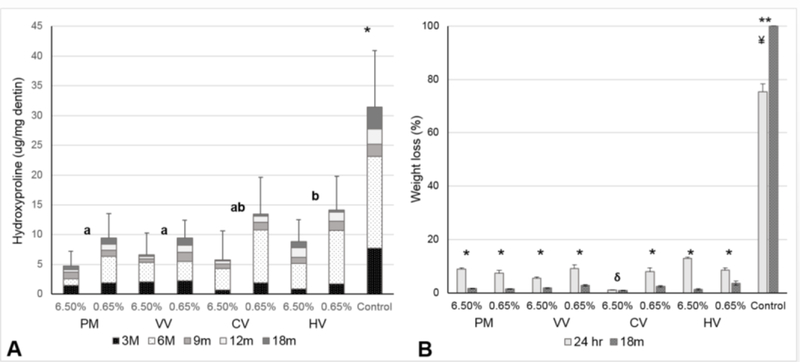
Results: After 18months, dentin matrices modified by PM and CV extracts, containing only non-galloylated PACs, were highly stable mechanically (p<0.05). Dentin matrices treated with CV exhibited the lowest degradation by bacterial collagenase after 1h and 18months of aging (p<0.05), while dentin matrices treated with PM showed the least mass loss and collagen solubilization by endogenous enzymes over time (p<0.05).
Significance: Resistance against long-term degradation was observed for all experimental groups; however, the most potent and long-lasting dentin biomodification resulted from non-galloylated PACs.
Keywords: Biodegradation; Collagen; Collagen cross-linkers; Dentinl; Polyphenols; Proanthocyanidins; Stiffness.
Copyright © 2018 The Academy of Dental Materials. Published by Elsevier Inc. All rights reserved.
Figures
References
-
- Marshall GW Jr, Marshall SJ, Kinney JH, Balooch M. The dentin substrate: structure and properties related to bonding. J Dent 1997; 25:441–58. - PubMed
-
- Carrilho MR, Tay FR, Pashley DH, Tjäderhane L, Carvalho RM. Mechanical stability of resin-dentin bond components. Dent Mater 2005;21:232–41. - PubMed
Publication types
MeSH terms
Substances
Grants and funding
LinkOut - more resources
Full Text Sources
