


PATJ Low Frequency Variants Are Associated With Worse Ischemic Stroke Functional Outcome
- PMID: 30582445
- PMCID: PMC6501820
- DOI: 10.1161/CIRCRESAHA.118.313533
PATJ Low Frequency Variants Are Associated With Worse Ischemic Stroke Functional Outcome
Abstract
Rationale: Ischemic stroke is among the leading causes of adult disability. Part of the variability in functional outcome after stroke has been attributed to genetic factors but no locus has been consistently associated with stroke outcome.
Objective: Our aim was to identify genetic loci influencing the recovery process using accurate phenotyping to produce the largest GWAS (genome-wide association study) in ischemic stroke recovery to date.
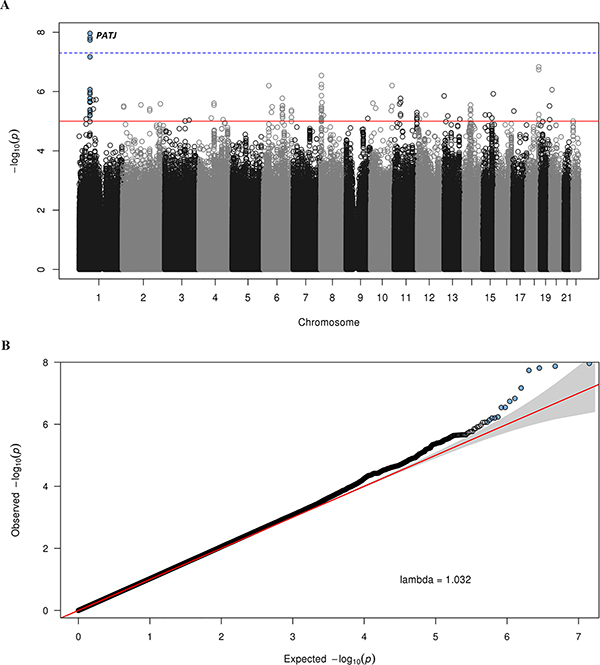
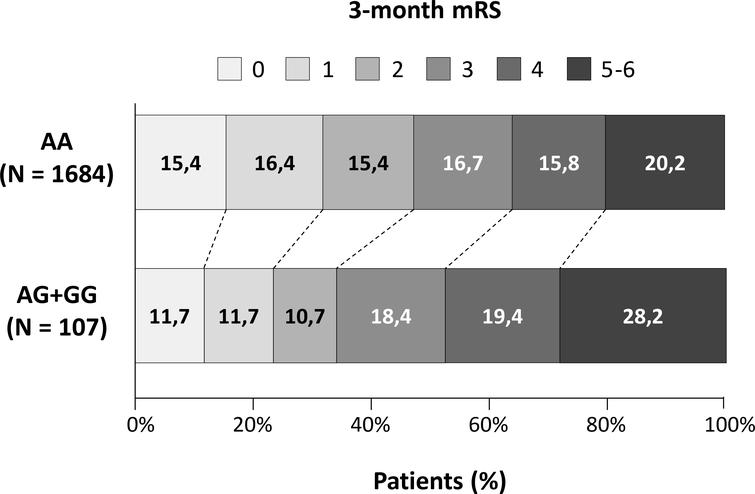
Methods and results: A 12-cohort, 2-phase (discovery-replication and joint) meta-analysis of GWAS included anterior-territory and previously independent ischemic stroke cases. Functional outcome was recorded using 3-month modified Rankin Scale. Analyses were adjusted for confounders such as discharge National Institutes of Health Stroke Scale. A gene-based burden test was performed. The discovery phase (n=1225) was followed by open (n=2482) and stringent joint-analyses (n=1791). Those cohorts with modified Rankin Scale recorded at time points other than 3-month or incomplete data on previous functional status were excluded in the stringent analyses. Novel variants in PATJ (Pals1-associated tight junction) gene were associated with worse functional outcome at 3-month after stroke. The top variant was rs76221407 (G allele, β=0.40, P=1.70×10⁻⁹).
Conclusions: Our results identify a set of common variants in PATJ gene associated with 3-month functional outcome at genome-wide significance level. Future studies should examine the role of PATJ in stroke recovery and consider stringent phenotyping to enrich the information captured to unveil additional stroke outcome loci.
Keywords: allele; genetic loci; genetic variant; genome-wide association study; ischemic stroke.
Figures

Comment in
-
Genetics of Recovery After Stroke.Circ Res. 2019 Jan 4;124(1):18-20. doi: 10.1161/CIRCRESAHA.118.314269. Circ Res. 2019. PMID: 30605410 No abstract available.
References
-
- Mozaffarian D, Benjamin EJ, Go AS, et al. Heart Disease and Stroke Statistics−−2015 Update: A Report From the American Heart Association. Circulation 2015; 131:e535. - PubMed
-
- World Health Organization. The top 10 causes of death. May 2014. http://www.who.int/mediacentre/factsheets/fs310/en/ (accessed June 11, 2017).
-
- Feigin VL, Lawes CMM, Bennett DA, Anderson CS. Stroke epidemiology: A review of population-based studies of incidence, prevalence, and case-fatality in the late 20th century. Lancet Neurol 2003; 2:43–53. - PubMed
-
- Roquer J, Ois A, Rodriguez-Campello A, Gomis M, Munteis E, Jimenez-Conde J, Cuadrado-Godia E, Martinez-Rodriguez JE. Atherosclerotic burden and early mortality in acute ischemic stroke. Arch Neurol 2007; 64:699–704. - PubMed
