Effect of Korean Herbal Formula (Modified Ojayeonjonghwan) on Androgen Receptor Expression in an Aging Rat Model of Late Onset Hypogonadism
- PMID: 30584994
- PMCID: PMC6305862
- DOI: 10.5534/wjmh.180051
Effect of Korean Herbal Formula (Modified Ojayeonjonghwan) on Androgen Receptor Expression in an Aging Rat Model of Late Onset Hypogonadism
Abstract
Purpose: Testosterone replacement therapy is an effective treatment for late-onset hypogonadism (LOH) despite a few contraindications and side-effects. The aim of this study was to determine whether modified Ojayeonjonghwan (KH-204, Korean herbal formula) improved LOH. KH-204 is a strong antioxidant herbal formula. We evaluated the effect of Korean herbal prescription on androgen receptor (AR) expression in an aged rat model of LOH.
Materials and methods: Eighteen-month-old rats were used as aged LOH rat models. Eighteen Sprague-Dawley rats were randomly divided into three equal groups of six animals each and treated with one of the following: 1) normal control group (oral administration with distilled water, n=6), 2) KH-204 200 group (oral administration with 200 mg/kg of KH-204, n=6), and 3) KH-204 400 group (oral administration with 400 mg/kg of KH-204, n=6). After four weeks of treatment (once daily, distilled water or KH-204), serum testosterone levels, changes in testicular and epididymal weight, Western blotting analysis of AR expression and measurement of oxidative stress were examined.
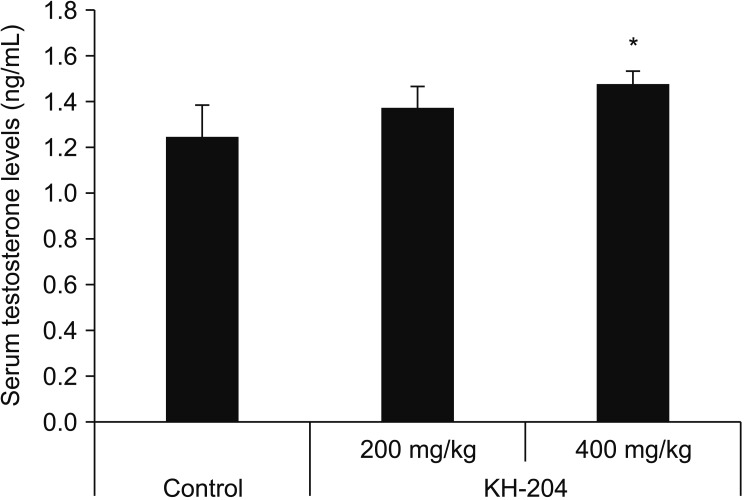
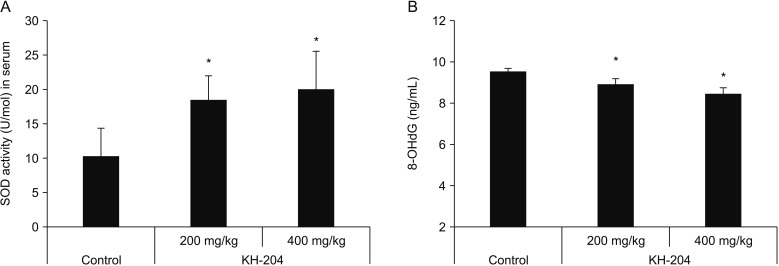
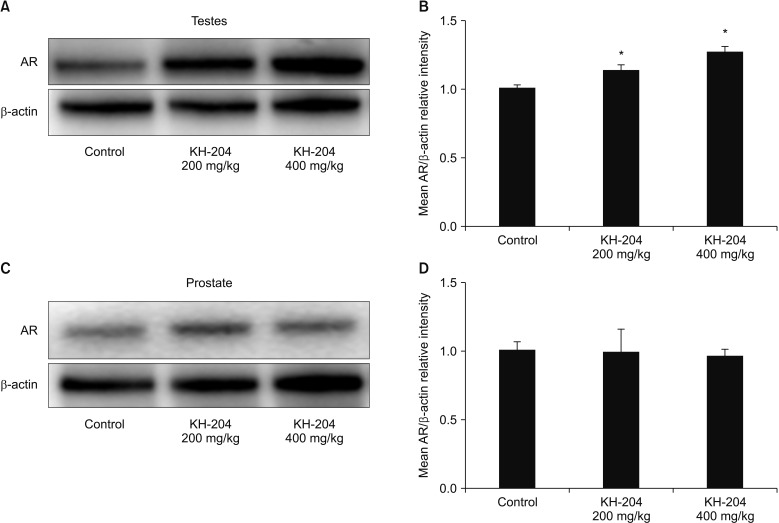
Results: Treatment with the herbal formulation KH-204 200 mg/kg and 400 mg/kg (1) increased the weights of testis and epididymis; (2) increased the level of serum testosterone; (3) increased the level of superoxide dismutase and reduced the level of 8-hydroxy-20-deoxyguanosine; and (4) upregulated AR expression in testicular tissue.
Conclusions: KH-204 might be an effective alternative for LOH. It improves antioxidant mechanisms and increases testicular AR expression without side-effects.
Keywords: Hypogonadism; Phytotherapy; Receptors, androgen; Testosterone.
Copyright © 2019 Korean Society for Sexual Medicine and Andrology.
Conflict of interest statement
The authors have no potential conflicts of interest to disclose.
Figures
References
-
- Lunenfeld B, Mskhalaya G, Kalinchenko S, Tishova Y. Recommendations on the diagnosis, treatment and monitoring of late-onset hypogonadism in men: a suggested update. Aging Male. 2013;16:143–150. - PubMed
-
- Dean JD, McMahon CG, Guay AT, Morgentaler A, Althof SE, Becher EF, et al. The International Society for Sexual Medicine's process of care for the assessment and management of testosterone deficiency in adult men. J Sex Med. 2015;12:1660–1686. - PubMed
-
- Gray A, Feldman HA, McKinlay JB, Longcope C. Age, disease, and changing sex hormone levels in middle-aged men: results of the Massachusetts male aging study. J Clin Endocrinol Metab. 1991;73:1016–1025. - PubMed
-
- Feldman HA, Longcope C, Derby CA, Johannes CB, Araujo AB, Coviello AD, et al. Age trends in the level of serum testosterone and other hormones in middle-aged men: longitudinal results from the Massachusetts male aging study. J Clin Endocrinol Metab. 2002;87:589–598. - PubMed
-
- Wu FC, Tajar A, Beynon JM, Pye SR, Silman AJ, Finn JD, et al. Identification of late-onset hypogonadism in middle-aged and elderly men. N Engl J Med. 2010;363:123–135. - PubMed
Grants and funding
LinkOut - more resources
Full Text Sources
Research Materials