


Kenya tuberculosis prevalence survey 2016: Challenges and opportunities of ending TB in Kenya
- PMID: 30586448
- PMCID: PMC6306266
- DOI: 10.1371/journal.pone.0209098
Kenya tuberculosis prevalence survey 2016: Challenges and opportunities of ending TB in Kenya
Erratum in
-
Correction: Kenya tuberculosis prevalence survey 2016: Challenges and opportunities of ending TB in Kenya.PLoS One. 2019 Jan 25;14(1):e0211593. doi: 10.1371/journal.pone.0211593. eCollection 2019. PLoS One. 2019. PMID: 30682195 Free PMC article.
Abstract
Background: We aimed to determine the prevalence of pulmonary TB amongst the adult population (≥15 years) in 2016 in Kenya.
Method: A nationwide cross-sectional survey where participants first underwent TB symptom screening and chest x-ray. Subsequently, participants who reported cough >2weeks and/or had a chest x-ray suggestive of TB, submitted sputum specimen for laboratory examination by smear microscopy, culture and Xpert MTB/RIF.
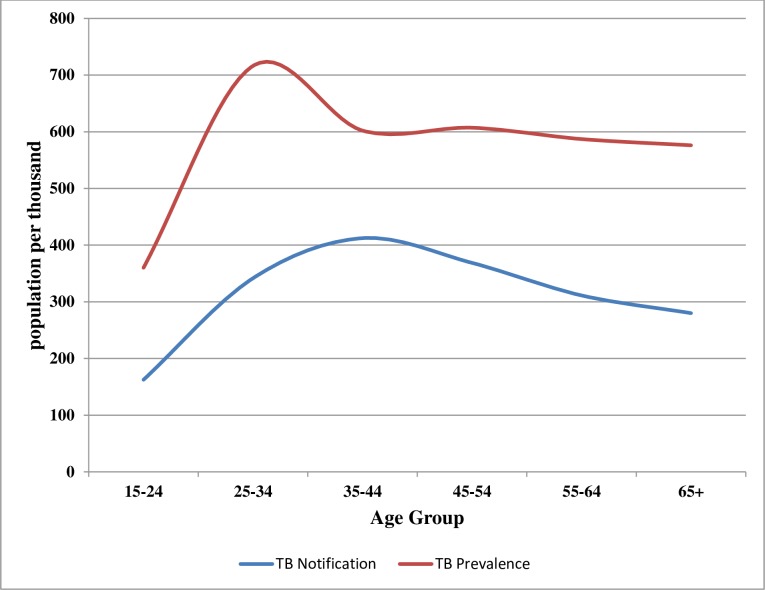
Result: The survey identified 305 prevalent TB cases translating to a prevalence of 558 [95%CI 455-662] per 100,000 adult population. The highest disease burden was reported among people aged 25-34 years (716 [95% CI 526-906]), males (809 [(95% CI 656-962]) and those who live in urban areas (760 [95% CI 539-981]). Compared to the reported TB notification rate for Kenya in 2016, the prevalence to notification ratio was 2.5:1. The gap between the survey prevalence and notification rates was highest among males, age groups 25-34, and the older age group of 65 years and above. Only 48% of the of the survey prevalent cases reported cough >2weeks. In addition, only 59% of the identified cases had the four cardinal symptoms for TB (cough ≥2 weeks, fever, night sweat and weight loss. However, 88.2% had an abnormal chest x-ray suggestive of TB. The use of Xpert MTB/RIF identified 77.7% of the cases compared to smear microscopy's 46%. Twenty-one percent of the survey participants with respiratory symptoms reported to have sought prior health care at private clinics and chemists. Among the survey prevalent cases who reported TB related symptoms, 64.9% had not sought any health care prior to the survey.
Conclusion: This survey established that TB prevalence in Kenya is higher than had been estimated, and about half of the those who fall ill with the disease each year are missed.
Conflict of interest statement
The authors have declared that no competing interests exist.
Figures

References
-
- World Health Organization. Global tuberculosis report 2018 [Internet]. 2018. Available from: http://apps.who.int/iris/bitstream/handle/10665/274453/9789241565646-eng...
-
- World Health Organization. Implementing the End TB strategy: The Essentials [Internet]. World Health Organization, Geneva. Switzerland; 2015. Available from: http://www.who.int/tb/publications/2015/end_tb_essential.pdf
-
- World Health Organization. Global tuberculosis report 2016. [Internet]. Geneva: World Health Organization; 2016. Available from: http://apps.who.int/medicinedocs/documents/s23098en/s23098en.pdf
-
- Kenya National Bureau of Statistics. Kenya Economic Survey 2018 [Internet]. 2018 [cited 2018 Jul 6]. Available from: https://www.knbs.or.ke/download/economic-survey-2018/
-
- Roelsgaard E, Nyboe J. A tuberculosis survey in Kenya. Bull World Health Organ [Internet]. 1961. [cited 2018 Jul 6];25(6):851–70. Available from: https://www.ncbi.nlm.nih.gov/pmc/articles/PMC2555628/ - PMC - PubMed
Publication types
MeSH terms
Grants and funding
LinkOut - more resources
Full Text Sources
Miscellaneous
