


Twenty-Four-Hour Blood Pressure-Lowering Effect of a Sodium-Glucose Cotransporter 2 Inhibitor in Patients With Diabetes and Uncontrolled Nocturnal Hypertension: Results From the Randomized, Placebo-Controlled SACRA Study
- PMID: 30586745
- PMCID: PMC6493695
- DOI: 10.1161/CIRCULATIONAHA.118.037076
Twenty-Four-Hour Blood Pressure-Lowering Effect of a Sodium-Glucose Cotransporter 2 Inhibitor in Patients With Diabetes and Uncontrolled Nocturnal Hypertension: Results From the Randomized, Placebo-Controlled SACRA Study
Abstract
Background: The risk of cardiovascular disease and mortality in salt-sensitive patients with diabetes mellitus and uncontrolled nocturnal hypertension is high. The SACRA (Sodium-Glucose Cotransporter 2 [SGLT2] Inhibitor and Angiotensin Receptor Blocker [ARB] Combination Therapy in Patients With Diabetes and Uncontrolled Nocturnal Hypertension) study investigated changes in blood pressure (BP) with empagliflozin plus existing antihypertensive therapy.
Methods: This multicenter, double-blind, parallel study was conducted in Japan. Adult patients with type 2 diabetes mellitus and uncontrolled nocturnal hypertension receiving stable antihypertensive therapy including angiotensin receptor blockers were randomized to 12 weeks' treatment with empagliflozin 10 mg once daily or placebo. Clinic BP was measured at baseline and weeks 4, 8, and 12; 24-hour ambulatory BP monitoring was performed at baseline and week 12; and morning home BP was determined for 5 days before each visit. The primary efficacy end point was change from baseline in nighttime BP (ambulatory BP monitoring).
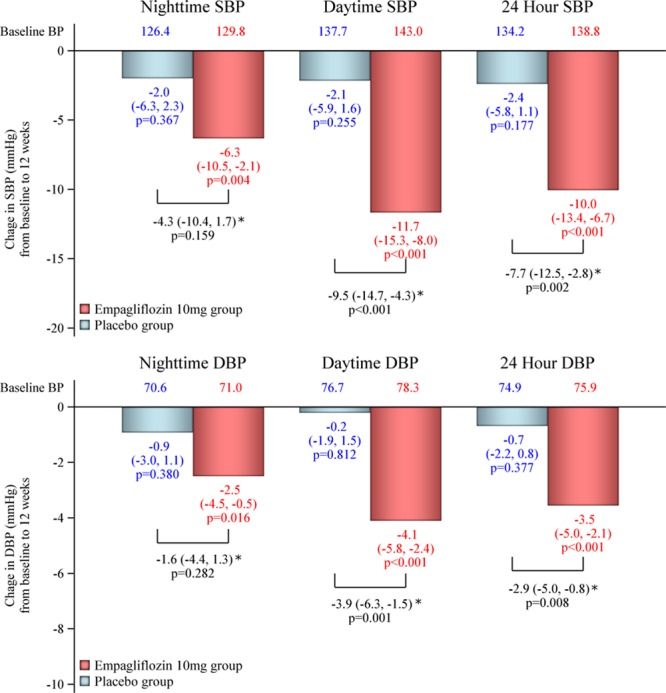
Results: One hundred thirty-two nonobese, older patients with well-controlled blood glucose were randomized (mean age 70 years, mean body mass index 26 kg/m2). Empagliflozin, but not placebo, significantly reduced nighttime systolic BP versus baseline (-6.3 mm Hg; P=0.004); between-group difference in change from baseline was -4.3 mm Hg (P=0.159). Reductions in daytime, 24-hour, morning home, and clinic systolic BP at 12 weeks with empagliflozin were significantly greater than with placebo (-9.5, -7.7, -7.5, and -8.6 mm Hg, respectively; all P≤0.002). Between-group differences in body weight and glycosylated hemoglobin reductions were significant, but small (-1.3 kg and -0.33%; both P<0.001). At 4 weeks, N-terminal pro-B-type natriuretic peptide levels were reduced to a greater extent in the empagliflozin versus placebo group (-12.1%; P=0.013); atrial natriuretic peptide levels decreased with empagliflozin versus placebo at weeks 4 and 12 (-8.2% [P=0.008] and -9.7% [P=0.019]). Changes in antihypertensive medication during the study did not differ significantly between groups.
Conclusions: Nonseverely obese older diabetes patients with uncontrolled nocturnal hypertension showed significant BP reductions without marked reductions in glucose with the addition of empagliflozin to existing antihypertensive and antidiabetic therapy. Use of sodium-glucose cotransporter 2 inhibitors in specific groups (eg, those with nocturnal hypertension, diabetes, and high salt sensitivity) could help reduce the risk of heart failure and cardiovascular mortality.
Clinical trial registration: URL: https://www.
Clinicaltrials: gov. Unique identifier: NCT03050229.
Keywords: hypertension; natriuretic peptides; sodium-glucose transporter 2 inhibitors; type 2 diabetes mellitus.
Figures



Comment in
-
Should Certain Antihyperglycemic Medications Be Preferred Over Antihypertensive Medications for Blood Pressure Control in Special Populations With Diabetes Mellitus?Circulation. 2019 Apr 30;139(18):2110-2112. doi: 10.1161/CIRCULATIONAHA.119.039044. Circulation. 2019. PMID: 31034292 No abstract available.
References
-
- Grempler R, Thomas L, Eckhardt M, Himmelsbach F, Sauer A, Sharp DE, Bakker RA, Mark M, Klein T, Eickelmann P. Empagliflozin, a novel selective sodium glucose cotransporter-2 (SGLT-2) inhibitor: characterisation and comparison with other SGLT-2 inhibitors. Diabetes Obes Metab. 2012;14:83–90. doi: 10.1111/j.1463-1326.2011.01517.x. - PubMed
-
- Häring HU, Merker L, Seewaldt-Becker E, Weimer M, Meinicke T, Broedl UC, Woerle HJ EMPA-REG MET Trial Investigators. Empagliflozin as add-on to metformin in patients with type 2 diabetes: a 24-week, randomized, double-blind, placebo-controlled trial. Diabetes Care. 2014;37:1650–1659. doi: 10.2337/dc13-2105. - PubMed
-
- Häring HU, Merker L, Seewaldt-Becker E, Weimer M, Meinicke T, Woerle HJ, Broedl UC EMPA-REG METSU Trial Investigators. Empagliflozin as add-on to metformin plus sulfonylurea in patients with type 2 diabetes: a 24-week, randomized, double-blind, placebo-controlled trial. Diabetes Care. 2013;36:3396–3404. doi: 10.2337/dc12-2673. - PMC - PubMed
-
- Kovacs CS, Seshiah V, Swallow R, Jones R, Rattunde H, Woerle HJ, Broedl UC EMPA-REG PIO™ trial investigators. Empagliflozin improves glycaemic and weight control as add-on therapy to pioglitazone or pioglitazone plus metformin in patients with type 2 diabetes: a 24-week, randomized, placebo-controlled trial. Diabetes Obes Metab. 2014;16:147–158. doi: 10.1111/dom.12188. - PubMed
-
- Roden M, Weng J, Eilbracht J, Delafont B, Kim G, Woerle HJ, Broedl UC EMPA-REG MONO trial investigators. Empagliflozin monotherapy with sitagliptin as an active comparator in patients with type 2 diabetes: a randomised, double-blind, placebo-controlled, phase 3 trial. Lancet Diabetes Endocrinol. 2013;1:208–219. doi: 10.1016/S2213-8587(13)70084-6. - PubMed
Associated data
LinkOut - more resources
Full Text Sources
Medical
