. 2019 Jan 30;39(5):918-928.
doi: 10.1523/JNEUROSCI.0353-18.2018. Epub 2018 Dec 26.

Adverse Effects of Aromatase Inhibition on the Brain and Behavior in a Nonhuman Primate

Affiliations

Adverse Effects of Aromatase Inhibition on the Brain and Behavior in a Nonhuman Primate

Nicole J Gervais et al. J Neurosci. .

Erratum in

Abstract

Breast cancer patients using aromatase inhibitors (AIs) as an adjuvant therapy often report side effects, including hot flashes, mood changes, and cognitive impairment. Despite long-term use in humans, little is known about the effects of continuous AI administration on the brain and cognition. We used a primate model of human cognitive aging, the common marmoset, to examine the effects of a 4-week daily administration of the AI letrozole (20 μg, p.o.) on cognition, anxiety, thermoregulation, brain estrogen content, and hippocampal pyramidal cell physiology. Letrozole treatment was administered to both male and female marmosets and reduced peripheral levels of estradiol (E2), but unexpectedly increased E2 levels in the hippocampus. Spatial working memory and intrinsic excitability of hippocampal neurons were negatively affected by the treatment possibly due to increased hippocampal E2. While no changes in hypothalamic E2 were observed, thermoregulation was disrupted by letrozole in females only, indicating some impact on hypothalamic activity. These findings suggest adverse effects of AIs on the primate brain and call for new therapies that effectively prevent breast cancer recurrence while minimizing side effects that further compromise quality of life.SIGNIFICANCE STATEMENT Aromatase inhibitors (AIs) are used as an adjuvant therapy for estrogen-receptor-positive breast cancer and are associated with side effects, including hot flashes, depression/anxiety, and memory deficits severe enough for many women to discontinue this life-saving treatment. AIs are also used by men, yet sex differences in the reported side effects have not been systematically studied. We show that AI-treated male and female marmosets exhibit behavioral changes consistent with these CNS symptoms, as well as elevated hippocampal estradiol and compromised hippocampal physiology. These findings illustrate the need for (1) a greater understanding of the precise mechanisms by which AIs impact brain function and (2) the development of new treatment approaches for breast cancer patients that minimize adverse effects on the brain.

Keywords: anxiety; aromatase inhibitors; hippocampal physiology; neuroestradiol; spatial working-memory; thermoregulation.


Figures

Figure 1.
Figure 1.
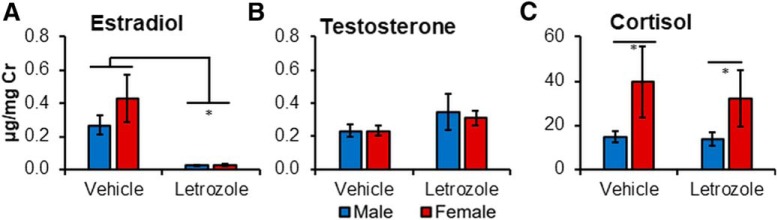
Four weeks of letrozole treatment (20 μg/d, p.o.) lowers circulating levels of E2 but has no effect on T or cortisol. Urinary hormone levels were collected from a mixed-sex sample of marmosets, who received either letrozole (males: n = 4; females: n = 3) or vehicle (males: n = 4; females: n = 4). A, E2 levels were significantly lower in the letrozole-treated than the control group. *p < 0.001. Free T (B) and cortisol (C) levels were not different across treatment groups but were higher in females than males. *p < 0.05. Mean values obtained in each group are presented in μg/mg Cr. Error bars indicate SEM.
Figure 2.
Figure 2.
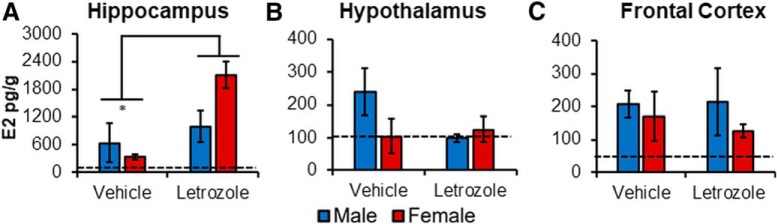
Region-specific increase in E2 levels following 4 weeks of letrozole (20 μg/d, p.o.). Brain regions analyzed were as follows: (A) hippocampus, (B) hypothalamus, and (C) frontal cortex. Letrozole (males: n = 4; females: n = 3) was associated with higher E2 levels in the hippocampus relative to the control group (males: n = 4; females: n = 4). *p < 0.05. Remaining regions were unaffected by drug treatment. There was no effect of sex on E2 levels of any region. Mean values obtained in each group are presented in pg/g. Error bars indicate SEM. Dashed horizontal lines indicate the average background E2 levels obtained by EIA for assay blanks.
Figure 3.
Figure 3.
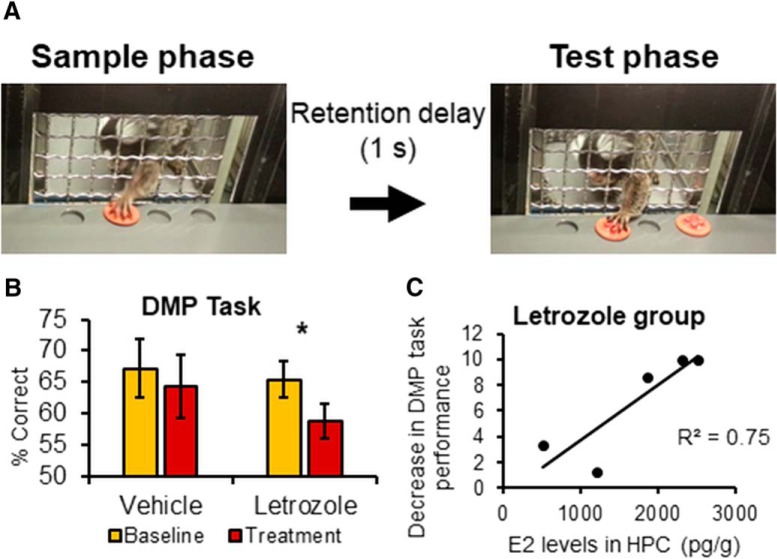
Letrozole (20 μg/d, p.o.) impairs spatial working memory, possibly by E2 in the hippocampus. A, Procedure for a delayed matching-to-sample (DMP) test trial includes the sample phase, when a monkey is presented with a red token placed over 1 of the 4 wells, and is allowed to displace the token to obtain a reward (dehydrated mini marshmallow). The test tray is then concealed from view for 1 s, during which time the reward is replaced and the token is repositioned over the sample location along with an identical token placed over a different well. During the test phase, the monkey must displace the token located in the same position to obtain the reward. Performance was averaged across trials given during a baseline phase, and after 4 weeks of drug treatment. Performance, which was measured as percentage of trials correct, was compared across phases within each experimental group (vehicle: n = 4; letrozole: n = 5). B, Mean accuracy of each group during the baseline and treatment week. Reduced performance was observed in the letrozole group (n = 5), whereas performance in the vehicle group (n = 4) did not change. *p < 0.05. Error bars indicate SEM. C, A larger reduction in performance is associated with higher E2 levels in the hippocampus within the letrozole group (r = −0.87, p = 0.058).
Figure 4.
Figure 4.
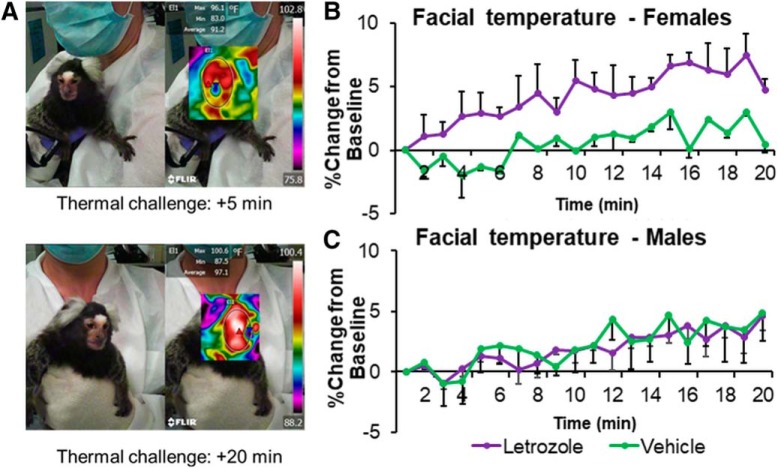
Letrozole (20 μg/d, p.o.) exerts sex-specific reduction in thermoregulation during thermal challenge. A, Facial temperature was measured via thermal camera during a 20 min thermal challenge. Representative images obtained 5 min and 20 min into the challenge are shown, along with the temperature reading. Percentage change in temperature (°F) from the first minutes of the thermal challenge was plotted over time for females (B; vehicle: n = 2; letrozole: n = 4) and males (C; vehicle: n = 5, letrozole: n = 4). Letrozole treatment resulted in greater elevation in temperature across time for females only (p < 0.001). Error bars indicate SEM.
Figure 5.
Figure 5.
IE of CA1 pyramidal neurons is attenuated by 4 weeks of letrozole treatment (20 μg/d, p.o.). *p < 0.05 on all 4 measures. This is observed across 4 measures. A, Firing frequency (Hz) is attenuated as a function of injected current from letrozole-treated cells (n = 14) relative to vehicle (n = 15). This shift in excitability was also related to changes in spontaneous activity by letrozole treatment, as indicated by (B) greater AHP amplitude (AHP; mV), (C) lower RMP (mV), and (D) lower spontaneous spike rate (Hz). Error bars indicate SEM.
Figure 6.
Figure 6.
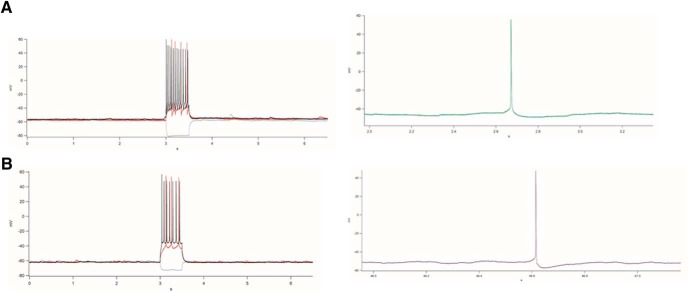
Representative recordings from CA1 pyramidal cells from animals following vehicle treatment (A) and letrozole treatment (B). Left, Voltage traces during 500 ms current steps. Gray represents −50 pA. Red represents rheobase. Black represents twice rheobase. Right, Single spontaneous action potentials showing differences in AHP amplitude.

References

    1. Ayoub DM, Greenough WT, Juraska JM (1983) Sex differences in dendritic structure in the preoptic area of the juvenile macaque monkey brain. Science 219:197–198. 10.1126/science.6849133 - DOI - PubMed
    1. Azcoitia I, Yague JG, Garcia-Segura LM (2011) Estradiol synthesis within the human brain. Neuroscience 191:139–147. 10.1016/j.neuroscience.2011.02.012 - DOI - PubMed
    1. Bailey DJ, Makeyeva YV, Paitel ER, Pedersen AL, Hon AT, Gunderson JA, Saldanha CJ (2017) Hippocampal aromatization modulates spatial memory and characteristics of the synaptic membrane in the male zebra finch. Endocrinology 158:852–859. 10.1210/en.2016-1692 - DOI - PMC - PubMed
    1. Bajetta E, Zilembo N, Dowsett M, Guillevin L, Di Leo A, Celio L, Martinetti A, Marchianò A, Pozzi P, Stani S, Bichisao E (1999) Double-blind, randomised, multicentre endocrine trial comparing two letrozole doses, in postmenopausal breast cancer patients. Eur J Cancer 35:208–213. 10.1016/S0959-8049(98)00392-X - DOI - PubMed
    1. Baker FC, Willoughby AR, Sassoon SA, Colrain IM, de Zambotti M (2015) Insomnia in women approaching menopause: Beyond perception. Psychoneuroendocrinol 60: 96–104. 10.1016/j.psyneuen.2015.06.005 - DOI - PMC - PubMed

Publication types

LinkOut - more resources