. 2018 Dec 19:12:69-81.
doi: 10.2147/JPR.S186372. eCollection 2019.

Cytokine production capabilities of human primary monocyte-derived macrophages from patients with diabetes mellitus type 2 with and without diabetic peripheral neuropathy

Affiliations

Cytokine production capabilities of human primary monocyte-derived macrophages from patients with diabetes mellitus type 2 with and without diabetic peripheral neuropathy

Perla Abigail Alvarado-Vázquez et al. J Pain Res. .

Abstract

Introduction: Monocytes from patients with diabetes mellitus type 2 (DM2) are dysfunctional, persistently primed, and prone to a proinflammatory phenotype. This may alter the phenotype of their differentiation to macrophages and result in diabetic peripheral neuropathy (DPN), nerve damage, nerve sensitization, and chronic pain. We have previously demonstrated that CD163 is a molecule that promotes an anti-inflammatory cellular phenotype in human primary macrophages, but this has not been proven in macrophages from patients with DM2 or DPN. Thus, we hypothesize that macrophages from patients with DM2 or DPN display an altered proinflammatory functional phenotype related to cytokine production and that the induction of CD163 expression will promote a more homeostatic phenotype by reducing their proinflammatory responsiveness.

Patients and methods: We tested these hypotheses in vitro using blood monocyte-derived macrophages from healthy subjects and patients with DM2 with and without DPN. Cells were incubated in the presence or the absence of 5 µg/mL of lipopolysaccharide (LPS). The concentrations of interleukin-10, interleukin-6, tumor necrosis factor-alpha (TNF-α), TGF-β, and monocyte chemoattractant protein-1 (MCP-1) were measured using ELISA assays. Macrophages were transfected with an empty vector plasmid or a plasmid containing the CD163 gene using mannosylated polyethylenimine nanoparticles.

Results: Our results show that nonstimulated DM2 or DPN macrophages have a constitutive primed proinflammatory state and display a deficient production of proinflammatory cytokines upon a proinflammatory challenge when compared to healthy macrophages. CD163 induction produced an anti-inflammatory phenotype in the healthy control group, and this effect was partial in DM2 or DPN macrophages.

Conclusion: Our results suggest that diabetic macrophages adopt a complex phenotype that is only partially reversed by CD163 induction. Future experiments are focused on elucidating this differential responsiveness between healthy and diabetic macrophages.

Keywords: CD163; LPS; primary human macrophages; transfection.


Conflict of interest statement

Disclosure The authors report no conflicts of interest in this work.

Figures
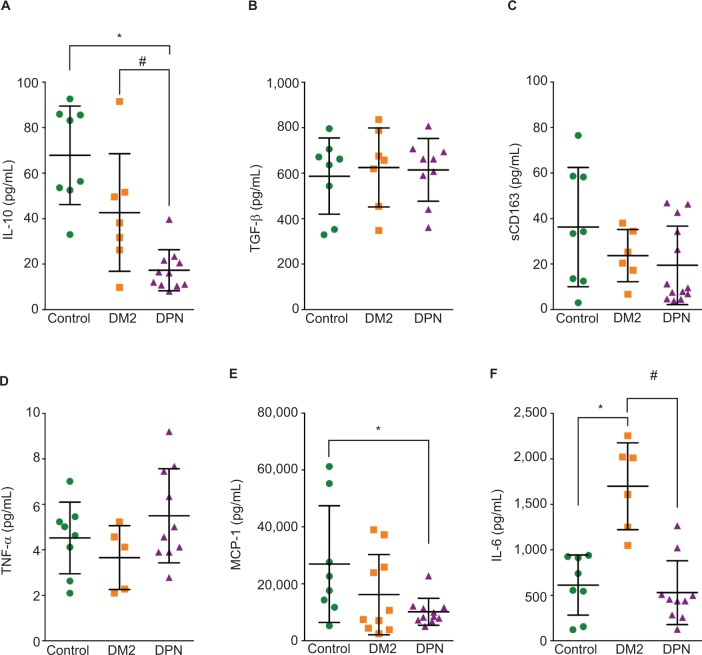
Figure 1
Figure 1
Cytokine concentration in nonstimulated primary human macrophages. Notes: Quantification for IL-10 (A), TGF-β (B), sCD163 (C), TNF-α (D), MCP-1 (E), and IL-6 (F) protein concentration in nonstimulated primary human macrophages from control, diabetic patients, and patients with DPN. Data shown are mean±SD; n=5–13. *P<0.05 vs the control group by Student’s t-test, #P<0.05 vs the connected group by Student’s t-test. Abbreviations: DM2, diabetes mellitus type 2; DPN, diabetic peripheral neuropathy; TNF-α, tumor necrosis factor-alpha; MCP-1, monocyte chemoattractant protein-1.
Figure 2
Figure 2
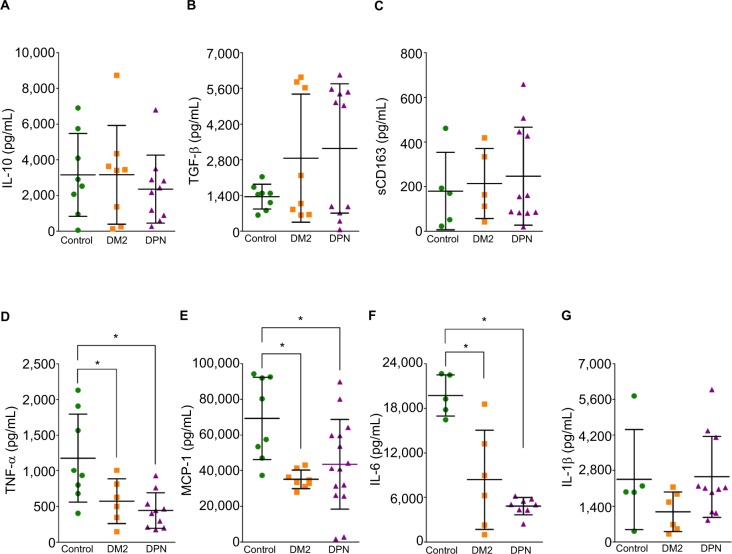
Cytokine concentration in LPS-stimulated primary human macrophages. Notes: Quantification for IL-10 (A), TGF-β (B), sCD163 (C), TNF-α (D), MCP-1 (E), IL-6 (F), and IL-1β (G) protein concentration in LPS-stimulated primary human macrophages from control, diabetic patients, and patients with DPN. Data shown are mean±SD; n=5–13. *P<0.05, vs the control group by Student’s t-test. Abbreviations: DM2, diabetes mellitus type 2; DPN, diabetic peripheral neuropathy; LPS, lipopolysaccharide; TNF-α, tumor necrosis factor-alpha; MCP-1, monocyte chemoattractant protein-1.
Figure 3
Figure 3
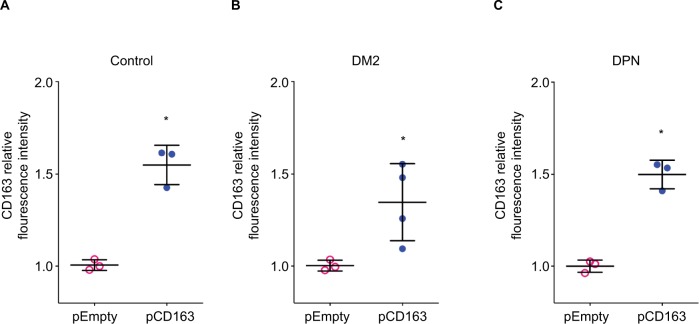
Overexpression of CD163 in human primary macrophages from healthy, diabetic patients, and DPN patients. Notes: Quantification of CD163 protein expression in primary human macrophages from control (A), diabetic patients (B), or diabetic patients with DPN (C) transfected with a plasmid encoding for CD163 gene (pCD163, blue symbols) or the empty vector (pEmpty, pink symbols). The fluorescence intensity of CD163 was normalized to the control group (pEmpty), which was assigned a value equal to 1. Data shown are mean±SD; n=3–4. *P<0.05 vs their respective pEmpty group by Student’s t-test. Abbreviations: DM2, diabetes mellitus type 2; DPN, diabetic peripheral neuropathy.
Figure 4
Figure 4
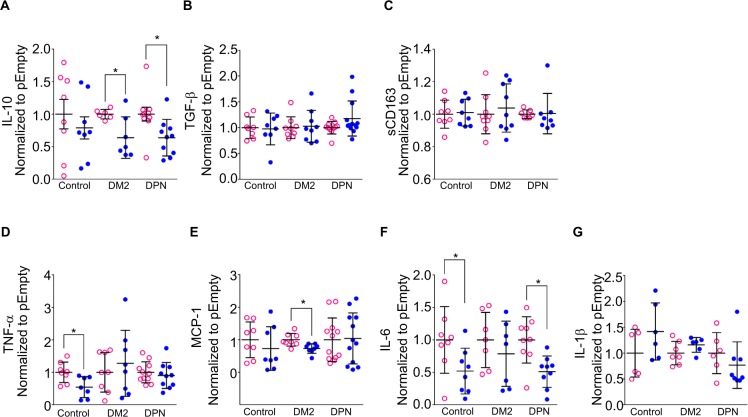
Cytokine expression in CD163-overexpressing macrophages from healthy, diabetic patients, and DPN patients. Notes: Quantification for IL-10 (A), TGF-β (B), sCD163 (C), TNF-α (D), MCP-1 (E), IL-6 (F), and IL-1β (G) protein concentration in primary human macrophages from healthy (control), diabetic patients, and patients with DPN. The macrophages were transfected with a CD163 gene (pCD163, blue symbols) or an empty vector (pEmpty, pink symbols). The concentration of each cytokine/chemokine was normalized to the control group (pEmpty), which was assigned a value equal to 1. Data shown are mean±SD; n=6–13. *P<0.05 vs their respective pEmpty group by Student’s t-test. Abbreviations: DM2, diabetes mellitus type 2; DPN, diabetic peripheral neuropathy; TNF-α, tumor necrosis factor-alpha; MCP-1, monocyte chemoattractant protein-1.

References

    1. Ogurtsova LU, Guariguata L, Whiting D, Shaw J, da Rocha Fernandes JD. IDF Diabetes Atlas: estimates for 2015 and 2040. Diabetes Res Clin Pract Press. 2015;128:40–50. - PubMed
    1. Barry JC, Shakibakho S, Durrer C, et al. Hyporesponsiveness to the anti-inflammatory action of interleukin-10 in type 2 diabetes. Sci Rep. 2016;6:21244. - PMC - PubMed
    1. Callaghan BC, Cheng HT, Stables CL, Smith AL, Feldman EL. Diabetic neuropathy: clinical manifestations and current treatments. Lancet Neurol. 2012;11(6):521–534. - PMC - PubMed
    1. Donath MY, Shoelson SE. Type 2 diabetes as an inflammatory disease. Nat Rev Immunol. 2011;11(2):98–107. - PubMed
    1. Juster-Switlyk K, Smith AG. Updates in diabetic peripheral neuropathy. F1000Res. 2016;5:738. - PMC - PubMed