. 2019 Mar;23(3):1714-1722.
doi: 10.1111/jcmm.14069. Epub 2018 Dec 26.

Alteration in gut microbiota caused by time-restricted feeding alleviate hepatic ischaemia reperfusion injury in mice

Affiliations

Alteration in gut microbiota caused by time-restricted feeding alleviate hepatic ischaemia reperfusion injury in mice

Jinjun Ren et al. J Cell Mol Med. 2019 Mar.

Abstract

Time-restricted feeding (TRF), that is, no caloric intake for 14-16 hours each day leads to favourable nutritional outcomes. This study is the first to investigate TRF through a surgical perspective verifying its efficacy against liver ischaemia reperfusion (I/R) injury. We randomly assigned 100 10-week-old wild-type male C57BL/6 mice into two feeding regimens: TRF and ad libitum access to food. Main outcomes were evaluated at 6, 12 and 24 hours post-I/R surgery after 12 weeks of intervention. TRF group demonstrated minor liver injury via histological study; lower serum levels of liver enzymes, glucose and lipids; higher concentrations of free fatty acid and β-hydroxybutyrate; decreased oxidative stress and inflammatory biomarkers; as well as less severe cell apoptosis and proliferation. Further exploration indicated better gut microenvironment and intestinal epithelial tight junction function. TRF employed its positive influence on a wide spectrum of biochemical pathways and ultimately revealed protective effect against hepatic I/R injury possibly through adjusting the gut microbiota. The results referred to a strong indication of adopting better feeding pattern for surgical patients.

Keywords: gut microbiome; hepatic ischaemia reperfusion injury; time-restricted feeding.


Figures

Figure 1
Figure 1
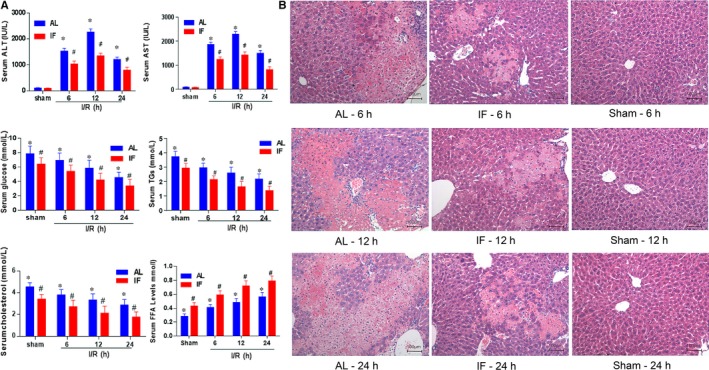
Indicators of ischaemia reperfusion injury. (A) Biochemistry profiles reflecting the severity of liver impairment, including serum ALT, AST, glucose, TGs, cholesterol and FFA levels were measured at the first 6, 12 and 24 h after hepatic portal occlusion surgery respectively. Sham operations were performed in the control group. *P < 0.05 indicated significant difference between ischaemia reperfusion group and sham group. # P < 0.05 was tagged if statistical significance was detected between AL and TRF groups at a given time. If not specified, n = 6. (B). Representative H&E‐stained histological sections of liver at 6, 12 and 24 h after portal vein blockage and sham operation (10 × 20 magnification). AL: ad libitum; TRF: Time‐restricted feeding; ALT: Alanine transaminase; AST: aspartate transaminase; TGs: triglycerides; FFA: free fatty acid
Figure 2
Figure 2
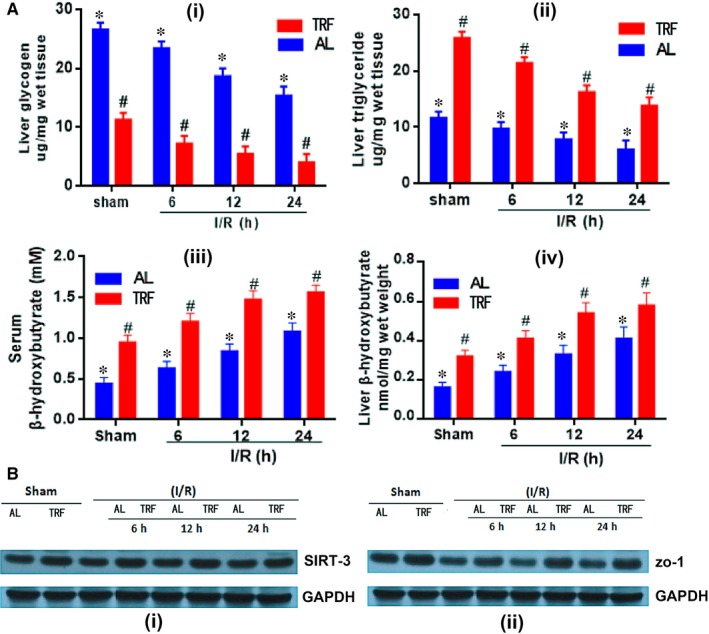
Alterations of liver energy source. (A) Concentrations of liver glycogen, liver triglyceride, serum β‐hydroxybutyrate and liver β‐hydroxybutyrate were shown by different timing and feeding model respectively, *P < 0.05 indicated significant difference between ischaemia reperfusion group and sham group. #P < 0.05 was tagged if statistical significance was detected between AL and TRF groups, n = 6. (B) Western blot was applied to show the increase of SIRT‐3 and zo‐1 proteins caused by TRF dietary pattern. GAPDH was used as the internal reference. AL: ad libitum; TRF: Time‐restricted feeding; zo‐1: zonula occludens‐1; GAPDH: glyceraldehyde 3‐phosphate dehydrogenase
Figure 3
Figure 3
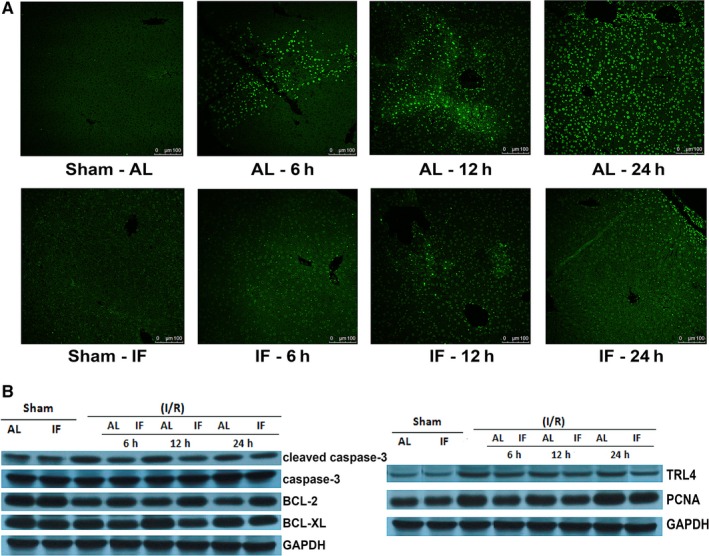
Hepatocytes apoptosis and regeneration. (A) Represented TUNEL‐stained histological liver sections of sham operation, as well as 6, 12 and 24 h after ischaemia reperfusion surgery by AL and TRF groups, n = 4. (B) Western blot results of some proteins participating in the process of cell apoptosis and regeneration. GAPDH was used as the internal reference, n = 5. AL: ad libitum; TRF: Time‐restricted feeding; TUNEL: terminal‐deoxynucleotidyl transferase mediated nick‐end labelling; Bcl‐2: B‐cell lymphoma 2; Bcl‐Xl: B‐cell lymphoma‐extra large; GAPDH: glyceraldehyde 3‐phosphate dehydrogenase; TRL4: toll‐like receptor 4; PCNA: Proliferating cell nuclear antigen
Figure 4
Figure 4
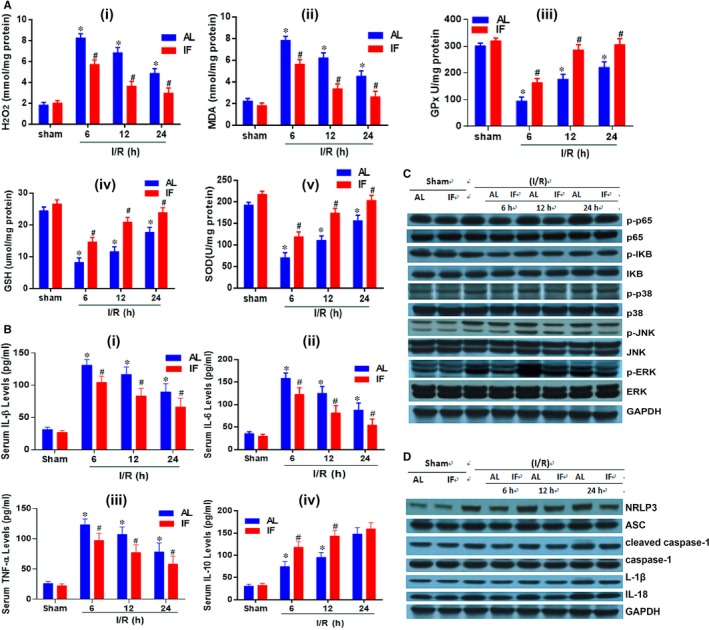
Biomarkers of oxidative stress and inflammatory reactions. (A) The levels of oxidative stress biomarkers in the liver measured at 6, 12, 24 h post‐operation, and comparison with the sham group. Biomarkers included: H2O2, MDA, GPx, GSH, and SOD. (B) Serum concentration of inflammatory factors including TNF‐α, IL‐1β, IL‐6, and IL‐10. *P < 0.05 indicated significant difference between ischaemia reperfusion group and sham group. #P < 0.05 was tagged if statistical significance was detected between AL and TRF groups, n = 6. (C) Western blot showing titre of proteins involved in ischaemia reperfusion injury pathways. (D) Demonstration of inflammatory complex and proteins via Western blot technology. AL: ad libitum; TRF: time‐restricted feeding; MDA: malondialdehyde; GPx: glutathione peroxidase; GSH: glutathione; SOD: superoxide dismutase; TNF‐α: tumour necrosis factor‐ α, IL: interleukin; p‐p65: phospho‐P65‐nuclear factor (NF)‐κB; p‐IKB: phospho‐IκB; p‐p38: phospho‐p38; GAPDH: glyceraldehyde 3‐phosphate dehydrogenase; NLRP3: NACHT, LRR and PYD domains‐containing protein 3; ASC: apoptosis‐associated speck‐like protein containing a caspase recruitment domain
Figure 5
Figure 5
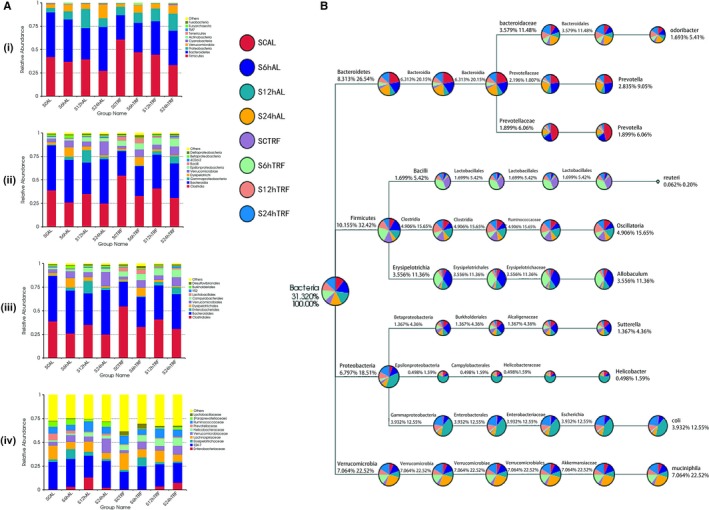
Gut microbiota. (A) Showed top 10 bacteria under phylum, class, order and family levels. Faeces samples were harvested at 6, 12 and 24 h after hepatic portal occlusion surgery, and controls were collected from sham operation group, n = 6. (B) Taxonomy tree revealing the relative abundance of the most frequent species detected. Different faeces samples collected at different timing from either AL or TRF group were indicated by different colours, and the sizes of circles represented the proportion of the corresponding micro‐organism, n = 6. SCAL: surgical control ad libitum; S6hAL: surgical 6 h ad libitum; S12hAL: surgical 12 h ad libitum; S24hAL: surgical 24 h ad libitum; SCTRF: surgical control time‐restricted feeding; S6hTRF: surgical 6 h time‐restricted feeding; S12hTRF: surgical 12 h time‐restricted feeding; S24hTRF: surgical 24 h time‐restricted feeding

References

    1. Chaix A, Zarrinpar A, Miu P, Panda S. Time‐restricted feeding is a preventative and therapeutic intervention against diverse nutritional challenges. Cell Metab. 2014;20(6):991‐1005. - PMC - PubMed
    1. Rothschild J, Hoddy KK, Jambazian P, Varady KA. Time‐restricted feeding and risk of metabolic disease: a review of human and animal studies. Nutr Rev. 2014;72(5):308‐318. - PubMed
    1. Asher G, Sassone‐Corsi P. Time for food: the intimate interplay between nutrition, metabolism, and the circadian clock. Cell. 2015;161(1):84‐92. - PubMed
    1. Zhang F, Xu X, Zhou B, He Z, Zhai Q. Gene expression profile change and associated physiological and pathological effects in mouse liver induced by fasting and refeeding. PLoS ONE. 2011;6(11):e27553. - PMC - PubMed
    1. Tajiri K, Shimizu Y. Gut bacteria may control development of hepatocellular carcinoma. Hepatobiliary Surg Nutr. 2017;6(6):417‐419. - PMC - PubMed

Publication types