. 2019 Apr;19(4):1202-1211.
doi: 10.1111/ajt.15228. Epub 2019 Jan 23.

Pretransplant sequential hypo- and normothermic machine perfusion of suboptimal livers donated after circulatory death using a hemoglobin-based oxygen carrier perfusion solution

Affiliations

Pretransplant sequential hypo- and normothermic machine perfusion of suboptimal livers donated after circulatory death using a hemoglobin-based oxygen carrier perfusion solution

Yvonne de Vries et al. Am J Transplant. 2019 Apr.

Abstract

Ex situ dual hypothermic oxygenated machine perfusion (DHOPE) and normothermic machine perfusion (NMP) of donor livers may have a complementary effect when applied sequentially. While DHOPE resuscitates the mitochondria and increases hepatic adenosine triphosphate (ATP) content, NMP enables hepatobiliary viability assessment prior to transplantation. In contrast to DHOPE, NMP requires a perfusion solution with an oxygen carrier, for which red blood cells (RBC) have been used in most series. RBC, however, have limitations and cannot be used cold. We, therefore, established a protocol of sequential DHOPE, controlled oxygenated rewarming (COR), and NMP using a new hemoglobin-based oxygen carrier (HBOC)-based perfusion fluid (DHOPE-COR-NMP trial, NTR5972). Seven livers from donation after circulatory death (DCD) donors, which were initially declined for transplantation nationwide, underwent DHOPE-COR-NMP. Livers were considered transplantable if perfusate pH and lactate normalized, bile production was ≥10 mL and biliary pH > 7.45 within 150 minutes of NMP. Based on these criteria five livers were transplanted. The primary endpoint, 3-month graft survival, was a 100%. In conclusion, sequential DHOPE-COR-NMP using an HBOC-based perfusion fluid offers a novel method of liver machine perfusion for combined resuscitation and viability testing of suboptimal livers prior to transplantation.

Keywords: clinical research/practice; donors and donation: extended criteria; ischemia reperfusion injury (IRI); liver allograft function/dysfunction; liver transplantation/hepatology; organ perfusion and preservation; organ procurement; organ procurement and allocation.


Figures

Figure 1
Figure 1
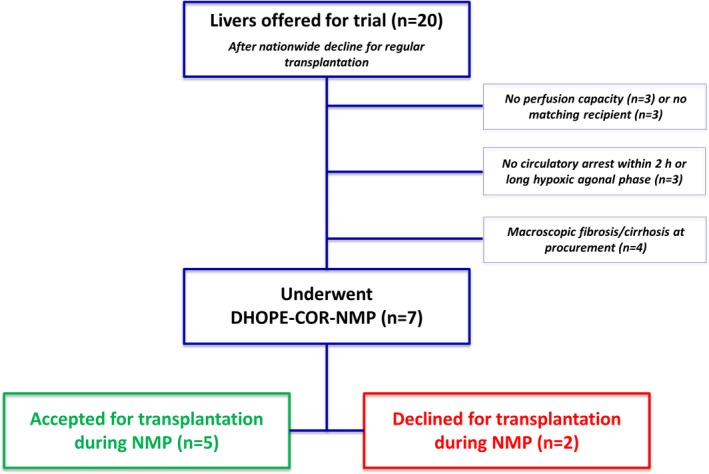
Flow chart of livers offered in the context of the DHOPECORNMP Trial. After initial decline by all Dutch liver transplant centers a total number of 20 livers were offered for inclusion in this trial. Thirteen livers did not undergo machine perfusion due to logistical reasons, long agonal phase, or macroscopic findings. Seven livers underwent machine perfusion for resuscitation and viability assessment. DHOPE, dual hypothermic oxygenated machine perfusion; COR, controlled oxygenated rewarming; NMP, normothermic machine perfusion [Color figure can be viewed at wileyonlinelibrary.com]
Figure 2
Figure 2
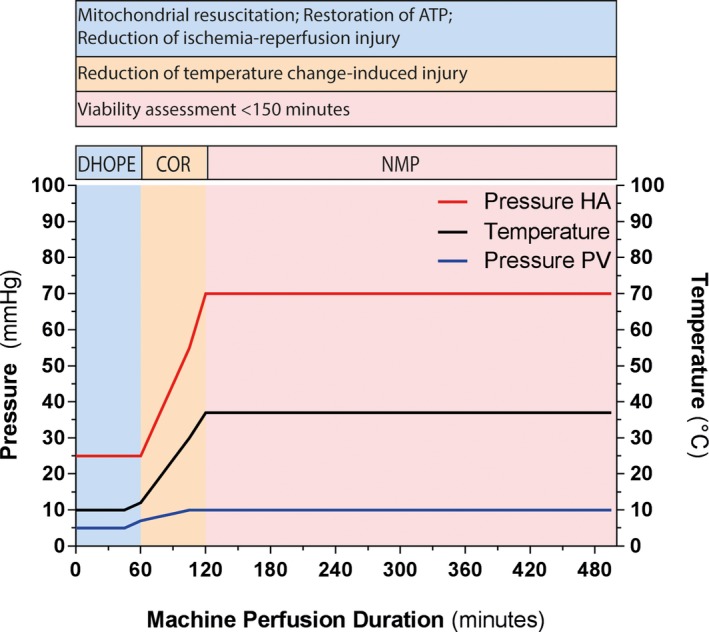
Overview of the machine perfusion protocol. A, The machine perfusion protocol included 1 h of DHOPE, 1 h of COR, and subsequent NMP for at least 150 minutes. Each phase of machine perfusion served a different purpose as described in the upper part of the figure. Machine perfusion settings were adjusted according to the perfusion temperature. The temperature was kept at 10°C during DHOPE and was gradually increased to 37°C during the COR phase, after which the liver was functionally tested during NMP. PV and mean HA pressure were set at 5 and 25 mm Hg, respectively, during DHOPE and were gradually increased during COR to 10 and 70 mm Hg, respectively, at the start of NMP. DHOPE, dual hypothermic oxygenated machine perfusion; COR, controlled oxygenated rewarming; HA, hepatic artery; NMP, normothermic machine perfusion; PV, portal vein [Color figure can be viewed at wileyonlinelibrary.com]
Figure 3
Figure 3
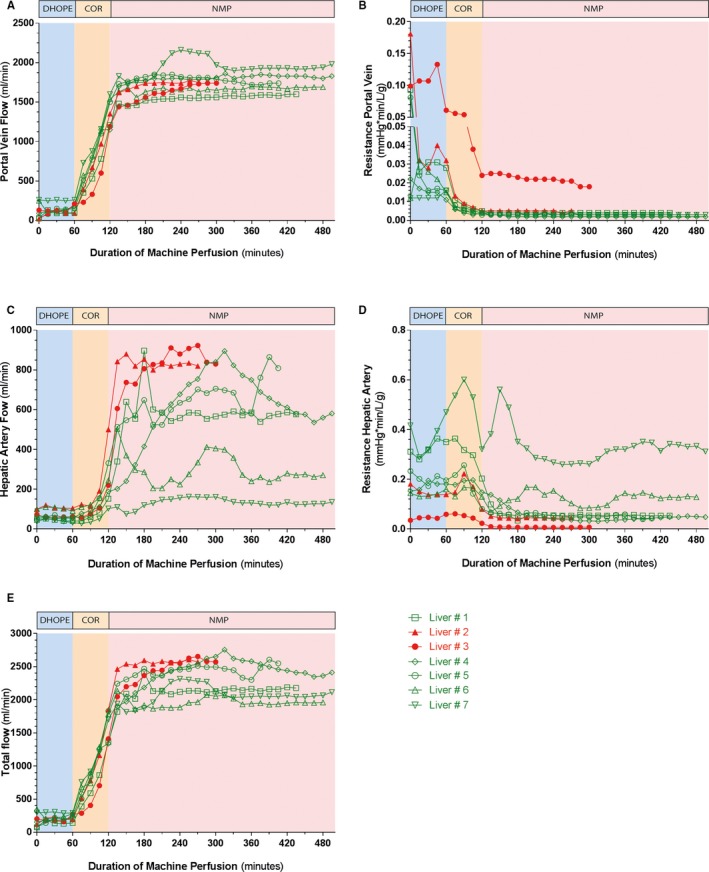
Flows and resistance during machine perfusion. A, PV flows were low during DHOPE. After 150 min of NMP, median portal vein flow was 1680 mL/min (IQR 1460‐1740 mL/min). B, Resistance in the portal vein was low, except for liver #3. C, Hepatic artery (HA) flows were low during DHOPE and COR. During NMP hepatic artery flows varied between 100 and 900 mL/min. At 150 min of NMP, median hepatic artery flow was 547 mL/min (IQR 240‐737 mL/min). D, Resistance in the hepatic artery was <0.2 mm Hg*min/L/g, except for liver #7. E, Total flow increased to a median of 2512 min (IQR 2133‐2570 min) at 150 minutes of NMP. The red lines represent the non‐transplanted livers and the green lines represent the transplanted livers. DHOPE, dual hypothermic oxygenated machine perfusion; COR, controlled oxygenated rewarming; HA, hepatic artery; IQR, interquartile range; NMP, normothermic machine perfusion; PV, portal vein; Tx, transplantation [Color figure can be viewed at wileyonlinelibrary.com]
Figure 4
Figure 4
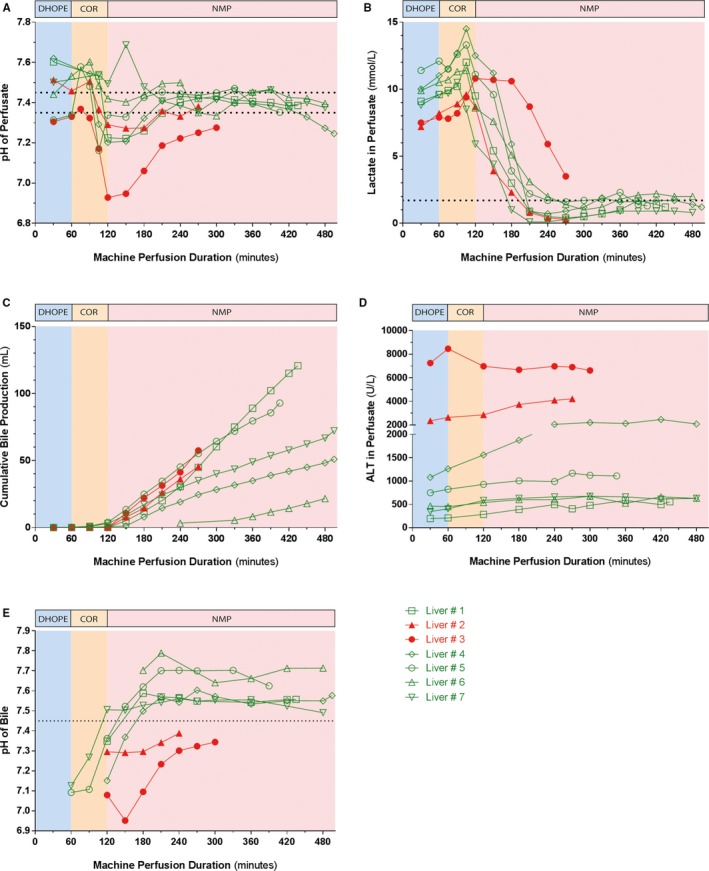
Machine perfusion fluid biochemistry. A‐B, Biochemical parameters used for viability assessment of the liver. In all but one liver, perfusate pH and lactate values normalized within 150 minutes after start of the NMP. C, All livers produced sufficient amounts of bile. Liver #6 seemingly produced less bile due to a cannulation problem of the bile duct. D, ALT perfusate levels were <2000 U/L in the transplanted livers and >2000 U/L in the nontransplanted livers. E, Biliary pH, a marker of biliary epithelial viability, increased to >7.45 in all livers that were transplanted, whereas biliary pH remained <7.45 in the livers that were not transplanted livers. The red lines represent the nontransplanted livers and the green lines represent the transplanted livers. ALT, alanine aminotransferase; NMP, normothermic machine perfusion [Color figure can be viewed at wileyonlinelibrary.com]
Figure 5
Figure 5
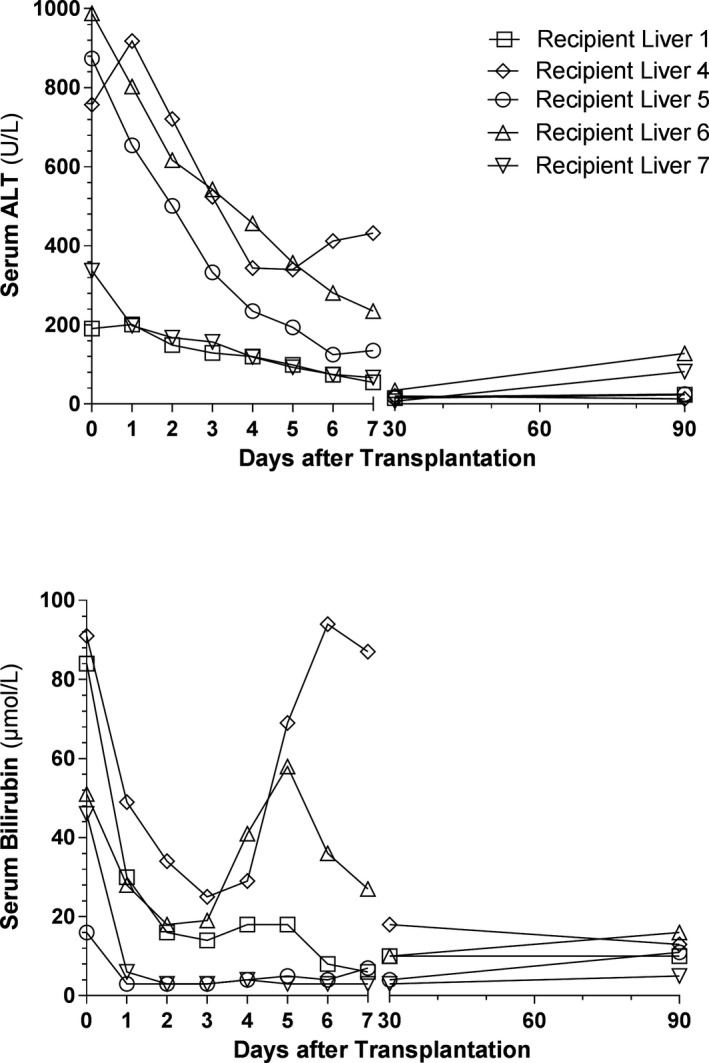
Posttransplantation serum ALT and total bilirubin. Laboratory values were recorded at postoperative day 0 until 7, and at 1 and 3 months. Postoperative day 0 was defined as the time from reperfusion in the recipient until midnight of the same day. A, Postoperative serum ALT concentrations rapidly decreased during the first week. The recipients of liver #1 and #7 had low peak serum ALT concentrations of 201 and 331 U/L, respectively. B, Postoperative total bilirubin concentration likewise decreased during the first week, except for a transient increase in the recipients of livers #4 and #6 at the end of the first week. Bilirubin levels of these livers, however, normalized during the weeks thereafter. ALT, alanine aminotransferase

References

    1. Karangwa SA, Dutkowski P, Fontes P, et al. Machine perfusion of donor livers for transplantation: a proposal for standardized nomenclature and reporting guidelines. Am J Transplant. 2016;16(10):2932‐2942. - PMC - PubMed
    1. van Rijn R, Karimian N, Matton APM, et al. Dual hypothermic oxygenated machine perfusion in liver transplants donated after circulatory death. Br J Surg. 2017;104(7):907‐917. - PMC - PubMed
    1. Dutkowski P, Polak WG, Muiesan P, et al. First comparison of hypothermic oxygenated PErfusion versus static cold storage of human donation after cardiac death liver transplants: an international‐matched case analysis. Ann Surg. 2015;262(5):1. - PubMed
    1. Perera T, Mergental H, Stephenson B, et al. First human liver transplantation using a marginal allograft resuscitated by normothermic machine perfusion. Liver Transpl. 2016;22(1):120‐124. - PubMed
    1. Watson CJ, Kosmoliaptsis V, Randle LV, et al. Preimplant normothermic liver perfusion of a suboptimal liver donated after circulatory death. Am J Transplant. 2016;16(1):353‐357. - PubMed

Publication types