


Toward the Bionic Face: A Novel Neuroprosthetic Device Paradigm for Facial Reanimation Consisting of Neural Blockade and Functional Electrical Stimulation
- PMID: 30589784
- PMCID: PMC6311722
- DOI: 10.1097/PRS.0000000000005164
Toward the Bionic Face: A Novel Neuroprosthetic Device Paradigm for Facial Reanimation Consisting of Neural Blockade and Functional Electrical Stimulation
Abstract
Background: Facial palsy is a devastating condition potentially amenable to rehabilitation by functional electrical stimulation. Herein, a novel paradigm for unilateral facial reanimation using an implantable neuroprosthetic device is proposed and its feasibility demonstrated in a live rodent model. The paradigm comprises use of healthy-side electromyographic activity as control inputs to a system whose outputs are neural stimuli to effect symmetric facial displacements. The vexing issue of suppressing undesirable activity resulting from aberrant neural regeneration (synkinesis) or nerve transfer procedures is addressed using proximal neural blockade.
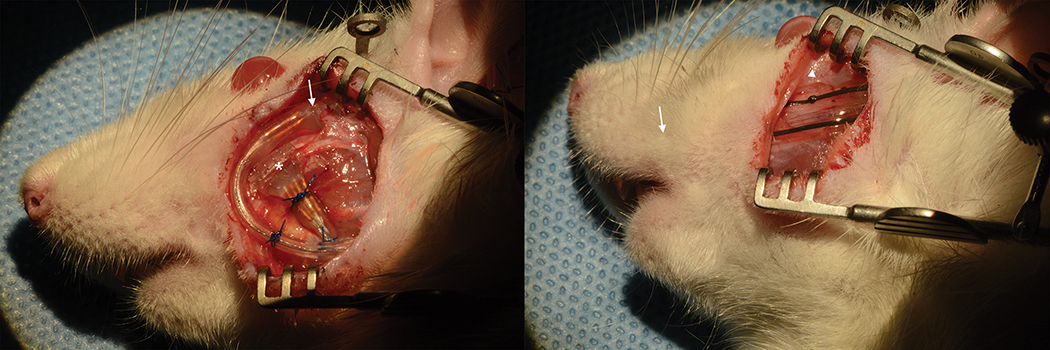
Methods: Epimysial and nerve cuff electrode arrays were implanted in the faces of Wistar rats. Stimuli were delivered to evoke blinks and whisks of various durations and amplitudes. The dynamic relation between electromyographic signals and facial displacements was modeled, and model predictions were compared against measured displacements. Optimal parameters to achieve facial nerve blockade by means of high-frequency alternating current were determined, and the safety of continuous delivery was assessed.
Results: Electrode implantation was well tolerated. Blinks and whisks of tunable amplitudes and durations were evoked by controlled variation of neural stimuli parameters. Facial displacements predicted from electromyographic input modelling matched those observed with a variance-accounted-for exceeding 96 percent. Effective and reversible facial nerve blockade in awake behaving animals was achieved, without detrimental effect noted from long-term continual use.
Conclusions: Proof-of-principle of rehabilitation of hemifacial palsy by means of a neuroprosthetic device has been demonstrated. The use of proximal neural blockade coupled with distal functional electrical stimulation may have relevance to rehabilitation of other peripheral motor nerve deficits.
Figures




References
-
- Coulson SE, O’Dwyer N,J, Adams RD, Croxson GR Expression of emotion and quality of life after facial nerve paralysis. Otol Neurotol 2004;25:1014–1019. - PubMed
-
- Ryzenman JM, Pensak ML, Tew JM Jr. Facial paralysis and surgical rehabilitation: a quality of life analysis in a cohort of 1,595 patients after acoustic neuroma surgery. Otol Neurotol 2005;26:516–521; discussion 521. - PubMed
-
- Lassaletta L, Alfonso C, Del Rio, L., Roda JM, Gavilan J Impact of facial dysfunction on quality of life after vestibular schwannoma surgery. Annals of Otology, Rhinology & Laryngology 2006;115:694–698. - PubMed
-
- Mehta RP, WernickRobinson M, Hadlock TA Validation of the Synkinesis Assessment Questionnaire. Laryngoscope 2007;117:923–926. - PubMed
-
- Hadlock T, Cheney ML Facial reanimation: an invited review and commentary. Arch Facial Plast Surg 2008;10:413–417. - PubMed
MeSH terms
Grants and funding
LinkOut - more resources
Full Text Sources
Other Literature Sources
