. 2019 May 1;28(9):1474-1486.
doi: 10.1093/hmg/ddy436.

Kctd13-deficient mice display short-term memory impairment and sex-dependent genetic interactions

Affiliations

Kctd13-deficient mice display short-term memory impairment and sex-dependent genetic interactions

Thomas Arbogast et al. Hum Mol Genet. .

Abstract

The 16p11.2 BP4-BP5 deletion and duplication syndromes are associated with a complex spectrum of neurodevelopmental phenotypes that includes developmental delay and autism spectrum disorder, with a reciprocal effect on head circumference, brain structure and body mass index. Mouse models of the 16p11.2 copy number variant have recapitulated some of the patient phenotypes, while studies in flies and zebrafish have uncovered several candidate contributory genes within the region, as well as complex genetic interactions. We evaluated one of these loci, KCTD13, by modeling haploinsufficiency and complete knockout in mice. In contrast to the zebrafish model, and in agreement with recent data, we found normal brain structure in heterozygous and homozygous mutants. However, recapitulating previously observed genetic interactions, we discovered sex-specific brain volumetric alterations in double heterozygous Kctd13xMvp and Kctd13xLat mice. Behavioral testing revealed a significant deficit in novel object recognition, novel location recognition and social transmission of food preference in Kctd13 mutants. These phenotypes were concomitant with a reduction in density of mature spines in the hippocampus, but potentially independent of RhoA abundance, which was unperturbed postnatally in our mutants. Furthermore, transcriptome analyses from cortex and hippocampus highlighted the dysregulation of pathways important in neurodevelopment, the most significant of which was synaptic formation. Together, these data suggest that KCTD13 contributes to the neurocognitive aspects of patients with the BP4-BP5 deletion, likely through genetic interactions with other loci.


Figures

Figure 1
Figure 1
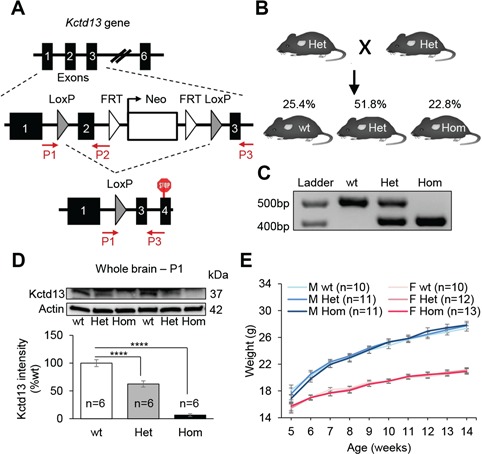
Kctd13 deficiency does not affect postnatal growth and viability. (A)Kctd13 deletion targeting strategy. We introduced LoxP sites flanking exon 2 of Kctd13 gene. Animals haploinsufficient for Kctd13 (Het) were obtained by crossing floxed mice with animals expressing the Cre under the CMV promoter, allowing the deletion of targeted exon in all tissues. (B) Mouse mating strategy used to generate mouse cohorts and ratios per genotype observed. (C) Molecular validation by PCR. (D) Western blots against Kctd13 and β-actin. Whole brains from P1 mice were used as samples. (E) Evolution of the body weight (g). Data are represented as the mean ± s.e.m., ****P < 0.0001 versus wt. Tukey’s test applied following a significant one-way ANOVA.
Figure 2
Figure 2
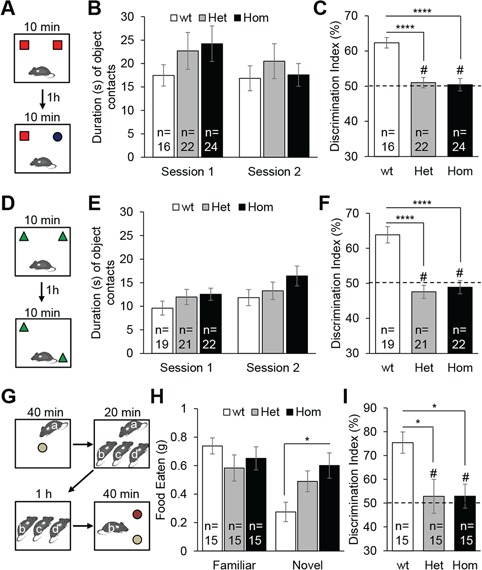
Kctd13 mutant mice show deficiency in short-term memory. (A) Experiment design of novel object recognition test consisting in two 10 min sessions with a delay of 1 h between sessions 1 and 2. (B) Exploration time (s) of the two familiar objects in session 1 and the familiar and novel objects in session 2. (C) Discrimination index (%) reflects the ability of mice to distinguish the novel object from the familiar object after a 1 h retention delay. The dashed line denotes a chance level of 50%. (D) Experiment design of novel location recognition test. (E) Exploration time (s) of the two familiar objects in session 1 and the unmoved and moved objects in session 2. (F) Discrimination index (%). (G) Experiment design of social transmission of food preference test. Mouse a: demonstrator; mice b, c, d: observers. (H) Quantity of food eaten (g) by the observer mice for the familiar and novel flavored pellets. (I) Discrimination index (%) reflects the ability of the observer mice to distinguish the familiar flavored food from the novel flavored food after a 1 h retention delay. Data are represented as the mean ± s.e.m., # not significant compared to 50%, *P < 0.05 versus wt, ****P < 0.0001 versus wt. Tukey’s test applied following a significant one-way ANOVA.
Figure 3
Figure 3
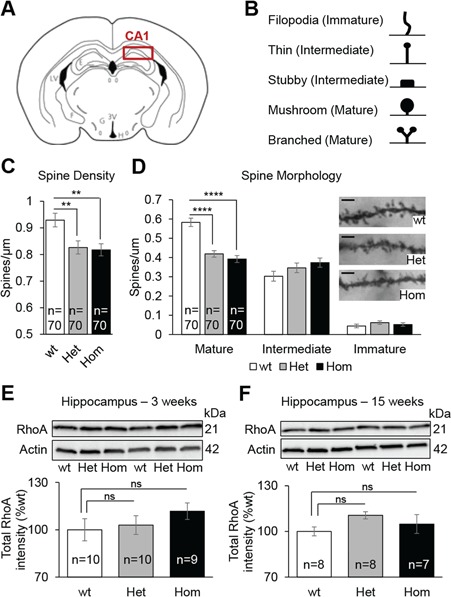
Kctd13 deficiency induce spine maturation deficit in the CA1 region of the hippocampus. (A) Coronal brain diagram indicating the region of interest. (B) Categorization of Golgi-Cox-stained dendritic spine types. Ten micrometer stretches of dendrites were analyzed. (C) Quantification of dendritic spine density of CA1 pyramidal neurons. (D) Representative dendrite stretches (scale bar: 2 μm) and spine morphology of dendritic stretches analyzed. (E and F) Western blots against RhoA and β-actin. Hippocampi from 3- and 15-week-old mice were used as samples. Data are represented as the mean ± s.e.m.; ns, not significant; ****P < 0.0001 versus wt. Tukey’s test applied following a significant one-way ANOVA.
Figure 4
Figure 4
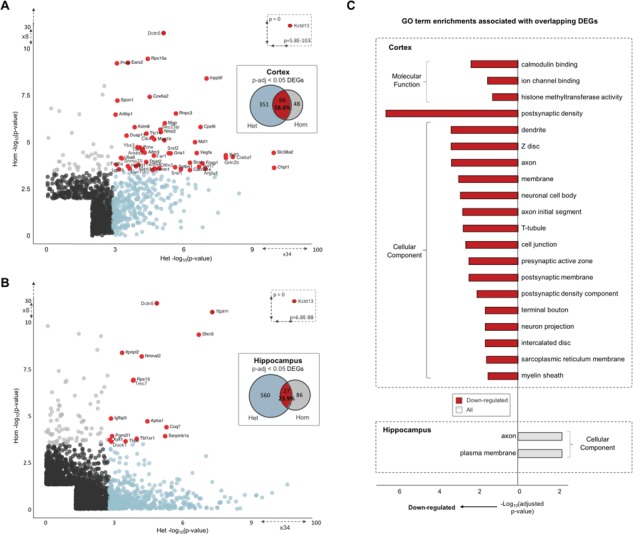
DEGs and associated enriched GO pathways. Cortex (A) and hippocampus (B) significant DEGs. The −log10P-values for significant (P-nominal < 0.05) protein-coding Het DEGs (x-axis) are plotted against Hom DEGs (y-axis). Het DEGs that reach significance at adjusted thresholds (P-adj < 0.05) are colored in blue, and Hom DEGs in gray. Overlapping adjusted significant DEGs across genotype comparisons are colored in red and gene names given. (C) Significant GO term enrichments (P-adj < 0.05) for overlapping Het and Hom DEGs (P-value < 0.05) for cortex and hippocampus. Red shading indicates terms associated with downregulated DEGs, and blue for upregulated terms. GO term categories are given outside of brackets.
Figure 5
Figure 5
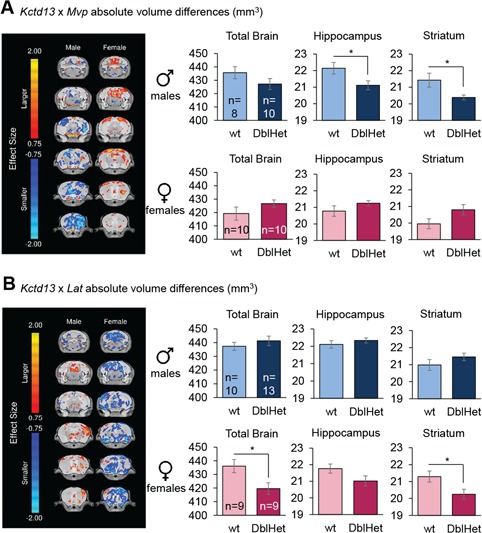
Kctd13xMvp and Kctd13xLat DblHet mutant mice show sex-specific brain structure alterations. (A)Kctd13xMvp Het mice. (B)Kctd13xLat mice. Highlighted are the trends, shown with effect size differences, in absolute volume throughout the brain on six different coronal sections. Bar graphs represent absolute volume on the total brain size, hippocampus and striatum. DblHet, double heterozygous. Data are represented as the mean ± s.e.m., *P < 0.05 versus wt. Student’s t-test.

References

    1. Cooper G.M., Coe B.P., Girirajan S., Rosenfeld J.A., Vu T.H., Baker C., Williams C., Stalker H., Hamid R., Hannig V. et al. (2011) A copy number variation morbidity map of developmental delay. Nat. Genet., 43, 838–U844. - PMC - PubMed
    1. Grayton H.M., Fernandes C., Rujescu D. and Collier D.A. (2012) Copy number variations in neurodevelopmental disorders. Prog. Neurobiol., 99, 81–91. - PubMed
    1. Moreno-De-Luca D., Sanders S.J., Willsey A.J., Mulle J.G., Lowe J.K., Geschwind D.H., State M.W., Martin C.L. and Ledbetter D.H. (2013) Using large clinical data sets to infer pathogenicity for rare copy number variants in autism cohorts. Mol. Psychiatry, 18, 1090–1095. - PMC - PubMed
    1. Jacquemont S., Reymond A., Zufferey F., Harewood L., Walters R.G., Kutalik Z., Martinet D., Shen Y.P., Valsesia A., Beckmann N.D. et al. (2011) Mirror extreme BMI phenotypes associated with gene dosage at the chromosome 16p11.2 locus. Nature, 478, 97–U111. - PMC - PubMed
    1. Weiss L.A., Shen Y.P., Korn J.M., Arking D.E., Miller D.T., Fossdal R., Saemundsen E., Stefansson H., Ferreira M.A.R., Green T. et al. (2008) Association between microdeletion and microduplication at 16p11.2 and autism. N. Engl. J. Med., 358, 667–675. - PubMed

Publication types

MeSH terms

Substances