


Comparative Effectiveness of Group-Delivered Acceptance and Commitment Therapy versus Cognitive Behavioral Therapy for Smoking Cessation: A Randomized Controlled Trial
- PMID: 30590810
- PMCID: PMC7297086
- DOI: 10.1093/ntr/nty268
Comparative Effectiveness of Group-Delivered Acceptance and Commitment Therapy versus Cognitive Behavioral Therapy for Smoking Cessation: A Randomized Controlled Trial
Abstract
Introduction: Preliminary trial data suggest group-delivered acceptance and commitment therapy (ACT) might be effective for smoking cessation. If so, this could offer a viable alternative to mainstream behavioral therapies, such as those grounded in cognitive behavioral therapy (CBT). The goal of the current study was to compare the effectiveness of group-delivered ACT versus group-delivered CBT in a rigorous randomized trial design with long-term follow-up.
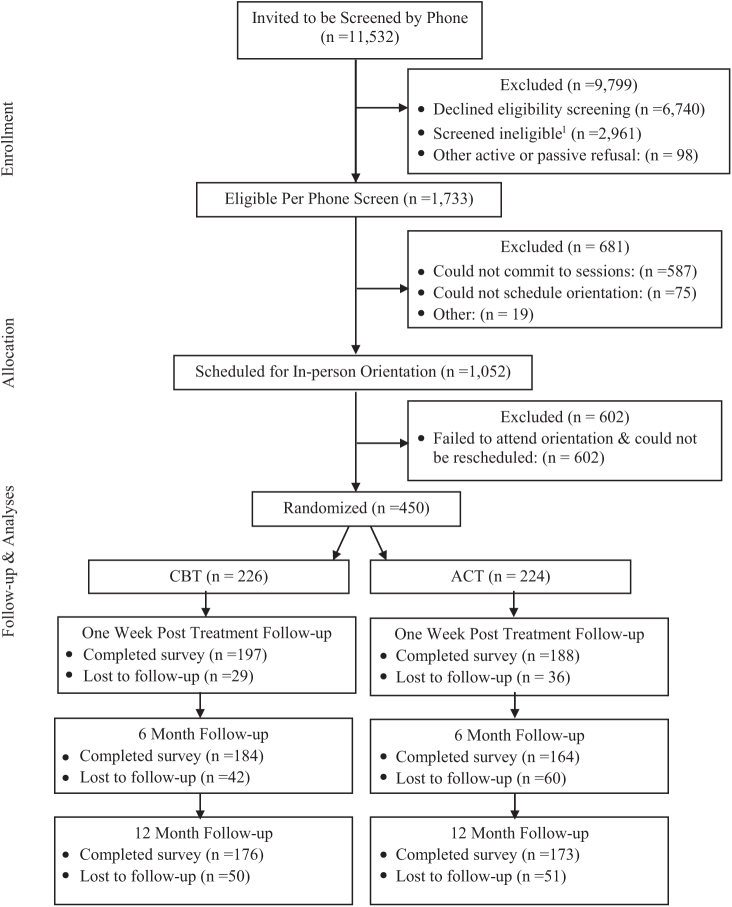
Methods: Participants (n = 450) were recruited from the Kaiser Permanente Washington health care system and randomized to either ACT-based group counseling or an attention-matched CBT-based group program. All were prescribed an 8-week course of nicotine patches. The primary outcome was self-reported 30-day point prevalence abstinence at 12 months post-randomization assessed with missing values imputed as smoking. Sensitivity analyses using multiple imputation and complete cases were examined, as were biochemically confirmed and 6-month outcomes.
Results: Thirty-day point prevalence abstinence rates at the 12-month follow-up did not differ between study arms in the primary analysis (13.8% ACT vs. 18.1% CBT, adjusted odds ratio = 0.68 [95% CI = 0.35 to 1.27], p = .23) or the sensitivity analyses.
Conclusions: Group-based ACT and CBT had similar long-term quit rates in this methodologically rigorous randomized trial. Group-based ACT is a reasonable alternative to group-based CBT for smoking cessation.
Implications: This study compared the effectiveness of group-based ACT with group-based CBT for smoking cessation using a rigorous, large-scale, attention-matched, randomized trial with 1-year follow-up. One-year cessation rates did not differ between group-based ACT and CBT, suggesting ACT-based intervention is a reasonable alternative to CBT-based counseling for smoking cessation. The results add to the nascent but growing literature assessing ACT and other mindfulness-based treatments for smoking cessation.
© The Author(s) 2018. Published by Oxford University Press on behalf of the Society for Research on Nicotine and Tobacco. All rights reserved. For permissions, please e-mail: journals.permissions@oup.com.
Figures
References
-
- Perkins KA, Conklin CA, Levine MD.. Cognitive-Behavioral Therapy for Smoking Cessation: A Practical Guidebook to the Most Effective Treatments. New York, NY: Routledge; 2008.
-
- Hayes SC, Luoma JB, Bond FW, Masuda A, Lillis J. Acceptance and commitment therapy: model, processes and outcomes. Behav Res Ther. 2006;44(1):1–25. - PubMed
-
- Hayes SC, Strosahl KD, Wilson KG.. Acceptance and Commitment Therapy: The Process and Practice of Mindful Change. New York, NY: The Guilford Press; 2012.
Publication types
MeSH terms
Grants and funding
LinkOut - more resources
Full Text Sources
Medical
