


eHealth Tools to Provide Structured Assistance for Atrial Fibrillation Screening, Management, and Guideline-Recommended Therapy in Metropolitan General Practice: The AF - SMART Study
- PMID: 30590964
- PMCID: PMC6405712
- DOI: 10.1161/JAHA.118.010959
eHealth Tools to Provide Structured Assistance for Atrial Fibrillation Screening, Management, and Guideline-Recommended Therapy in Metropolitan General Practice: The AF - SMART Study
Abstract
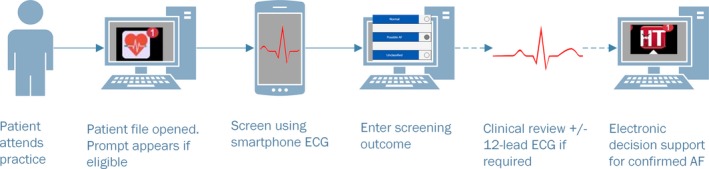
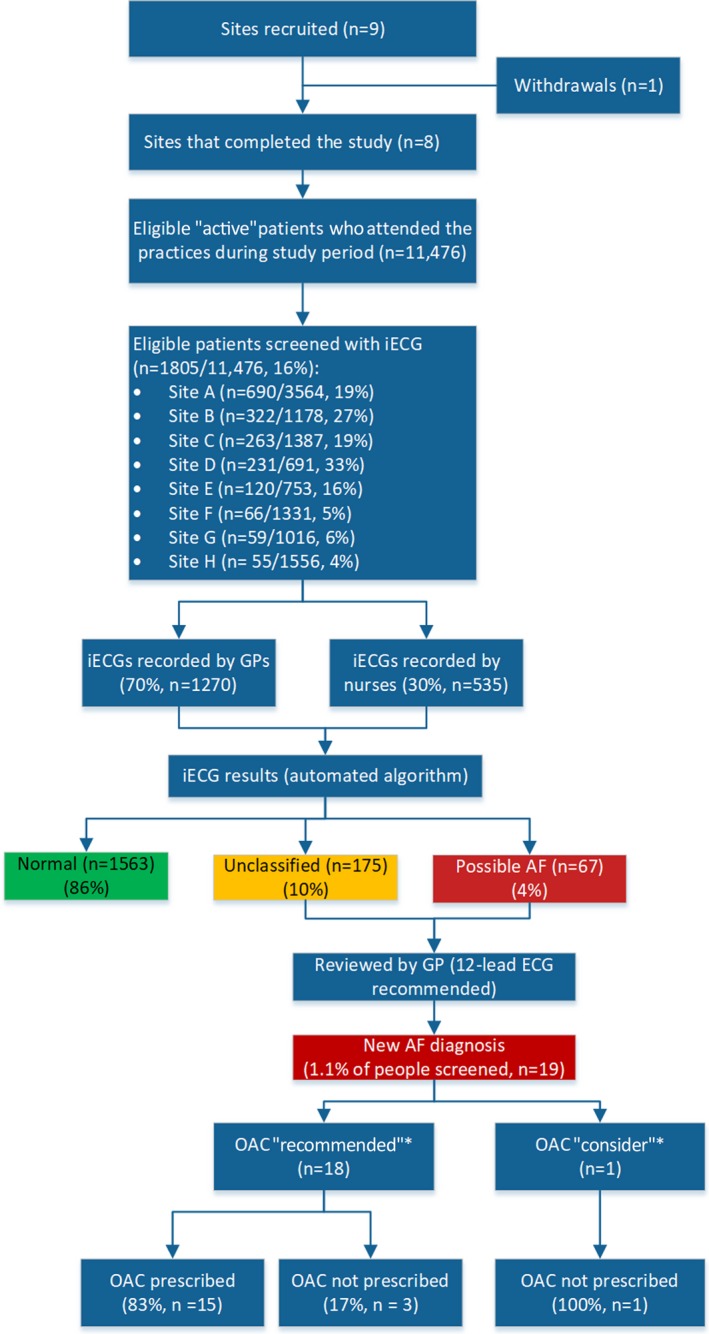
Background This eH ealth implementation study aimed to evaluate strategies to promote opportunistic atrial fibrillation ( AF ) screening using electronic screening prompts and improve treatment using electronic decision support ( EDS ) software. Methods and Results An electronic screening prompt appeared whenever an eligible patient's (aged ≥65 years, no AF diagnosis) medical record was opened in participating general practices. General practitioners and practice nurses offered screening using a smartphone ECG, with validated AF algorithm. Guideline-based EDS was provided to assist treatment decisions. Deidentified data were collected from practices using a data extraction tool. General practices (n=8) across Sydney, Australia, screened for a median of 6 months. A total of 1805 of 11 476 (16%) eligible patients who attended were screened (44% men, mean age 75.7 years). Screening identified 19 (1.1%) new cases of AF (mean age, 79 years; mean CHA 2 DS 2- VAS c, 3.7; 53% men). General practitioners (n=30) performed 70% of all screenings (range 1-448 patients per general practitioner). The proportion of patients with AF who had CHA 2 DS 2- VAS c ≥2 for men or ≥3 for women prescribed oral anticoagulants was higher for those diagnosed during the study: 15 of 18 (83%) for screen-detected and 39 of 46 (85%) for clinically detected, compared with 933 of 1306 (71%) patients diagnosed before the study ( P<0.001). The EDS was accessed 111 times for patients with AF and for 4 of 19 screen-detected patients. Conclusions The eH ealth tools showed promise. Adherence to guideline-based oral anticoagulant prescription was significantly higher in patients diagnosed during the study period, although the EDS was only used in a minority. While the proportion of eligible patients screened and EDS use was relatively low, further refinements may improve uptake in clinical practice. Clinical Trial Registration URL : www.anzctr.org.au . Unique identifier: ACTRN 12616000850471.
Keywords: atrial fibrillation; eHealth; general practices; screening; stroke prevention.
Figures
References
-
- Chugh SS, Havmoeller R, Narayanan K, Singh D, Rienstra M, Benjamin EJ, Gillum RF, Kim YH, McAnulty JH Jr, Zheng ZJ, Forouzanfar MH, Naghavi M, Mensah GA, Ezzati M, Murray CJ. Worldwide epidemiology of atrial fibrillation: a Global Burden of Disease 2010 Study. Circulation. 2014;129:837–847. - PMC - PubMed
-
- Ball J, Thompson DR, Ski CF, Carrington MJ, Gerber T, Stewart S. Estimating the current and future prevalence of atrial fibrillation in the Australian adult population. Med J Aust. 2015;202:32–35. - PubMed
-
- Magnani JW, Wang N, Benjamin EJ, Garcia ME, Bauer DC, Butler J, Ellinor PT, Kritchevsky S, Marcus GM, Newman A, Phillips CL, Sasai H, Satterfield S, Sullivan LM, Harris TB. Atrial fibrillation and declining physical performance in older adults: the Health, Aging, and Body Composition Study. Circ Arrhythm Electrophysiol. 2016;9:e003525. - PMC - PubMed
-
- Gallagher C, Hendriks J, Giles L, Elliott A, Middeldorp M, Mahajan R, Lau D, Sanders P, Wong C. Twenty‐year national trends in hospitalisations due to atrial fibrillation in Australia: a relentless rise. Heart Lung Circ. 2017;26:S175.
-
- PricewaterhouseCoopers . Commissioned by the National Stroke Foundation, The Economic Costs of Atrial Fibrillation in Australia. 2010.
Publication types
MeSH terms
Substances
Associated data
LinkOut - more resources
Full Text Sources
Other Literature Sources
Medical
