Review
. 2018 Dec 28;19(1):974.
doi: 10.1186/s12864-018-5262-0.

Systematics for types and effects of DNA variations

Affiliations
Review

Systematics for types and effects of DNA variations

Mauno Vihinen. BMC Genomics. .

Abstract

Background: Numerous different types of variations can occur in DNA and have diverse effects and consequences. The Variation Ontology (VariO) was developed for systematic descriptions of variations and their effects at DNA, RNA and protein levels.

Results: VariO use and terms for DNA variations are described in depth. VariO provides systematic names for variation types and detailed descriptions for changes in DNA function, structure and properties. The principles of VariO are presented along with examples from published articles or databases, most often in relation to human diseases. VariO terms describe local DNA changes, chromosome number and structure variants, chromatin alterations, as well as genomic changes, whether of genetic or non-genetic origin.

Conclusions: DNA variation systematics facilitates unambiguous descriptions of variations and their effects and further reuse and integration of data from different sources by both human and computers.

Keywords: Annotation; DNA variations; Databases; Mutation; Ontology; Systematics; VariO; Variation; Variation ontology.


Conflict of interest statement

Ethics approval and consent to participate

Not applicable.

Consent for publication

Not applicable.

Competing interests

The author declares that he has no competing interests.

Publisher’s Note

Springer Nature remains neutral with regard to jurisdictional claims in published maps and institutional affiliations.

Figures
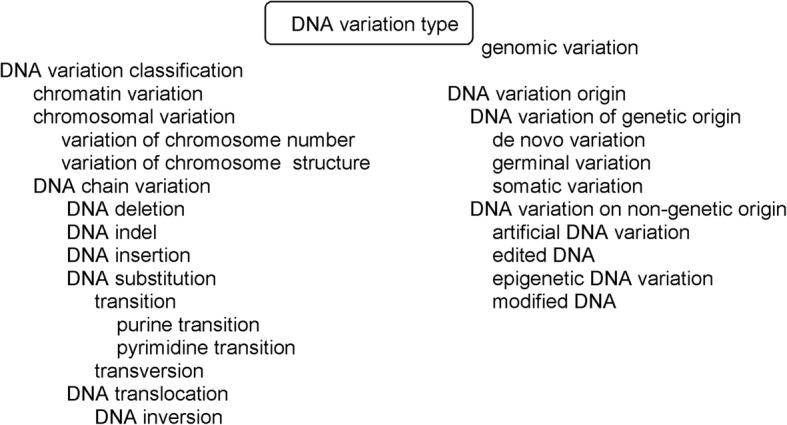
Fig. 1
Fig. 1
Terms to describe DNA variation types
Fig. 2
Fig. 2
Examples of DNA chain variations. The original sequence is in the middle. In the variant sequences the original bases at original positions are underlined
Fig. 3
Fig. 3
Terms for describing variations affecting DNA structure
Fig. 4
Fig. 4
Visualization of chromosomal structure variations. a Chromosome number variation, trisomy as an example. b Chromosomal amplification, more specifically copy number variation of type tandem repeat. c Intrespersed repeat chromosomal amplification. d Interstitial chromosomal deletion, (e) terminal deletion. There are several forms of chromosomal translocations. These include, (f) dicentric translocation, which is a form of interchromosomal translocation, (g) reciprocal translocation, h Robertsonian translocation, (i) paracentric inversion which is also intrachromosomal translocation, and (j) pericentric inversion. k Complex chromosomal variation. Several chromosomal changes are involved in immunological recognition molecule diversification, including (l) immunological receptor gene rearrangement, (m) immunological receptor gene conversion, (n) somatic hypermutation, and (o) class switch recombination. The gene segments are from the left V, D, J and C. There are up to tens of fragments in each segment type. p Isochromosome, (q) ring chromosome. r Telomere length variations, specifically telomere shortening. Note that the sizes of the telomeres in the ends of chromosomes as well as the telomere shortening are exaggerated
Fig. 5
Fig. 5
Three dimensional structures of DNA forms. Double helical structures. a A DNA (5iyg) [120], b B DNA (5f9i), c D DNA (5vy6) [121], and (d) Z DNA (4ocb) [122]. e Triple helix structure (1bwg) [125]. Four-stranded DNA structures (f) i motif (PDB entry 1el2) [130], and (g) G-quadruplex (2kzd) [142]. h DNA-RNA hybrid structure of type R loop (5mga) [137]. The DNA backbone is shown in cyan and the nucleotide bases with yellow. In H, the RNA chain backbone is in red

References

    1. Vihinen M. Variation ontology for annotation of variation effects and mechanisms. Genome Res. 2014;24:356–364. doi: 10.1101/gr.157495.113. - DOI - PMC - PubMed
    1. Niroula A, Vihinen M. Variation interpretation predictors: principles, types, performance, and choice. Hum Mutat. 2016;37:579–597. doi: 10.1002/humu.22987. - DOI - PubMed
    1. Zhou J, Troyanskaya OG. Predicting effects of noncoding variants with deep learning-based sequence model. Nat Methods. 2015;12:931–934. doi: 10.1038/nmeth.3547. - DOI - PMC - PubMed
    1. Consortium TEP. An integrated encyclopedia of DNA elements in the human genome. Nature. 2012;489:57–74. doi: 10.1038/nature11247. - DOI - PMC - PubMed
    1. Fu H, Zhang X. Noncoding variants functional prioritization methods based on predicted regulatory factor binding sites. Curr Genomics. 2017;18:322–331. doi: 10.2174/1389202918666170228143619. - DOI - PMC - PubMed

LinkOut - more resources
