. 2018 Dec 28;19(Suppl 21):476.
doi: 10.1186/s12859-018-2544-0.

Predicting adverse drug reactions through interpretable deep learning framework

Affiliations

Predicting adverse drug reactions through interpretable deep learning framework

Sanjoy Dey et al. BMC Bioinformatics. .

Abstract

Background: Adverse drug reactions (ADRs) are unintended and harmful reactions caused by normal uses of drugs. Predicting and preventing ADRs in the early stage of the drug development pipeline can help to enhance drug safety and reduce financial costs.

Methods: In this paper, we developed machine learning models including a deep learning framework which can simultaneously predict ADRs and identify the molecular substructures associated with those ADRs without defining the substructures a-priori.

Results: We evaluated the performance of our model with ten different state-of-the-art fingerprint models and found that neural fingerprints from the deep learning model outperformed all other methods in predicting ADRs. Via feature analysis on drug structures, we identified important molecular substructures that are associated with specific ADRs and assessed their associations via statistical analysis.

Conclusions: The deep learning model with feature analysis, substructure identification, and statistical assessment provides a promising solution for identifying risky components within molecular structures and can potentially help to improve drug safety evaluation.

Keywords: Adverse drug reaction; Chemical fingerprint; Deep learning.


Conflict of interest statement

Ethics approval and consent to participate

Not applicable.

Consent for publication

Not applicable.

Competing interests

The authors declare that they have no competing interests.

Publisher’s Note

Springer Nature remains neutral with regard to jurisdictional claims in published maps and institutional affiliations.

Figures
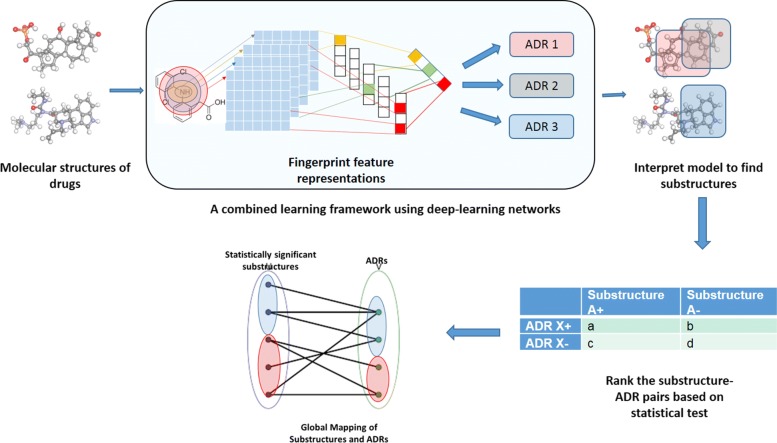
Fig. 1
Fig. 1
Overall Framework: The general workflow for ADR prediction
Fig. 2
Fig. 2
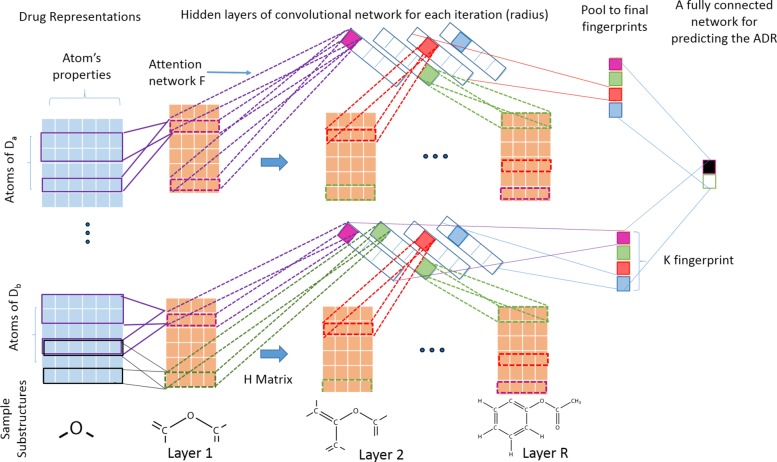
Neural fingerprint method with attention mechanism for predicting an ADR
Fig. 3
Fig. 3
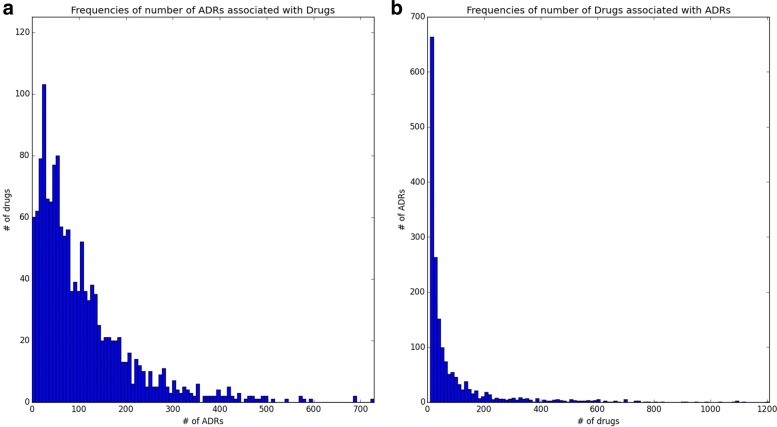
The frequencies of ADRs and Drugs: (a) Histogram of number of positive ADRs associated with each drug with average of 106, (b) Histogram of number of drugs associated with each ADR with average of 86
Fig. 4
Fig. 4
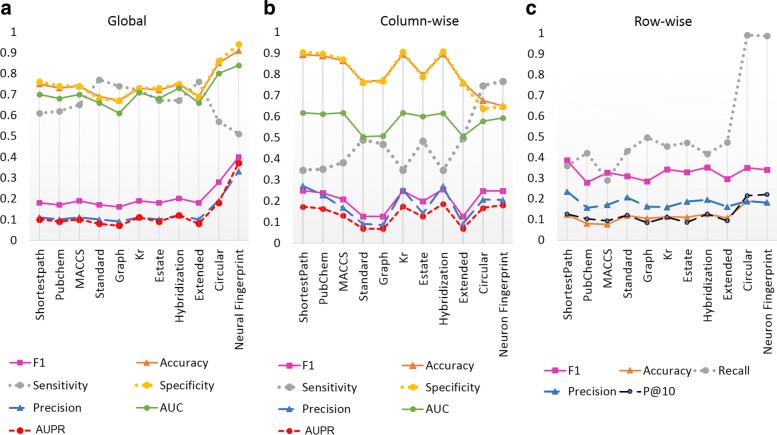
Predictive performance Comparison of different fingerprint methods on SIDER dataset based on (a) global, (b) column-wise (by ADR) and (c) row-wise (by drug) evaluations
Fig. 5
Fig. 5
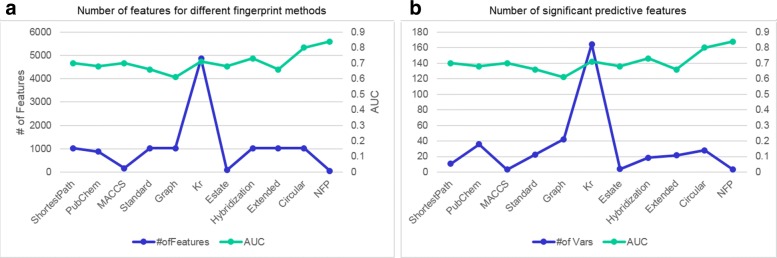
Number of features used and selected by different methods Panel (a) shows the average number of features defined by different chemical fingerprint methods in left y-axis and area under the curve (AUC) in right y-axis. Panel (b) shows the average number of significant features that are predictive of ADRs in left y-axis and AUC in the right y-axis. The proposed neural fingerprint (NFP) have better predictive power than other fingerprints, although it uses significantly less number of features than other techniques
Fig. 6
Fig. 6
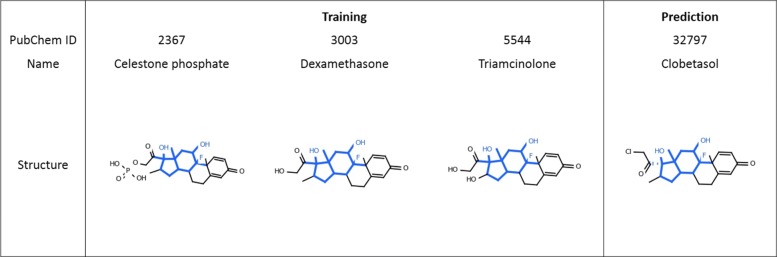
Case Study 1: Drugs structures for the training and prediction of aseptic necrosis (UMLS ID: C0085660). The highlighted substructures within the chemical structures were identified as important features for predicting this ADR
Fig. 7
Fig. 7
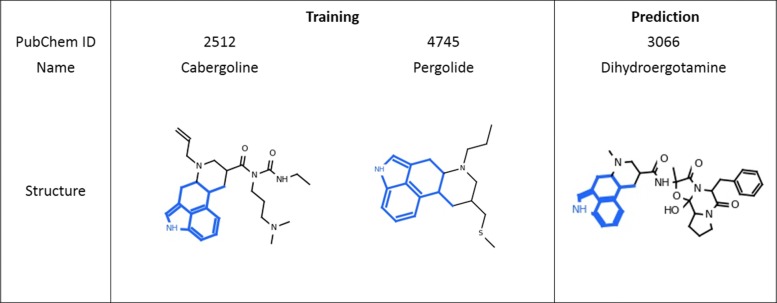
Case Study 2: Drugs structures for the training and prediction of back pain (UMLS ID: C0004604). The highlighted substructures within the chemical structures were identified as important features for predicting this ADR
Fig. 8
Fig. 8
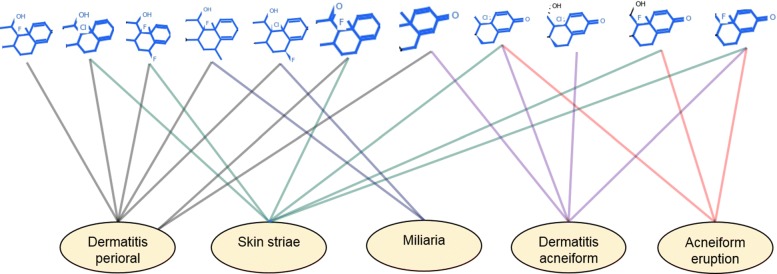
Higher Level representation of significant substructure-ADR associations: Our biclustering algorithms on the bipartite graph containing significant substructures discovered a family of similar chemical structures from Cortisols that are mostly that are associated with many of skin related ADRs
Fig. 9
Fig. 9
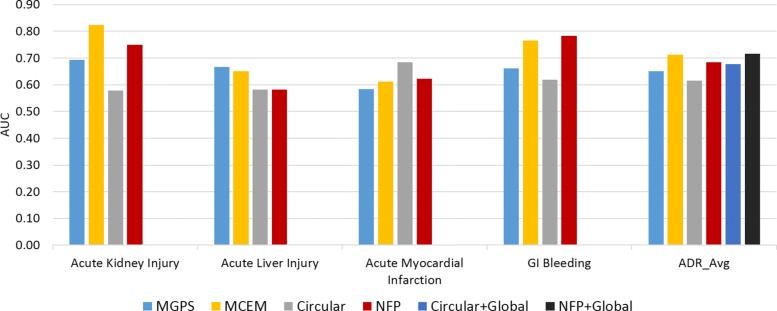
AUC comparisons of NFP method with three models on OMOP benchmark dataset: OMOP data consists of gold standards of four ADRs: Acute Kidney Injury, Acute Liver Injury, Acute Myocardial Infarction, and GI Bleeding. The other ADR prediction model is Circular fingerprint method. Signal detection methods include MGPS and MCEM, and results come from [34]

References

    1. Edwards IR, Aronson JK. Adverse drug reactions: definitions, diagnosis, and management. Lancet. 2000;356(9237):1255–9. doi: 10.1016/S0140-6736(00)02799-9. - DOI - PubMed
    1. Lounkine E, Keiser MJ, Whitebread S, Mikhailov D, Hamon J, Jenkins JL, Lavan P, Weber E, Doak AK, Côté S, et al. Large-scale prediction and testing of drug activity on side-effect targets. Nature. 2012;486(7403):361–7. doi: 10.1038/nature11159. - DOI - PMC - PubMed
    1. Ernst FR, Grizzle AJ. Drug-related morbidity and mortality: updating the cost-of-illness model. J Am Pharm Assoc (1996) 2001;41(2):192–9. doi: 10.1016/S1086-5802(16)31229-3. - DOI - PubMed
    1. Pauwels E, Stoven V, Yamanishi Y. Predicting drug side-effect profiles: a chemical fragment-based approach. BMC Bioinformatics. 2011;12(1):1. doi: 10.1186/1471-2105-12-169. - DOI - PMC - PubMed
    1. Zhang P, Wang F, Hu J, Sorrentino R. Proceedings of the 2013 AMIA Annu Symp: 16-20 Nov 2013. Washington DC: American Medical Informatics Association; 2013. Exploring the relationship between drug side-effects and therapeutic indications. - PMC - PubMed