


Randomized study of the impact of a therapeutic education program on patients suffering from chronic low-back pain who are treated with transcutaneous electrical nerve stimulation
- PMID: 30593158
- PMCID: PMC6314771
- DOI: 10.1097/MD.0000000000013782
Randomized study of the impact of a therapeutic education program on patients suffering from chronic low-back pain who are treated with transcutaneous electrical nerve stimulation
Abstract
Background: Transcutaneous electrical nerve stimulation (TENS) is often used for the treatment of low-back pain (LBP). However, its effectiveness is controversial.
Objective: To determine the efficacy of TENS in the treatment LBP when associated to a therapeutic education program (TEP).
Design: Open randomized monocentric study.
Setting: University hospital between 2010 and 2014.
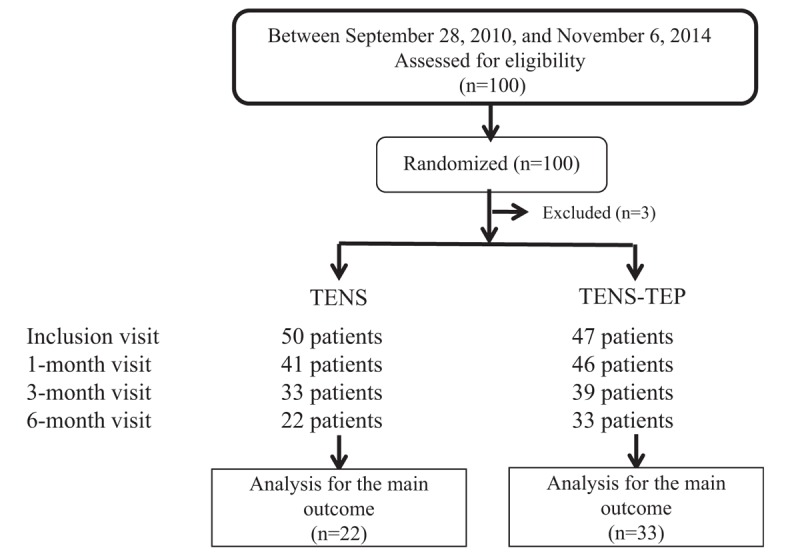
Patients: A total of 97 patients suffering from LBP.
Interventions: Routine care (TENS group) or routine care plus a therapeutic education program (TENS-TEP group) based on consultation support by a pain resource nurse.
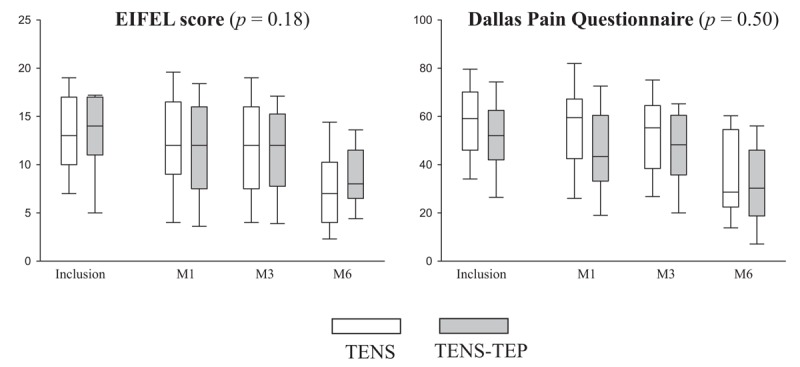
Main outcome measures: EIFEL and Dallas Pain Questionnaire scores.
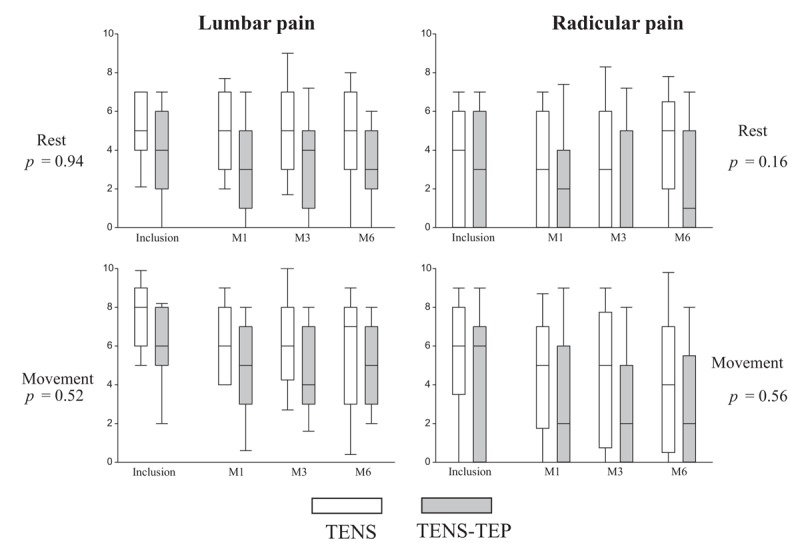
Results: Twenty-two patients (44%) were still assessable at the end-of-study visit, whereas 33 (70%) were assessable at the same time point in the TENS-TEP group (P = .013). The EIFEL score and the Dallas score had a similar evolution over time between groups (P = .18 and P = .50 respectively). Similarly, there were no significant differences between the groups with respect to resting pain scores (P = .94 for back pain and P = .16 for leg pain) and movement pain scores (P = .52 for back pain and P = .56 for leg pain). At Month 6, there was no significant difference between the groups (P = .85) with regard to analgesics and social impact. Two patients presented a serious adverse event during the study (one in each group) but non-attributable to the treatment studied.
Conclusion: This study does not support the use of TENS in the treatment of patients with chronic LBP even though patients benefited from a therapeutic education program by a pain resource nurse. However, the higher number of premature withdrawals in the TENS group may be due to early withdrawal of patients who did not experience improvement of their symptoms.
Conflict of interest statement
The authors have no conflicts of interest to disclose.
Figures
References
-
- Andersson GB. Epidemiological features of chronic low-back pain. Lancet 1999;354:581–5. - PubMed
-
- Dionne CE, Dunn KM, Croft PR, et al. A consensus approach toward the standardization of back pain definitions for use in prevalence studies. Spine (Phila Pa 1976) 2008;33:95–103. - PubMed
-
- Webster LR, Markman J. Medical management of chronic low back pain: efficacy and outcomes. Neuromodulation 2014;17Suppl 2:18–23. - PubMed
-
- Chou R, Huffman LH, American Pain S. American College of P. Medications for acute and chronic low back pain: a review of the evidence for an American Pain Society/American College of Physicians clinical practice guideline. Ann Intern Med 2007;147:505–14. - PubMed
-
- Winter A. Pain relief—transcutaneous nerve stimulation. J Med Soc N J 1974;71:365–7. - PubMed
Publication types
MeSH terms
LinkOut - more resources
Full Text Sources
Other Literature Sources
Medical
Miscellaneous
