Review
. 2019 Mar;12(3):475-484.
doi: 10.1016/j.tranon.2018.11.010. Epub 2019 Jan 1.

The Role of TGF-β and Its Receptors in Gastrointestinal Cancers

Affiliations
Review

The Role of TGF-β and Its Receptors in Gastrointestinal Cancers

Jingwen Luo et al. Transl Oncol. 2019 Mar.

Abstract

Early detection of gastrointestinal tumors improves patient survival. However, patients with these tumors are typically diagnosed at an advanced stage and have poor prognosis. The incidence and mortality of gastrointestinal cancers, including esophageal, gastric, liver, colorectal, and pancreatic cancers, are increasing worldwide. Novel diagnostic and therapeutic agents are required to improve patient survival and quality of life. The tumor microenvironment, which contains nontumor cells, signaling molecules such as growth factors and cytokines, and extracellular matrix proteins, plays a critical role in cancer cell proliferation, invasion, and metastasis. Transforming growth factor beta (TGF-β) signaling has dual roles in gastrointestinal tumor development and progression as both a tumor suppressor and tumor promoter. Here, we review the dynamic roles of TGF-β and its receptors in gastrointestinal tumors and provide evidence that targeting TGF-β signaling may be an effective therapeutic strategy.


Figures

Figure 1
Figure 1
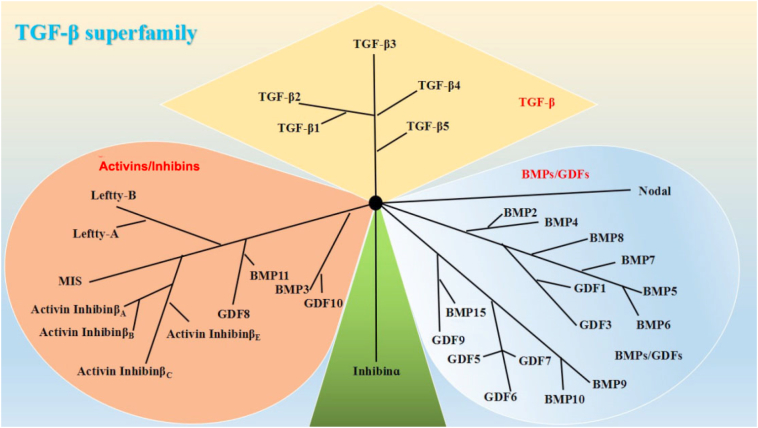
The TGF-β superfamily. Based on their structural features, the mammalian members of the TGF-β family are subdivided into (i) TGF-βs, (ii) activins/inhibins, and (iii) BMPs/growth and differentiation factors (GDFs).
Figure 2
Figure 2
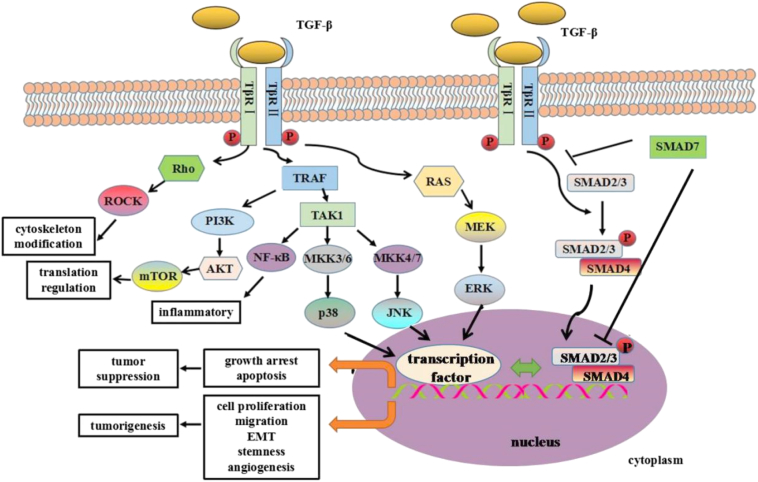
Schematic representation of TGF-β signaling as well as the role of TGF-β signaling pathway in cancer onset and progression. TGF-β activates both Smad-dependent canonical and Smad-independent noncanonical signaling pathways. TGF-β binds to TβRII which then activates TβRI. TβRI-phosphorylated Smad2/3 form complexes with Smad4, entering nucleus and regulating the transcription of different targeted genes in both early and late stages of tumor development, contributing to tumor suppression and tumorigenesis, respectively. Smad7 antagonizes TGF-β signaling through blocking Smad2/3 activation and interfering with the formation of Smad2/3/4-DNA complex. In the noncanonical signaling pathways, TGF-β receptors initiate the signal through MAPKs, PI3K, and Rho family of small GTPases etc. Activated JNK/p38/ERK either interact with SMADs or induce their individual transcriptional programs directly to affect cancer cells. Rho-activated Rho-associated protein kinase is involved in cytoskeleton modification in the process of EMT. Through PI3K-AKT pathway, TGF-β can also activate mammalian target of rapamycin to regulate protein translation. In addition, TGF-β activation of the tumor necrosis factor receptor–associated factor proteins can also induce NF-κB signaling for inflammatory response.

References

    1. Massague J. TGFbeta signalling in context. Nat Rev Mol Cell Biol. 2012;13(10):616–630. - PMC - PubMed
    1. Massague J. TGFbeta in cancer. Cell. 2008;134(2):215–230. - PMC - PubMed
    1. Fabregat I, Fernando J, Mainez J, Sancho P. TGF-beta signaling in cancer treatment. Curr Pharm Des. 2014;20(17):2934–2947. - PubMed
    1. David CJ, Massague J. Contextual determinants of TGFbeta action in development, immunity and cancer. Nat Rev Mol Cell Biol. 2018;19(7):419–435. - PMC - PubMed
    1. Toomey PG, Vohra NA, Ghansah T, Sarnaik AA, Pilon-Thomas SA. Immunotherapy for gastrointestinal malignancies. Cancer Control. 2013;20(1):32–42. - PMC - PubMed