


Inter-brain synchrony in mother-child dyads during cooperation: An fNIRS hyperscanning study
- PMID: 30594570
- PMCID: PMC6937429
- DOI: 10.1016/j.neuropsychologia.2018.12.021
Inter-brain synchrony in mother-child dyads during cooperation: An fNIRS hyperscanning study
Abstract
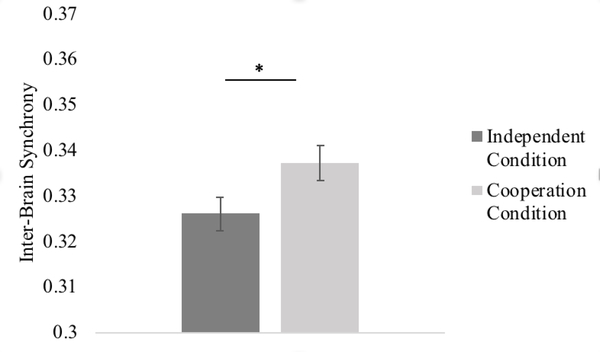
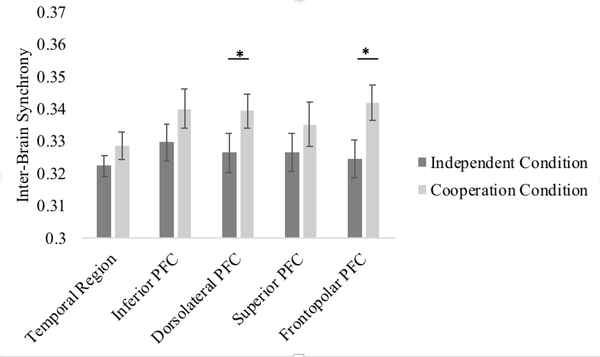
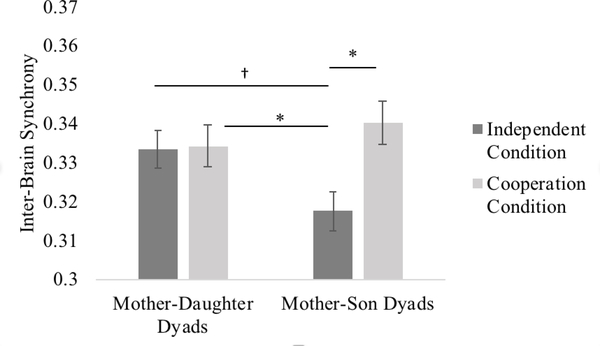
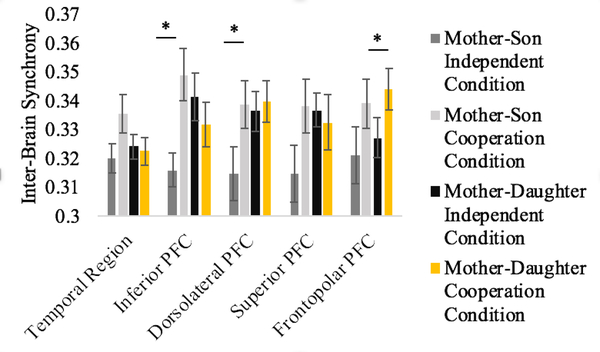
Coordinated brain activity between individuals, or inter-brain synchrony, has been shown to increase during cooperation and correlate with cooperation success. However, few studies have examined parent-child inter-brain synchrony and whether it is associated with meaningful aspects of the parent-child relationship. Here, we measured inter-brain synchrony in the right prefrontal (PFC) and temporal cortices in mother-child dyads while they engaged in a cooperative and independent task. We tested whether inter-brain synchrony in mother-child dyads (1) increases during cooperation, (2) differs in mother-son versus mother-daughter dyads, and (3) is related to cooperation performance and the attachment relationship. Overall inter-brain synchrony in the right hemisphere, and the right dorsolateral and frontopolar PFC in particular, was higher during cooperation. Mother-son dyads showed less inter-brain synchrony during the independent task and a stronger increase in synchrony in response to cooperation than mother-daughter dyads. Lastly, we did not find strong evidence for links between inter-brain synchrony and child attachment. Mother-child cooperation may increase overall inter-brain synchrony, although differently for mother-son versus mother-daughter dyads. More research is needed to better understand the potential role of overall inter-brain synchrony in mother-child cooperation, and the potential link between inter-brain synchrony and attachment.
Keywords: Cooperation; Inter-brain synchrony; Mother-child attachment; fNIRS hyperscanning.
Copyright © 2018 Elsevier Ltd. All rights reserved.
Figures
References
-
- Bilek E, Ruf M, Schäfer A, Akdeniz C, Calhoun VD, Schmahl C, … Meyer-Lindenberg AM (2015). Information flow between interacting human brains: Identification, validation, and relationship to social expertise. Proceedings of the National Academy of Sciences of the United States of America, 112, 5207–5212. 10.1073/pnas.1421831112 - DOI - PMC - PubMed
-
- Brenning K, Soenens B, Braet C, & Bosmans G. (2011). An adaptation of the Experiences in Close Relationships Scale-Revised for use with children and adolescents. Journal of Social and Personal Relationships, 28, 1048–1072. 10.1177/0265407511402418 - DOI
Publication types
MeSH terms
Grants and funding
LinkOut - more resources
Full Text Sources
Miscellaneous
