


Non-transcriptional processes in circadian rhythm generation
- PMID: 30596188
- PMCID: PMC6302373
- DOI: 10.1016/j.cophys.2018.10.003
Non-transcriptional processes in circadian rhythm generation
Abstract
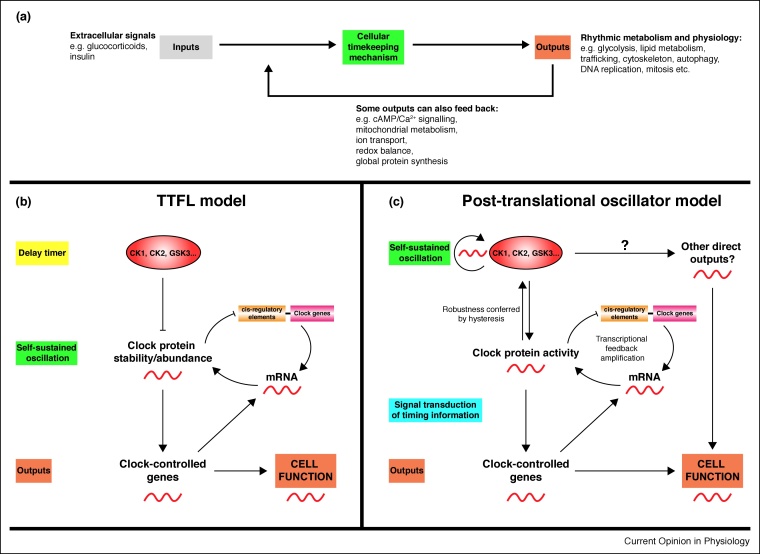
'Biological clocks' orchestrate mammalian biology to a daily rhythm. Whilst 'clock gene' transcriptional circuits impart rhythmic regulation to myriad cellular systems, our picture of the biochemical mechanisms that determine their circadian (∼24 hour) period is incomplete. Here we consider the evidence supporting different models for circadian rhythm generation in mammalian cells in light of evolutionary factors. We find it plausible that the circadian timekeeping mechanism in mammalian cells is primarily protein-based, signalling biological timing information to the nucleus by the post-translational regulation of transcription factor activity, with transcriptional feedback imparting robustness to the oscillation via hysteresis. We conclude by suggesting experiments that might distinguish this model from competing paradigms.
Figures
References
-
- Woelfle M.A., Ouyang Y., Phanvijhitsiri K., Johnson C.H. The adaptive value of circadian clocks: an experimental assessment in Cyanobacteria. Curr Biol. 2004;14:1481–1486. - PubMed
-
- Roenneberg T., Merrow M. What watch?… such much!” complexity and evolution of circadian clocks. Cell Tissue Res. 2002;309:3–9. - PubMed
-
- Dodd A.N., Salathia N., Hall A., Kévei E., Tóth R., Nagy F., Hibberd J.M., Millar A.J., Webb A.A.R. Plant circadian clocks increase photosynthesis, growth, survival, and competitive advantage. Science. 2005;309:630–633. - PubMed
Publication types
Grants and funding
LinkOut - more resources
Full Text Sources
Other Literature Sources