. 2019 Jan;148(1):51-64.
doi: 10.1037/xge0000505.

Domain-general enhancements of metacognitive ability through adaptive training

Affiliations

Domain-general enhancements of metacognitive ability through adaptive training

Jason Carpenter et al. J Exp Psychol Gen. 2019 Jan.

Abstract

The metacognitive ability to introspect about self-performance varies substantially across individuals. Given that effective monitoring of performance is deemed important for effective behavioral control, intervening to improve metacognition may have widespread benefits, for example in educational and clinical settings. However, it is unknown whether and how metacognition can be systematically improved through training independently of task performance, or whether metacognitive improvements generalize across different task domains. Across 8 sessions, here we provided feedback to two groups of participants in a perceptual discrimination task: an experimental group (n = 29) received feedback on their metacognitive judgments, while an active control group (n = 32) received feedback on their decision performance only. Relative to the control group, adaptive training led to increases in metacognitive calibration (as assessed by Brier scores), which generalized both to untrained stimuli and an untrained task (recognition memory). Leveraging signal detection modeling we found that metacognitive improvements were driven both by changes in metacognitive efficiency (meta-d'/d') and confidence level, and that later increases in metacognitive efficiency were positively mediated by earlier shifts in confidence. Our results reveal a striking malleability of introspection and indicate the potential for a domain-general enhancement of metacognitive abilities. (PsycINFO Database Record (c) 2018 APA, all rights reserved).


Figures
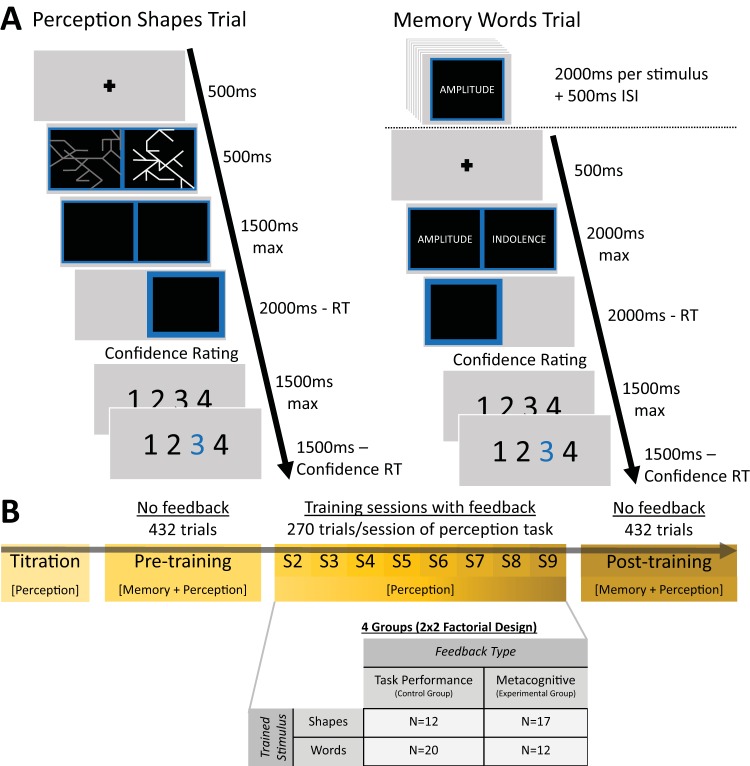
Figure 1
Figure 1
Task and session structure. Panel A: Participants were tested on both a perceptual discrimination and recognition memory task, each involving two stimulus types: abstract shapes and words. The perceptual task (left) comprised a two-alternative forced-choice discrimination judgment as to the brighter of two simultaneously presented stimuli on each trial. The memory task (right) comprised an encoding phase followed by a series of two-alternative forced-choice recognition memory judgments. Panel B: Experiment timeline. Each participant completed 10 sessions in total: a pretraining session, eight training sessions, and a posttraining session. All four conditions were assessed at pre- and posttraining, but only the perceptual task with a single stimulus type (shapes or words) was trained during Sessions 2 through 9. During training sessions, the control groups received feedback on their objective perceptual discrimination performance, whereas the experimental groups received feedback on their metacognitive calibration. In both groups, feedback was delivered every 27 trials.
Figure 2
Figure 2
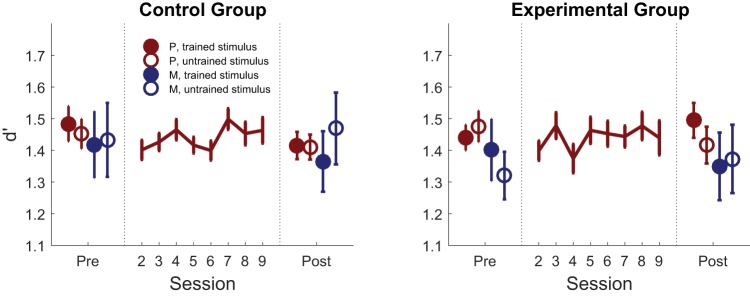
First-order discrimination performance. Effect of training on first-order performance (d′) in the control group (who received feedback on perceptual discrimination performance) and the experimental group (who received feedback on their metacognitive judgments) as a function of whether the judgment was made on a perception (red) or memory (blue) trial, and on the trained (filled) or untrained (unfilled) stimulus type. Error bars represent between-subjects SEM. P = perception; M = memory.
Figure 3
Figure 3
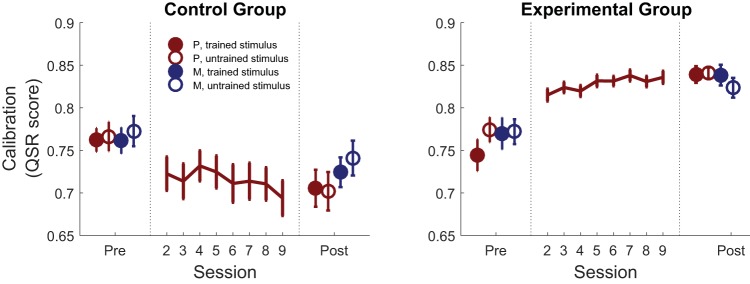
Metacognitive calibration. Effect of training on confidence calibration (the average quadratic scoring rule score [QSR]). Calibration improved over training sessions in the experimental group in the absence of changes in first-order performance, and this improvement transferred both to an untrained stimulus and untrained recognition memory task. Error bars represent between-subjects SEM. P = perception, M = memory.
Figure 4
Figure 4
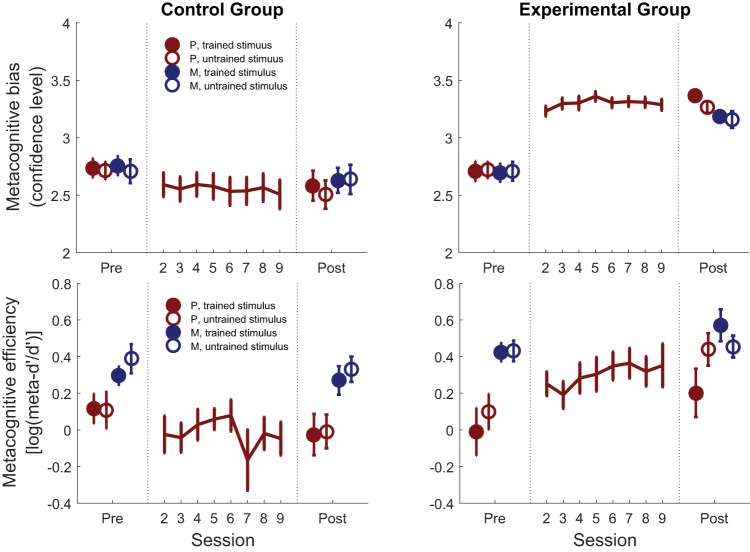
Effects of training on components of metacognition. Effects of training on metacognitive bias (confidence level; top panels) and metacognitive efficiency (log[meta-d′/d′]; bottom panels). The left-hand column shows data from the control group; the right-hand column shows data from the experimental group. Metacognitive efficiency (log[meta-d′/d′]) gradually improved over training in the experimental group (bottom panel) in the absence of changes in first-order performance. Error bars represent between-subjects SEM. One participant was excluded when plotting mean log(meta-d′/d′) for Session 6 due to a negative value of meta-d′ precluding a log-transform. P = perception, M = memory.
Figure 5
Figure 5
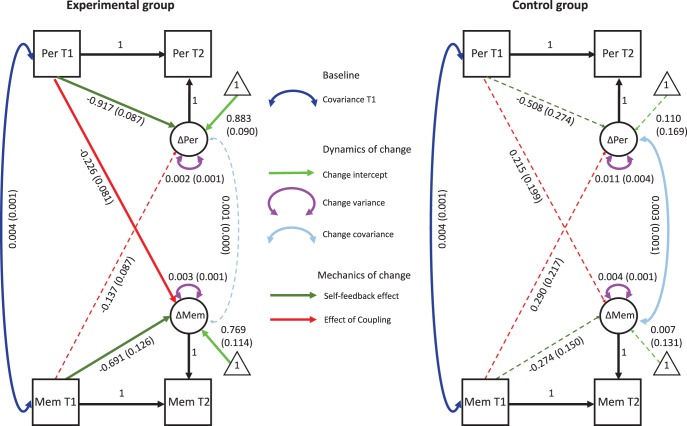
Estimated parameters for the bivariate latent change score model of metacognitive calibration (quadratic scoring rule [QSR] scores). Calibration scores were modeled pretraining (T1) and posttraining (T2) across both domains, restricted to the trained stimulus type. Unstandardized parameter estimates are given separately for each group (with standard errors in parentheses). Solid lines indicate parameter significance at p < .05. Note that the T1 covariance, T1 intercepts and T1 memory variance were constrained to be equal across groups. T1 perception variance was estimated separately for each group as explained in the text. Per = perception; Mem = memory.
Figure 6
Figure 6
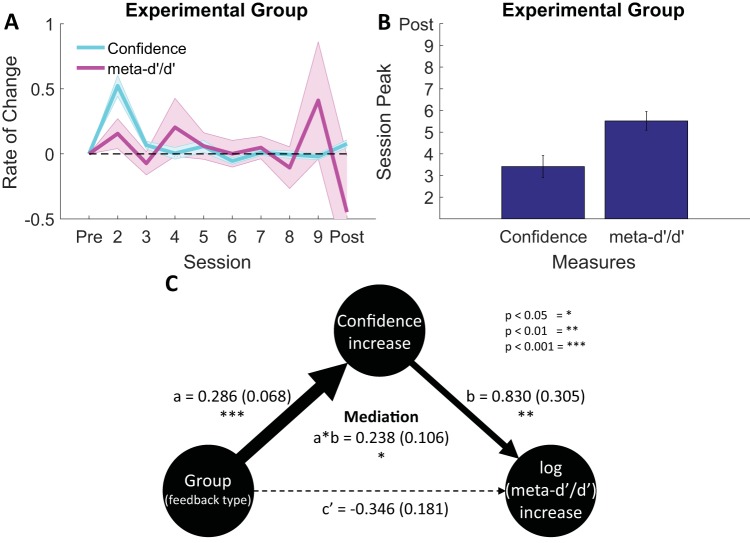
Temporal dissociation of shifts in metacognitive bias and metacognitive efficiency. Panel A: Rate of change over sessions of confidence level and meta-d′/d′ in the experimental group showing an early shift toward responding with higher confidence. This shift in confidence was dissociated in time from a more gradual improvement in metacognitive efficiency, with the largest changes occurring toward the end of training. Panel B: The session at which this peak shift occurred was significantly earlier for metacognitive bias (confidence level) compared with metacognitive efficiency (meta-d′/d′). Panel C: Early increases in confidence mediate the impact of feedback type on later increases in metacognitive efficiency. Values outside of parentheses indicate the coefficient mean and values inside parentheses indicate the SEM.

References

    1. Adams P. A., & Adams J. K. (1958). Training in confidence-judgments. The American Journal of Psychology, 71, 747–751. 10.2307/1420334 - DOI - PubMed
    1. Ais J., Zylberberg A., Barttfeld P., & Sigman M. (2016). Individual consistency in the accuracy and distribution of confidence judgments. Cognition, 146, 377–386. 10.1016/j.cognition.2015.10.006 - DOI - PubMed
    1. Allen M., Glen J. C., Müllensiefen D., Schwarzkopf D. S., Fardo F., Frank D., et al. Rees G. (2017). Metacognitive ability correlates with hippocampal and prefrontal microstructure. NeuroImage, 149, 415–423. 10.1016/j.neuroimage.2017.02.008 - DOI - PMC - PubMed
    1. Bahrami B., Olsen K., Latham P. E., Roepstorff A., Rees G., & Frith C. D. (2010). Optimally interacting minds. Science, 329, 1081–1085. 10.1126/science.1185718 - DOI - PMC - PubMed
    1. Baird B., Mrazek M. D., Phillips D. T., & Schooler J. W. (2014). Domain-specific enhancement of metacognitive ability following meditation training. Journal of Experimental Psychology: General, 143, 1972–1979. 10.1037/a0036882 - DOI - PubMed