


Progress toward implementing the Swiss Hepatitis Strategy: Is HCV elimination possible by 2030?
- PMID: 30596701
- PMCID: PMC6312389
- DOI: 10.1371/journal.pone.0209374
Progress toward implementing the Swiss Hepatitis Strategy: Is HCV elimination possible by 2030?
Abstract
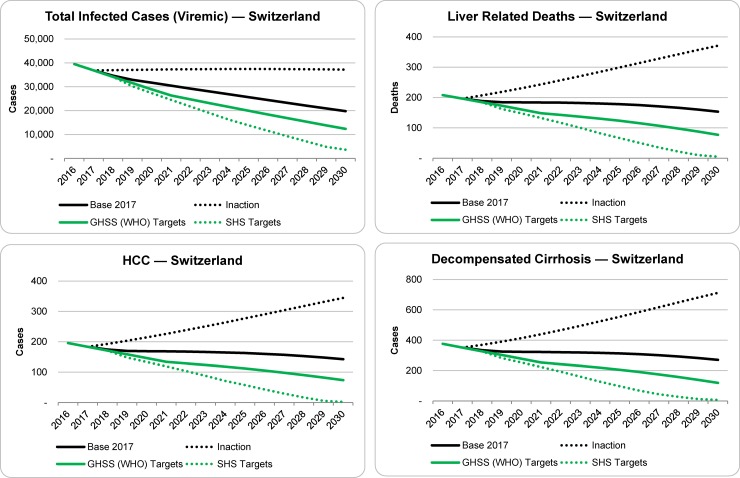
Catalyzed by the concerns over the growing public health and economic burden of Hepatitis C virus (HCV) in Switzerland, a diverse group of experts and patient representatives came together in 2014 to develop the Swiss Hepatitis Strategy, setting targets for the elimination of viral hepatitis in Switzerland by 2030. Previous studies have reported the estimated number of chronic HCV infections and forecasted burden of disease given different intervention strategies. However, given new prevalence data by the Swiss Federal Office of Public Health, which decreased total infections by about half, an updated analysis is warranted. We aimed to provide an updated viremic prevalence estimate for Switzerland and evaluate the impact on forecasted liver related morbidity and mortality of an 'inaction' scenario and intervention scenarios to achieve the Global Health Sector Strategy for Viral Hepatitis and Swiss Hepatitis Strategy goals by 2030. A Markov disease-progression model was used to calculate the present and future burden of HCV infection by disease stage according to these different strategies. In 2017, there were an estimated 36,800 (95% UI: 26,900-39,200) viremic infections in Switzerland. Given the current standard of care, total viremic infections are expected to decline by 45%, while cases of decompensated cirrhosis, hepatocellular carcinoma, and liver-related deaths will decrease by 20%. If treatment and diagnosis efforts were to cease in 2018, late stage HCV-related morbidity and mortality would increase by 90-100% by 2030. Increasing treatment and diagnosis to achieve the Global Health Sector Strategy or Swiss Hepatitis Strategy goals by 2030, will reduce the number of chronic infections to less than 13,000 and 4,000, respectively. Although the HCV epidemic is declining in Switzerland, efforts to expand diagnosis and treatment are needed to achieve elimination by 2030.
Conflict of interest statement
This work was supported by Gilead Sciences. Gilead Sciences had no input on the content, the study design, data selection, decision to publish or preparation of the manuscript. This does not alter our adherence to PLOS ONE policies on sharing data and materials. As the corresponding author, I declare, on behalf of all my co-authors that there no additional competing interests.
Figures
References
-
- Sagmeister M, Renner EL, Mullhaupt B, Wong JB. Simulation of hepatitis C based on a mandatory reporting system. Eur J Gastroenterol Hepatol. 2002;14(1):25–34. - PubMed
-
- Bruggmann P, Berg T, Ovrehus AL, Moreno C, Brandao Mello CE, Roudot-Thoraval F, et al. Historical epidemiology of hepatitis C virus (HCV) in selected countries. J Viral Hepat. 2014;21 Suppl 1:5–33. - PubMed
-
- Armstrong GL, Wasley A, Simard EP, McQuillan GM, Kuhnert WL, Alter MJ. The prevalence of hepatitis C virus infection in the United States, 1999 through 2002. Ann Intern Med. 2006;144(10):705–14. - PubMed
Publication types
MeSH terms
LinkOut - more resources
Full Text Sources
Medical
