


Blood lead, bone lead and child attention-deficit-hyperactivity-disorder-like behavior
- PMID: 30597466
- PMCID: PMC7781015
- DOI: 10.1016/j.scitotenv.2018.12.219
Blood lead, bone lead and child attention-deficit-hyperactivity-disorder-like behavior
Abstract
Background and objective: Mounting evidence showed that lead exposure increased the risk of child attention-deficit-hyperactivity disorder (ADHD). Epidemiologic studies have typically used the blood-lead as a biomarker of lead exposure; blood-lead levels mostly reflect recent lead exposure. However, few studies have examined the relationship between bone-lead, a biomarker of cumulative exposure, and ADHD. Therefore, we aimed to compare the associations of bone-lead vs blood-lead levels with child ADHD symptoms and comorbidities.
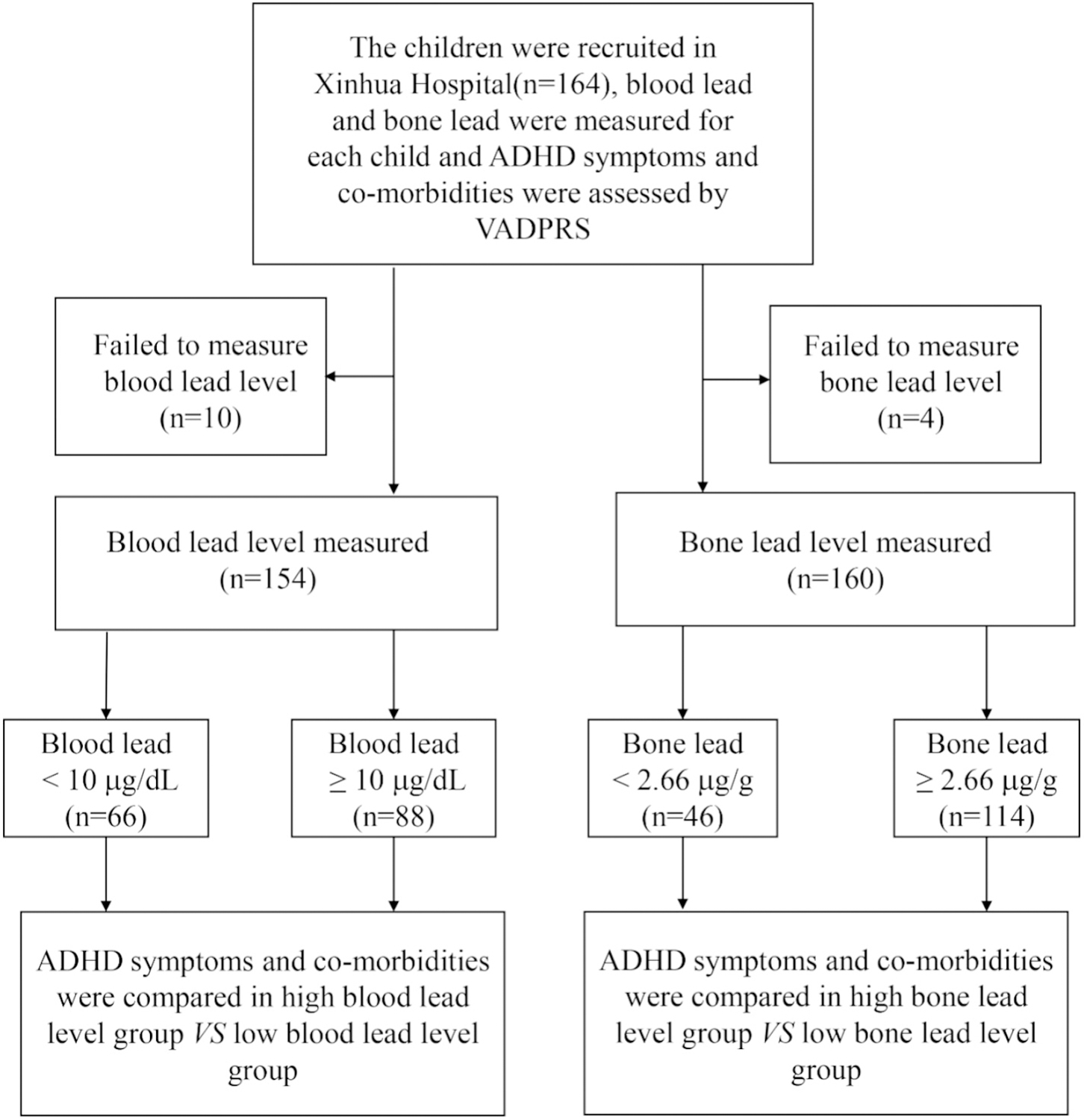
Methods: A total of 164 children aged 3-15 years were enrolled during 2014-2015. The Vanderbilt-ADHD-Diagnostic-Parent-Rating Scale (VADPRS) was used to evaluate the children's ADHD symptoms and comorbidities. Children's blood and bone lead concentrations were assessed, the latter using a non-invasive K-X-ray-fluorescence technique. According to blood-lead levels, children were classified into high (blood-lead ≥ 10.0 μg/dL) and low (blood-lead < 10.0 μg/dL) blood-lead groups. According to bone-lead levels, children were classified into high (bone-lead ≥ 2.66 μg/g) and low (bone-lead < 2.66 μg/g) bone-lead groups. We associated blood/bone lead with VADPRS data using multi-variable binary logistic regression models.
Results: Children in the high blood-lead group had higher hyperactivity/impulsivity (P = 0.02) scores than the corresponding low blood-lead group. Children in the high bone-lead group had higher hyperactivity/impulsivity (P = 0.02) and oppositional-defiant-disorder (ODD) (P = 0.03) scores than the corresponding low bone-lead group. After adjusting for relevant confounders, children in the high bone-lead group were more likely to have ODD-behavior than the low group (OR = 6.7, 95%CI: 1.2-36.5). However, no adjusted association was observed between blood-lead and any ADHD-domain score.
Conclusion: High levels of cumulative lead exposure in children may be an independent risk factor of ODD-behavior.
Keywords: ADHD; Blood; Bone; Lead; ODD.
Copyright © 2018 Elsevier B.V. All rights reserved.
Conflict of interest statement
Conflict of interest: The other authors have indicated they have no potential conflicts of interest to disclose.
Figures
References
-
- Acharya S, Acharya UR, 1997. In vivo lipid peroxidation responses of tissues in lead-treated Swiss mice. Ind. Health 35, 542–544. - PubMed
-
- Adonaylo VN, Oteiza PI, 1999. Pb2+ promotes lipid oxidation and alterations in membrane physical properties. Toxicology 132, 19–32. - PubMed
-
- Aebi M, Plattner B, Metzke CW, Bessler C, Steinhausen HC, 2013. Parent-and self-reported dimensions of oppositionality in youth: construct validity, concurrent validity, and the prediction of criminal outcomes in adulthood. J. Child Psychol. Psychiatry 54, 941–949. - PubMed
-
- APA, 2000. Diagnostic and Statistical Manual of Mental Disorders DSM-IV-TR Fourth Edition (Text Revison). American Psychiatric Association.
MeSH terms
Substances
Grants and funding
LinkOut - more resources
Full Text Sources
Medical
