Review
. 2018 Dec 28;11(1):29.
doi: 10.3390/cancers11010029.

NK Cell-Based Immunotherapy in Cancer Metastasis

Affiliations
Review

NK Cell-Based Immunotherapy in Cancer Metastasis

Seila Lorenzo-Herrero et al. Cancers (Basel). .

Abstract

Metastasis represents the leading cause of cancer-related death mainly owing to the limited efficacy of current anticancer therapies on advanced malignancies. Although immunotherapy is rendering promising results in the treatment of cancer, many adverse events and factors hampering therapeutic efficacy, especially in solid tumors and metastases, still need to be solved. Moreover, immunotherapeutic strategies have mainly focused on modulating the activity of T cells, while Natural Killer (NK) cells have only recently been taken into consideration. NK cells represent an attractive target for cancer immunotherapy owing to their innate capacity to eliminate malignant tumors in a non-Major Histocompatibility Complex (MHC) and non-tumor antigen-restricted manner. In this review, we analyze the mechanisms and efficacy of NK cells in the control of metastasis and we detail the immunosubversive strategies developed by metastatic cells to evade NK cell-mediated immunosurveillance. We also share current and cutting-edge clinical approaches aimed at unleashing the full anti-metastatic potential of NK cells, including the adoptive transfer of NK cells, boosting of NK cell activity, redirecting NK cell activity against metastatic cells and the release of evasion mechanisms dampening NK cell immunosurveillance.

Keywords: adoptive transfer; antibodies; cancer; checkpoint; chimeric antigen receptor (CAR); cytokines; epithelial-to-mesenchymal transition (EMT); metastasis; natural killer cell; therapy.


Conflict of interest statement

The authors declare no conflicts of interest.

Figures
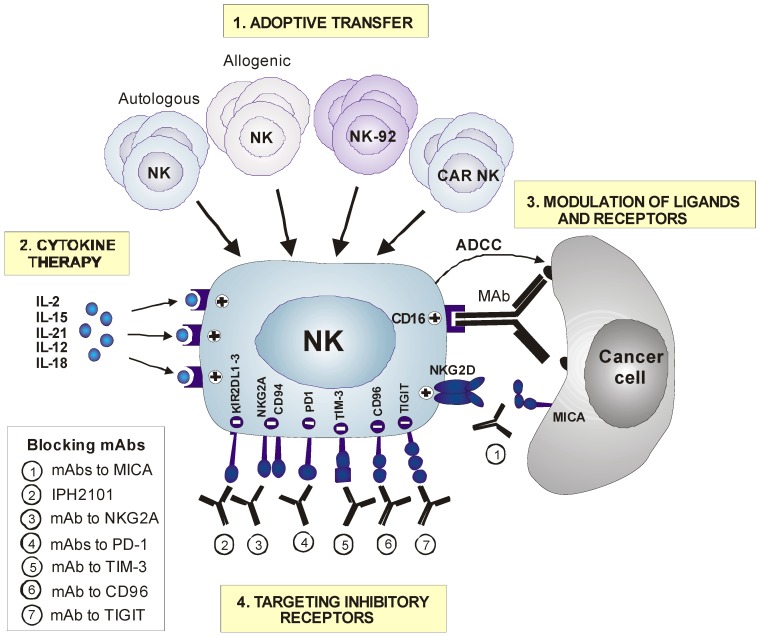
Figure 1
Figure 1
Therapeutic approaches involving Natural Killer (NK) cells to treat metastatic cancer. (1) The transfer of expanded and activated NK cells is increasingly used to improve NK cell responses. Autologous NK cells, allogenic NK cells, NK cell lines, such as NK-92 cells, or Chimeric Antigen Receptor (CAR) NK cells may be harnessed as a source of NK cells for adoptive transfer. (2) The activity of NK cells may also be stimulated by cytokine or drug treatment. IL-2, IL-15, and IL-21 are the most interesting agents that potentiate NK cell activity. (3) Therapeutic approaches that engage NK cell activating receptors are widely used in clinics, particularly, mAbs that engage CD16 receptors and induce Antibody-Dependent Cellular Cytotoxicity (ADCC) activity. Trastuzumab or cetuximab are the most widely employed therapeutic strategies involving NK cells used in clinics. The so-called bispecific and trispecific antibodies may improve ADCC activity by redirecting NK cells and T cells to tumor cells. Targeting other activating NK cell receptors, such as NKG2D, or their ligands, such as MHC class I polypeptide-related sequence A (MICA), are innovative strategies that need to be evaluated in clinical trials. (4) Targeting inhibitory receptors and immunosubversive mechanisms developed by cancer cells may release the antitumor potential of NK cells. Blocking antibodies directed against MICA boosts NK cell activity by preventing the shedding of soluble MICA and NKG2D downregulation. Blocking antibodies against inhibitory NK cell receptors or checkpoint proteins, including, but not limited to, Killer cell Immunoglobulin-like Receptors (KIRs) or Natural Killer Group 2A (NKG2A), Programmed Death-1 (PD-1)/PD-L1, TIM-3, CD96, or T cell immunoreceptor with Ig and ITIM domains (TIGIT), have great clinical potential.

References

    1. Chiossone L., Dumas P.Y., Vienne M., Vivier E. Natural killer cells and other innate lymphoid cells in cancer. Nat. Rev. Immunol. 2018;18:671–688. doi: 10.1038/s41577-018-0061-z. - DOI - PubMed
    1. Sun J.C., Lanier L.L. NK cell development, homeostasis and function: Parallels with CD8(+) T cells. Nat. Rev. Immunol. 2011;11:645–657. doi: 10.1038/nri3044. - DOI - PMC - PubMed
    1. Cerwenka A., Lanier L.L. Natural killer cell memory in infection, inflammation and cancer. Nat. Rev. Immunol. 2016;16:112–123. doi: 10.1038/nri.2015.9. - DOI - PubMed
    1. Moretta L., Locatelli F., Pende D., Sivori S., Falco M., Bottino C., Mingari M.C., Moretta A. Human NK receptors: From the molecules to the therapy of high risk leukemias. FEBS Lett. 2011;585:1563–1567. doi: 10.1016/j.febslet.2011.04.061. - DOI - PubMed
    1. Moretta A., Bottino C., Vitale M., Pende D., Cantoni C., Mingari M.C., Biassoni R., Moretta L. Activating receptors and coreceptors involved in human natural killer cell-mediated cytolysis. Annu. Rev. Immunol. 2001;19:197–223. doi: 10.1146/annurev.immunol.19.1.197. - DOI - PubMed
